Japan's wartime atrocities, including the forced labor of tens of thousands of Asian laborers and Allied prisoners of war to build a 415-kilometer railway through jungles from 1942 to 1943, have been disclosed in a newly produced documentary series.
Produced by China Global Television Network (CGTN), the documentary series, entitled "Unforgotten Scars: Lives Shattered by Japan's Wartime Atrocities," was released on the occasion of the 80th anniversary of the Tokyo Trials, which falls on Sunday.
During World War II (WWII), Japan formulated the Southern Expansion Policy, aimed at invading Southeast Asia and plundering strategic resources such as oil and rubber to sustain its wartime industrial system. After capturing Burma (present-day Myanmar) in 1942, Japan committed numerous atrocities, inflicting catastrophic suffering on the local population.
In June 1942, Japan began constructing the Thailand-Burma Railway, mobilizing 62,000 Allied prisoners of war and forcibly conscripting over 350,000 laborers, including about 180,000 from Myanmar. Driven by ruthless coercion, a project that would normally have taken six years was completed in just 18 months.
The conditions of the work camps are remembered by survivors as some of the worst in modern history.
Under extreme labor conditions, severe malnutrition, and rampant diseases, some 12,000 prisoners of war and more than 130,000 laborers perished, including about 40,000 Burmese (estimates range from 30,000 to 80,000). With nearly 150,000 deaths overall -- a mortality rate of 37.5 percent, equivalent to one life lost for every three meters of track -- the railway became infamously known as the "Death Railway".
Thongphrom Thayang, one of Thailand's last living witnesses, died in 2021 at the age of 99. His testimony survives in archival footage and his son's memories.
Thongphrom and other fellow laborers were promised wages. Instead, they stepped into a world marked by hunger, disease, and death.
"I had to deliver logs on the back of my elephant from morning to night. I would see the prisoners of war every day. They never stopped digging. They would die of sickness, of starvation. There was a square hole in the ground, and the dead would just be thrown in. There were so many deaths. I was so scared," said Thongphrom.
For most of his life, Thongphrom kept silent about his suffering, even to his family.
It was only when his son began digging near their home that the past resurfaced.
"I used to go digging, digging near the dam. They started building the dam, and there were piles of bones everywhere. I think I must have dug up about 30 skulls in total. I took them to the temple," said Sukcharoen Thayang, son of Thongphrom Thayang.
Historians say the suffering of Asian laborers remains less documented, as records were controlled and later destroyed. What is known points to staggering losses and a lack of even basic medical care or burial.
"Approximately 200,000 laborers were hired to work on this railway, and it is estimated that at least 90,000 laborers died during the railway's construction. The Japanese didn't provide doctors or anything to treat them when they worked so hard. When they died, there was no burial. But we have little information about Asian laborers because all the documents were controlled by the Japanese and destroyed when Japan lost the war," said Ketjana Rukdech, operations manager of the Thailand-Burma Railway Center.
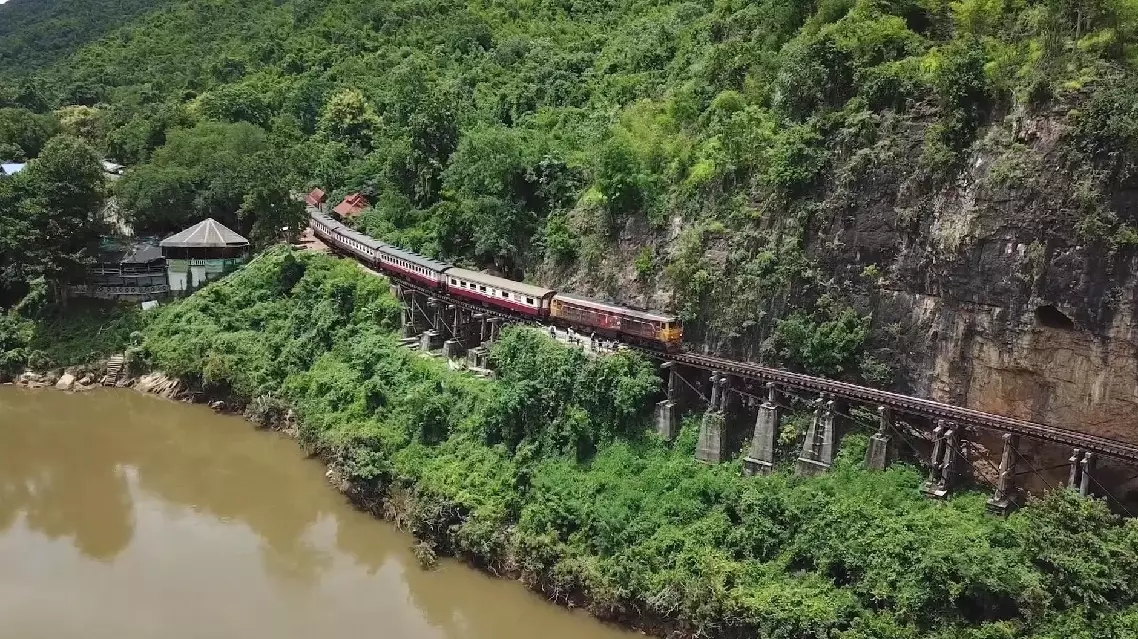
Japan's forced labor atrocities on Thailand-Burma Railway exposed in CGTN documentary