ATMORE, Ala. (AP) — Alabama executed a man Thursday who admitted to killing five people with an ax and gun during a drug-fueled rampage in 2016 and dropped his appeals and asked to be put to death.
Derrick Dearman, 36, was pronounced dead at 6:14 p.m. Thursday at Holman prison in southern Alabama. He pleaded guilty to the killings that prosecutors said began when he broke into the home where his estranged girlfriend had taken refuge.
Strapped to a gurney in the Alabama execution chamber, Dearman spoke to the family members of the victims and to his own family in his final statement. “Forgive me. This is not for me. This is for you,” he said to the victims’ families before adding, “I’ve taken so much.” He closed by telling his own family, “Y'all already know I love y’all.” Some of his words were inaudible.
The lethal injection was carried out after Dearman dropped his appeals this year and asked that his execution go forward. “I am guilty,” he wrote in an April letter to a judge, adding that “it’s not fair to the victims or their families to keep prolonging the justice that they so rightly deserve.”
Dearman’s execution was one of two planned Thursday in the U.S. Robert Roberson in Texas was scheduled to be the nation’s first person put to death for a murder conviction tied to the diagnosis of shaken baby syndrome, in the 2002 death of his 2-year-old daughter. A judge granted a last-ditch request from state lawmakers to delay his execution, and a Texas appeals court reversed the order Thursday night.
Killed on Aug. 20, 2016, at the home near Citronelle, about 30 miles (50 kilometers) north of Mobile, were Shannon Melissa Randall, 35; Joseph Adam Turner, 26; Robert Lee Brown, 26; Justin Kaleb Reed, 23; and Chelsea Randall Reed, 22. Chelsea Reed, who was married to Justin Reed, was pregnant when she was killed. All of the victims were related by blood or marriage.
In a statement read by the Alabama prison commissioner, a man who lost his daughter, sister and brother in the killings, wrote there were no words to describe the impact the murders had on him and his family. He said Dearman got to say a final goodbye to his family, but they did not.
“I so long for a final goodbye to my daughter and I would have loved to meet my grandchild,” Bryant Henry Randall, the father of Chelsea Randall Reed wrote. He said his siblings did not get to see their children grow up.
"I was stripped in many ways of happiness and the bond of family by your senseless act," he wrote of Dearman.
Robert Brown, the father of Robert Lee Brown, told reporters that his family will "suffer for the rest of their lives."
“This don't bring nothing back," he said. “I can't get my son back or any of them back.”
The execution started about 5:58 p.m., but it is unclear when the drugs began flowing. At one point, Dearman raised his head and looked around the chamber as if to inquire when they were starting. He soon after appeared to lose consciousness.
His left arm moved slightly after a guard performed a consciousness check — which involves shouting his name and pinching his arm — to make sure he is not awake when the final lethal drugs are given. Alabama Corrections Commissioner John Hamm said Dearman was not awake and the arm movement was not a sign of consciousness.
When the curtains to the viewing room closed at about 6:08 p.m., his father, who was in the same viewing room as media witnesses, sobbed and repeatedly called out his son's name.
The day before the killing, Joseph Turner, the brother of Dearman’s girlfriend, brought her to their home after Dearman became abusive toward her, according to a judge’s sentencing order.
Dearman had shown up at the home multiple times that night asking to see his girlfriend and was told he could not stay there. Sometime after 3 a.m., he returned when all the victims were asleep, according to a judge’s sentencing order. He worked his way through the house, attacking the victims with an ax taken from the yard and then with a gun found in the home, prosecutors said. He forced his girlfriend, who survived, to get in the car with him and drive to Mississippi.
As he was escorted to jail, Dearman blamed the rampage on drugs, telling reporters that he was high on methamphetamine when he went into the home and that the “drugs were making me think things that weren’t really there happening.”
Dearman initially pleaded not guilty but changed his plea to guilty after firing his attorneys. Because it was a capital murder case, Alabama law required a jury to hear the evidence and determine whether the state had proven the case. The jury found Dearman guilty and unanimously recommended a death sentence.
Before he dropped his appeal, Dearman’s lawyers argued that his trial counsel failed to do enough to demonstrate Dearman’s mental illness and “lack of competency to plead guilty.”
The Equal Justice Initiative, which represented Dearman in the appeal, wrote on its website that Dearman “suffered from lifelong and severe mental illness, including bipolar disorder with psychotic features" and was executed “despite evidence that he suffers from serious mental illness.”

FILE - Crime scene tape marks the home on Jim Platt Road near Citronelle, Ala., Sunday, Aug. 21, 2016, where authorities said five people were killed. (John Sharp/Press-Register via AP, File)

This undated photo from the Alabama Department of Corrections shows Derrick Dearman, scheduled to be executed by lethal injection in Alabama on Oct. 17, 2024. (Alabama Department of Corrections) via AP

FILE - In this Monday, Aug. 22, 2016, photo, Derrick Dearman, 27, of Leakesville, Miss., center, is escorted into Mobile County Metro Jail in Mobile, Ala. (Lawrence Specker/Press-Register via AP, File)
KITTERY, Maine (AP) — There are lots of questions about Graham Platner, a first-time Democratic candidate running for U.S. Senate in Maine. Now they are also part of a trivia game.
“What was the nature of the controversy of Graham’s tattoo he received while in the Marines?” an emcee recently asked at a local community center.
The answer? “It was claimed to be a Neo-Nazi tattoo (totenkopf).”
This was not a new way of delivering opposition research, but an official campaign event for Platner's supporters. And it showed how the 41-year-old oyster farmer and military veteran has capitalized on voters' willingness to forgive past transgressions and embrace a populist message.
Platner is facing Gov. Janet Mills, 78, in the June 9 primary, with the winner taking on five-term Republican Sen. Susan Collins, 73, in a race that could help determine Senate control.
“Graham Platner’s campaign gave me a place to put my energy in a positive way,” said Beth Knight, a 63-year-old teacher who attended the trivia night in Kittery, a small seaside town on the border with New Hampshire. “I believe he has a true redemption story.”
Participants drank soda and ate cookies while listening to Dropkick Murphys, a Boston punk band that Platner likes. Some seemed to know a lot about a candidate who was practically unknown just last year, from his dog's name to the name of a bar where he once worked in the nation's capital.
Among the questions was “what characteristics make Graham the best candidate to beat Susan Collins?” One of the options was “he is handsome and has a deep voice,” but the correct answer in the game was "he has grown as an individual and is honest.”
Mills, now in her second term, is backed by the party leader in the Senate, Chuck Schumer of New York, and other Democrats who say it is too risky to support an untested candidate such as Platner. Maine has one of the oldest voting populations in the country, and voters often elect politicians with a reputation for being moderate.
But Platner has excited some supporters with an antiestablishment message that his campaign believes could carry him to victory.
“What specific group did Graham identify as the primary enemy in his campaign launch video?” the emcee asked at trivia night. The answer was "the oligarchy and the billionaires.”
Platner has centered his campaign on affordability issues such as housing and health care, but much of the news coverage has focused on his past behavior. He has been dogged by questions about the skull-and-crossbones tattoo reminiscent of a Nazi symbol that he said he got during a night of drinking while on military leave in Croatia.
Platner has maintained that he was unaware at the time that the image had been associated with Nazis, and he has since covered the tattoo with a different design. But there also have been lingering questions about inflammatory comments he made in old online postings, which he has since disavowed. More recently, he has been questioned for being a guest on a podcast hosted by Nate Cornacchia, a retired Green Beret who has been accused of antisemitism.
All the while, Platner keeps filling theaters, meeting halls and rallies. From his August campaign announcement to the end of March, Platner had hosted 50 town halls throughout Maine. His campaign accused Mills and Collins of holding none.
The events include traditional canvassing and phone-banking training, as well as happy hours at breweries and poster-making before No Kings protests. That wide footprint has increased Platner's visibility. For example, on the same night that the campaign hosted the recent trivia game in Kittery, Platner was more than 350 miles away at a town hall in Fort Kent, in the state's far north.
“He’s bringing an energy of wanting to create something in this race, win or lose. He wants to create a lasting connection in communities where people can get together and can actually talk to their neighbors face to face again,” said Megan Smith, a community organizer with the Maine People’s Alliance, an advocacy group that has endorsed Platner.
The Mills and Collins campaigns both rejected the idea that Platner is more accessible to voters, and both cited their candidate’s busy workload as an elected official.
“As the only Democrat to have won statewide in 20 years, voters trust Janet Mills, they know she is the only candidate who has delivered progress for Maine people, and they see her leading our state every single day,” Mills campaign spokesperson Tommy Garcia said.
Collins spokesperson Blake Kernen said that “town halls are often organized by partisan or dark money groups."
“She prefers smaller group meetings, rather than holding town halls where very few people get to speak, and the level of civility is often not that high,” she said.
To date, Platner has significantly outspent Mills on advertising since jumping into the race in August, $4.8 million compared with Mills’ $1.5 million according to a recent analysis by AdImpact.
The spending comes as the campaign intensifies as the primary nears. Mills recently released a video in which women read some of Platner’s old social media posts that were dismissive of sexual assault.
Platner's defenders do not appear worried about that increased attention, arguing that Democrats are more willing to elect candidates who are honest about past mistakes as long as they make an effort to show how they have changed.
“In this environment, you know, where we have people like Donald Trump in public office who have done terrible things, there is more appetite in the Democratic Party to have people that are not just purely polished and have been on an election track their whole lives,” said Sen. Martin Heinrich, a New Mexico Democrat who has endorsed Platner.
Smith, the community organizer, said some voters bristle at the assumption that outsiders such as Schumer know better than Mainers.
“Mainers are kind of stubborn and we don’t like to be told what to do,” she said. “They’re not thrilled to have D.C. Democrats weighing in on our primaries.”
Still, Platner will have to overcome historical precedent to beat Mills.
“Historically, there’s been an inclination of Democratic primary voters in Maine to pick the known candidate,” said Michael Franz, a government professor with Bowdoin College. “Oftentimes, that is an older candidate who’s been in office for a while.”
Franz described Platner as “a high-risk, high-reward type of candidate.”
“He might end up being the new national figure that captures everyone’s attention if he’s elected to the Senate," he said. "Or he might just be the candidate that everyone thought could come out of nowhere but ended up only getting 42% of the vote.”
Kruesi reported from Providence, R.I. Associated Press writer Joey Cappelletti in Washington contributed to this report.

This combination of photos shows Democratic Gov. Janet Mills on Jan. 30, 2024, in Augusta, Maine, left, Democratic candidate for U.S. Senate Graham Platner on Nov. 3, 2025, in Sullivan, Maine, center, and Sen. Susan Collins, R-Maine, on March 26, 2026, in Washington, right. (AP Photo)
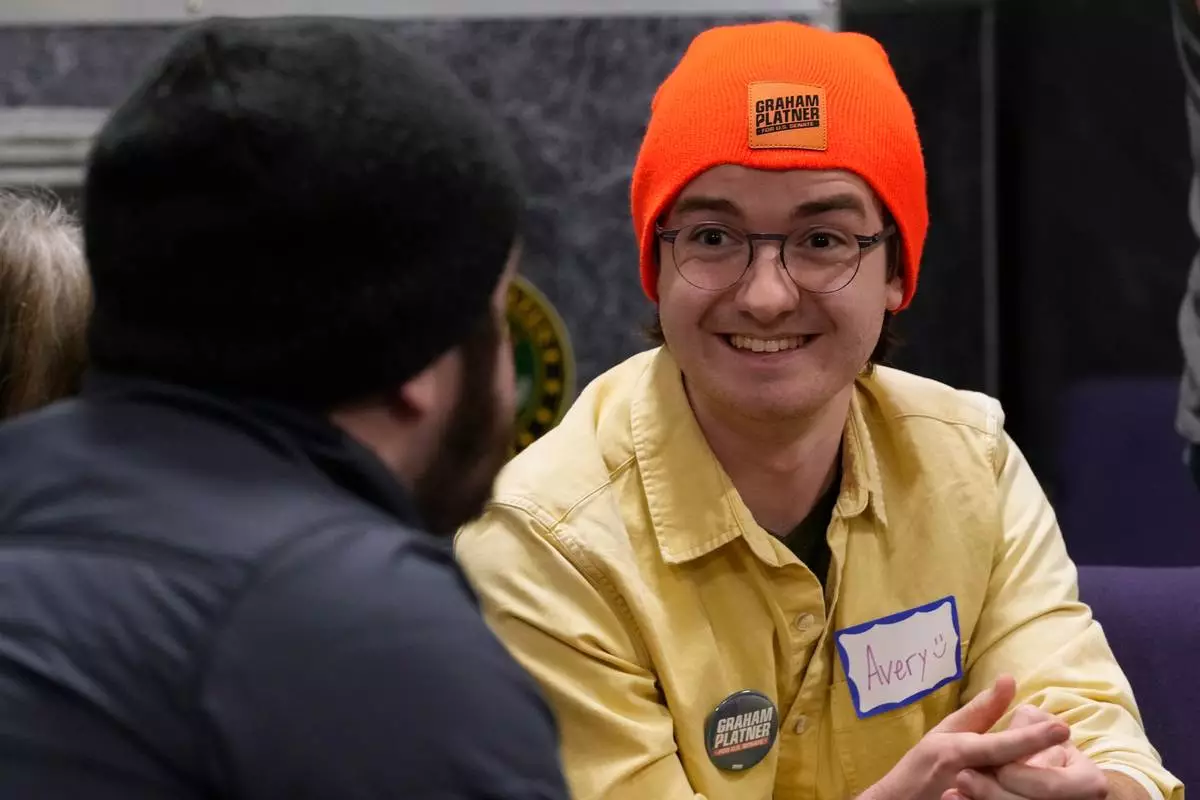
Avery Seuter talks with a fellow supporter of US Senate candidate Graham Platner during a Platner-themed trivia night, Thursday, March 26, 2027, in Kittery, Maine. (AP Photo/Robert F. Bukaty)
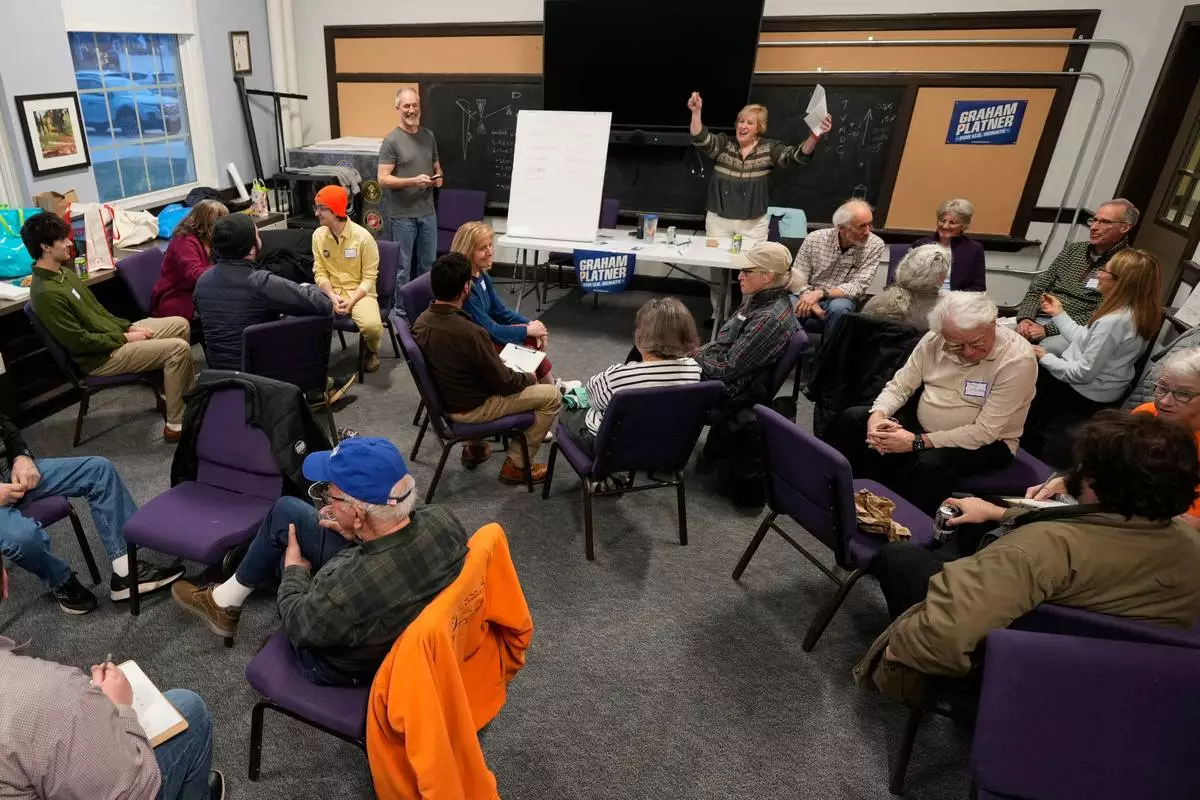
Joanie Monteith leads a trivia night for supporters of U.S. Senate candidate Graham Platner, Thursday, March 26, 2026, in Kittery, Maine. (AP Photo/Robert F. Bukaty)

FILE - Senate candidate Graham Platner acknowledges the large crowd that attended Platner's town hall, Sept. 25, 2025, at Bunker Brewing in Portland, Maine. (Daryn Slover/Portland Press Herald via AP, File)
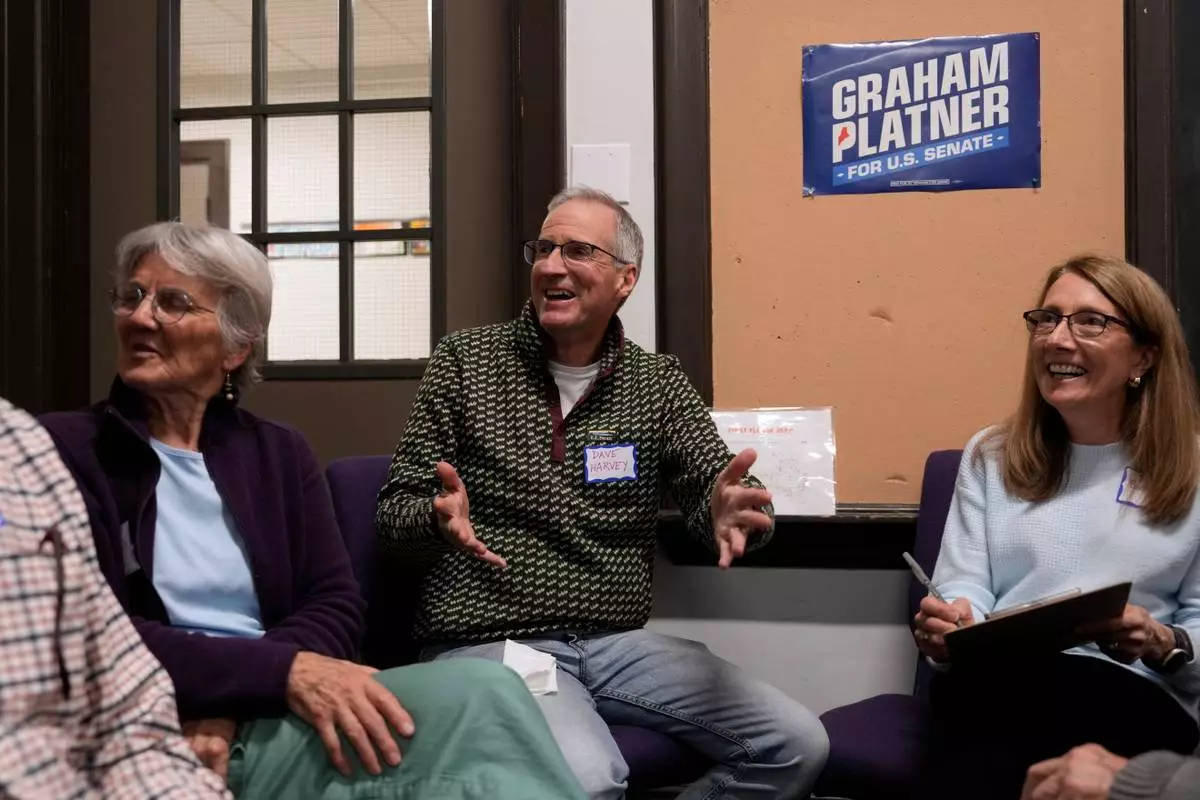
Dave Harvey participates in a trivia night for supporters of U.S. Senate candidate Graham Platner, Thursday, March 26, 2026, in Kittery, Maine. (AP Photo/Robert F. Bukaty)