Skip to Content Facebook Feature Image

1.2 million Lebanese people displaced by war: UN officials

China

China

China

1.2 million Lebanese people displaced by war: UN officials

2024-10-17 21:20 Last Updated At:10-18 00:17

About 1.2 million people in Lebanon have been displaced by Israeli airstrikes, said UN officials on Wednesday.

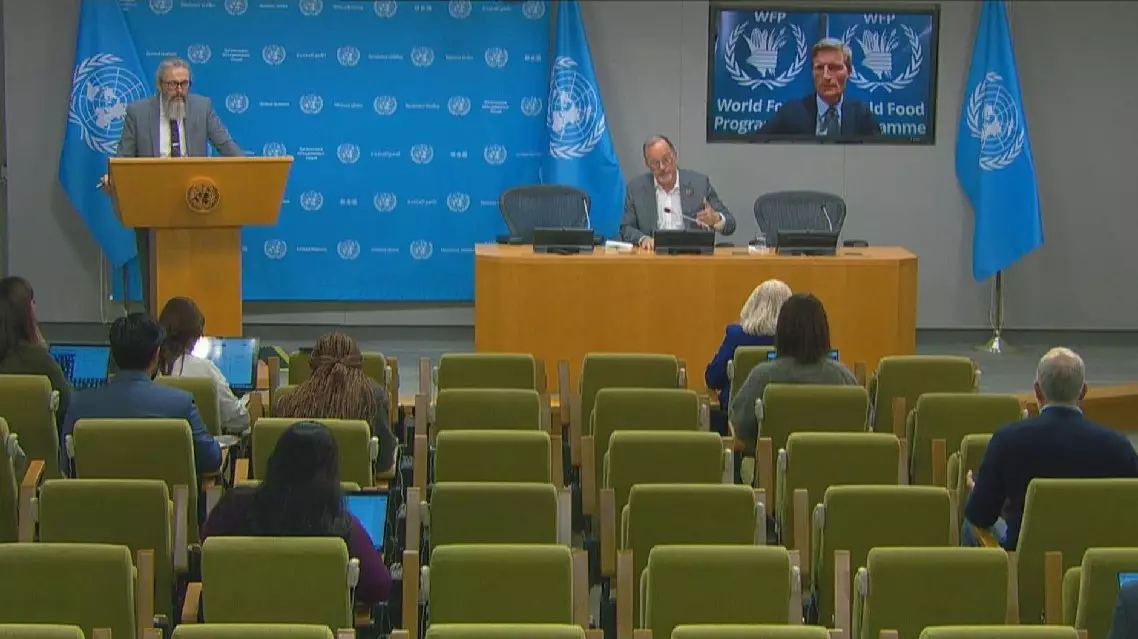
While briefing the press on their recent visit to Lebanon, UNICEF's Deputy Chief Ted Chaiban and Chief Operating Officer of the World Food Program (WFP) Carl Skau highlighted the plight of these displaced people.

"In Lebanon, approximately 1.2 million people, men, women and children, have been displaced by this war. And that includes approximately 400,000 children. Nearly 190,000 of those have been forced from their homes into makeshift shelters and are hoping for a semblance of safety there. Mostly those are public schools, while countless others seek refuge with anyone who can offer a roof and a place to rest," said Chaiban.

The UNICEF official noted the "profound acts of solidarity" witnessed "across communal, sectarian and religious lines," but he warned that as fighting and displacement continues, this solidarity "will become stretched pretty quickly."

Chaiban also talked about the loss of education for Lebanese students, noting that most public school students are unable to access educational opportunities.

"The school year has started in Beirut for private schools, but the public schools are either inaccessible, largely destroyed or used as shelters. There's about 15 percent of the public schools that can be used, but the vast majority of them cannot now accommodate students. So, we need to find a way to work on the issue of education to avoid losing a generation," he said.

Joining virtually from Rome, Skau said many of the displaced "have lost everything because they know that their villages or towns have been completely destroyed," and he described the situation as "a real sense of desperation".

He noted that during their visit, the fighting escalated, and they could see the "over packed minibuses heading north, and we could hear the bombing."

WFP, he said, was ready for this and has been preparing for this over the past few weeks and months.

"We were able to quickly step up, working hand in hand with other partners like UNICEF and other organizations. We are now delivering daily to some 200,000 people with ready-to-eat food and cash. And we have the capacity to scale up to a million people," Skau said.
1.2 million Lebanese people displaced by war: UN officials


1.2 million Lebanese people displaced by war: UN officials

The three astronauts of China's recently-returned Shenzhou-20 mission on Friday shared the experiences of their dramatic 204-day space mission, including detailing the emergency procedures which were implemented to bring them safely home after their return capsule was struck by space debris.

The trio -- Chen Dong, Chen Zhongrui, and Wang Jie -- met with the press in Beijing on Friday afternoon, marking their first public appearance since returning to Earth in November.

When detailing the emergency response mechanisms which were enacted prior to their scheduled return, the astronauts explained that upon discovering a triangular crack on the spacecraft's viewport window, they immediately took photos for documentation and transmitted them to the ground team, who swiftly activated an emergency plan to get the trio home safely.

Experienced mission commander Chen Dong explained how the crew had complete faith in their colleagues on the ground to find a solution to these unforeseen circumstances which led to their return being delayed.

"First, we must trust the ground team, who would anticipate everything and develop the safest return plan for us. Second, we must believe in ourselves; as well-trained astronauts, we have the ability to manage various unexpected failures. I believe that with the collaboration of astronauts and researchers on the ground, our space home will surely go farther, more steadily, and for a longer time," he said.

Following their extended stay in space as a result of the debris incident, the Shenzhou-20 crew spent a total 204 days in orbit, setting a new record for the longest duration by a single group of Chinese astronauts.

During their mission, they completed multiple payload operations, conducted extensive scientific experiments, and carried out four extravehicular activities.

"Our crew worked together with the ground team in unity and coordination, completing four extravehicular activities, several payload entry and exit tasks, and a large number of scientific experiments. It was a fulfilling yet challenging mission. The path to exploring the heavens is long and arduous, but I firmly believe that China's space missions will succeed," said Chen Zhongrui, a former air force pilot who was making his first spaceflight during the mission.

"From the ground to space, from learning to application, I have deeply felt the solid progress of Chinese space endeavors and the quiet dedication of countless personnel behind the scenes. In the future, I will accomplish each mission with full commitment, living up to the trust of the motherland and the people," said fellow astronaut Wang Jie, who was also making his debut spaceflight.

After returning to Earth on Nov 14, the trio successfully completed their isolation recovery and rehabilitation and will now resume normal training following health assessments.

The crew's return, originally scheduled for Nov 5, was postponed due to safety concerns, with the astronauts later using the return capsule belonging to their successor crew of the Shenzhou-21 mission to get back to Earth. China later launched the unmanned Shenzhou-22 spacecraft which will serve the future return of the crew now aboard the Tiangong Space Station.

Shenzhou-20 astronauts share experiences after safely returning from debris incident

Shenzhou-20 astronauts share experiences after safely returning from debris incident

Recommended Articles