China Petrochemical Corporation (Sinopec Group), the country's largest oil refiner, has announced that its Shengli Oilfield, driven by technology breakthroughs, has set a new record for single-well daily shale oil production in China.
A total of 94 horizontal shale oil wells have been built in the 7,300-square-km Jiyang shale oil national demonstration zone owned by the Shengli Oilfield in east China's Shandong Province since it was established two years ago, among which 36 wells have achieved peak daily oil production exceeding 100 tonnes, with a maximum of 262.8 tonnes for a single well, the Science and Technology Daily reported on Sunday.
The achievements were made with the driving force of technology innovations, according to the Sinopec Shengli Oilfield.
Shale oil mainly refers to liquid hydrocarbons trapped in formations of shale rock that can be extracted for refining. It is often found in organic-rich shale and thin interlayers of carbonate rocks, sandstones, and siltstones.
China has abundant shale oil resources, but they are mainly continental shale oil, making exploration and production difficult.
Compared with the shale oil reserves in North America, those in Jiyang are buried deeper, somewhere between 3,000 and 5,500 meters, and have lower maturity, posing a series of challenges to exploration and development.
The technology innovation team of the Shengli Oilfield overcame difficulties in exploration such as high temperature, high pressure, and simultaneous seepage in shale oil reservoirs.
They have developed a fast drilling technology centered on synthetic-based drilling fluid systems, enabling efficient drilling of horizontal wells with depths exceeding 3,300 meters and horizontal sections longer than 2,000 meters, thus reducing the drilling cycle from 133 days to 29.5 days.
"We have successively deployed a number of systematic coring wells. Based on the study of core shale samples buried tens of thousands of meters deep, we have conducted 150,000 indoor experiments, and made breakthroughs in more than 40 national and provincial-level research projects, uncovering the enrichment mechanisms of Jiyang shale oil and initially clarifying the patterns of shale oil accumulation and high production in Jiyang," said Jiao Hongyan, manager of the Shale Oil Project Department at Sinopec Shengli Oilfield.
It is estimated that the shale oil resources in Jiyang amount to 10.5 billion tonnes. The Jiyang demonstration zone, the third of its kind in China following the ones in northwest China's Xinjiang and Daqing in the northeast, has reported a daily oil production of 1,600 tonnes and a cumulative oil production surpassing 800,000 tonnes.
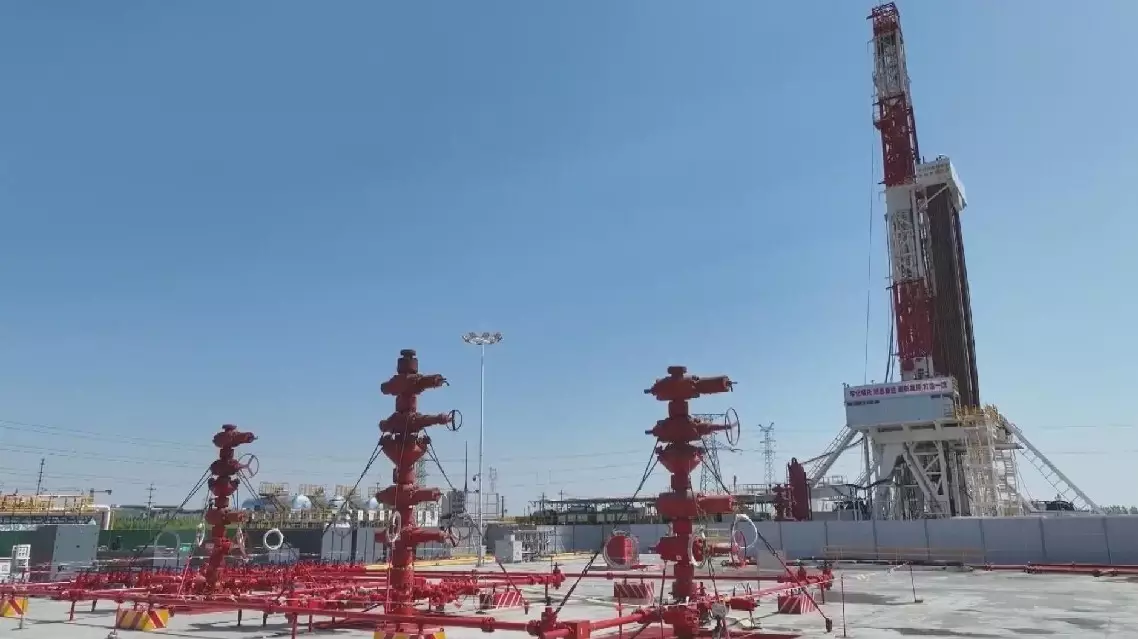
Tech breakthroughs bring record high shale oil production in China

A cold front has brought snowfall and freezing temperatures across many parts of China, disrupting transportation and prompting emergency responses. On Sunday morning, many places in Handan City of north China's Hebei Province have experienced snowfall.
The province on Sunday activated a Level-IV emergency response for major meteorological disasters in preparation for incoming heavy snowfall.
According to the provincial meteorological observatory, heavy snow is forecast to hit areas including Shijiazhuang, Cangzhou and Hengshui from day to night on Sunday. Some regions may experience blizzard conditions.
Forecasters warn that the severe weather will disrupt transportation, urban services, and greenhouse agriculture.
Local authorities have been urged to closely monitor weather conditions, enhance risk assessment, and eliminate potential safety hazards.
China has a four-tier emergency response system, with Level I being the most severe response.
Starting early Sunday morning, a new round of snowfall began in areas such as Qingyang City and Dingxi City in northwest China's Gansu Province.
In order to ensure smooth traffic and people's normal life and production, local departments have made coordinated efforts to clear snow from roads.
Local traffic police have also increased presence at key areas to direct traffic and ensure timely response to emergencies.
In addition, widespread snowfall affected the northern parts of northwest China's Xinjiang Uygur Autonomous Region, posing challenges to urban transportation and railway operations.
Traffic police and city departments are mobilizing to clear roads and ensure safe travel for residents.
Railway authorities also implemented pre-arranged snow-response plans, using equipment such as wind-powered snow blowers and de-icing equipment to clear key sections of track and prevent switches from freezing.
The current round of snowfall in the northern parts of Xinjiang is expected to end on March 2. Some areas in east China's Shandong Province also experienced heavy snow on Sunday. At 11:00, the provincial weather service issued yellow warnings for icy roads.
At the Mount Tai scenic area in Tai'an City, the weather transitioned from a mix of rain and snow to snowfall during the day. As of 15:00 on Sunday, the average precipitation had reached 18.9 millimeters, with the snowfall still ongoing. To ensure the safety of visitors, the scenic area has decided to suspend all access routes starting from 16:00. On Sunday morning, cold air prompted snowfall in many places of north China's Shanxi Province. The Shanxi Provincial Meteorological Observatory issued a yellow alert for blizzard, covering areas such as Jinzhong City, Linfen City, and Yuncheng City.
Icy road conditions led to temporary traffic restrictions on several highway sections.
Local authorities promptly activated emergency response plans, deploying crews for snow removal and traffic control.
Snowfall hits many parts of China, affecting transportation