More financially open and interconnected Asian markets will play a key role in promoting cooperation within the framework of the China-proposed Belt and Road Initiative (BRI), which will eventually deliver benefits to all countries and regions involved in the global development strategy, said the attendees of the Annual Conference of Financial Street Forum 2024.
The Annual Conference of Financial Street Forum 2024 was held in Beijing from Friday to Sunday with the theme "Trust and Confidence -- Work Together to Promote Financial Openness, Cooperate for Shared Economic Stability and Growth". More than 500 guests from over 30 countries and regions worldwide attend the conference to exchange views on current economic and financial hot topics.
It was a consensus reached among the attendees at a parallel forum on the BRI at this year's conference in which they discussed opportunities for financial cooperation in Asia and the BRI cooperation in the next phase.
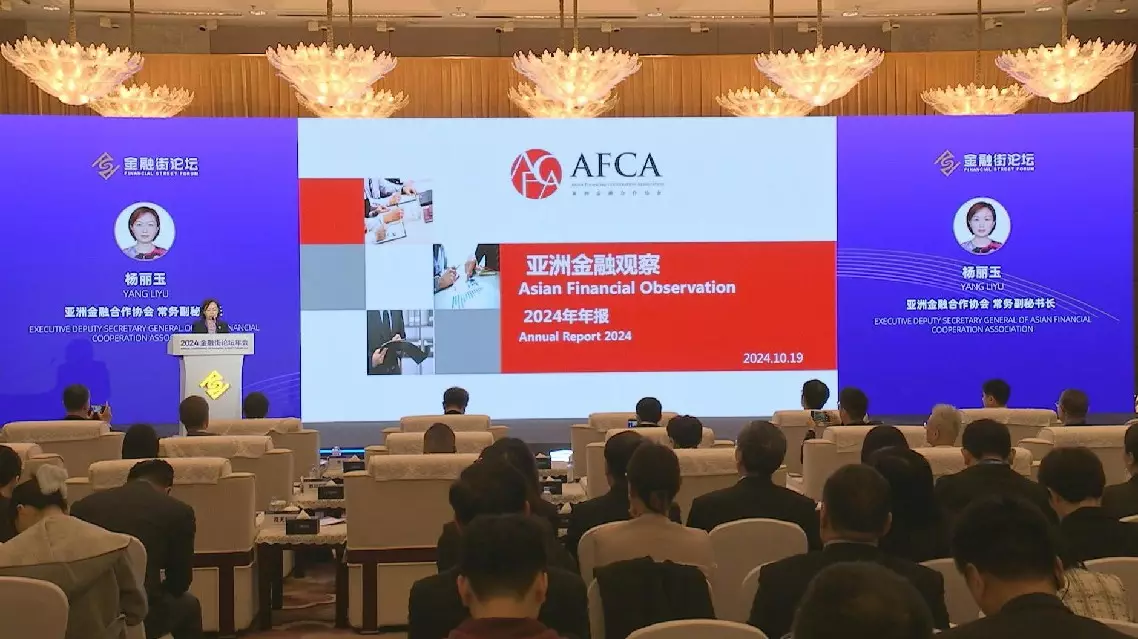
At the conference, the Asian Financial Cooperation Association (AFCA), a regional non-government and non-profit international organization, released its annual Asian Financial Observation report, forecasting a robust 4.5-percent GDP growth rate in Asia for 2024, which will lay a solid foundation for the development of the financial sector in the region.
"Business opportunities abound in credit, financing, investment, banking, wealth management, pension insurance, cross-border business, the green sector and carbon reduction, and digital economy, among other fields, with international capital expected to keep increasing its holdings of Asian assets, and the stock and bond markets on upward trajectories," Yang Liyu, AFCA's deputy secretary general, said while releasing the report at the conference.
However, the report also pointed out that the development of the Asian financial markets still lags behind those of the developed countries in the West, with their stability vulnerable to the shocks from and easily constrained by the Western markets. All attendees agreed that concerted efforts by all Asian countries and regions are needed to catch up with the developed economies.
Another shared understanding among the attendees was that BRI cooperation, as an important way of improving regional connectivity and boosting common prosperity in Asia and beyond, face challenges in financing amid the new wave of technological revolution and industrial transformation.
"We will steadily expand two-way opening up of the financial sector, take the initiative to adopt high-standard international economic and trade rules, and create a market-oriented, law-based and internationalized first-class business environment. We will appropriately reduce the negative list for foreign investment access and actively introduce high-quality professional foreign institutions and long-term capital to China to start business. We will encourage Chinese-funded financial institutions to plan their business layout in countries along the Belt and Road and step up their financial services," said Zhou Liang, deputy head of the National Financial Regulatory Administration, when introducing the steps China will take to bolster financial cooperation with BRI partner countries at the conference.
"It is necessary that relevant countries and regions further strengthen financial opening up, deepen market connectivity, work together to solve difficulties, reconnect the existing disrupted links, and strive to facilitate and accelerate the flow of goods, technology and information, and cycle of interaction," said Wang Zhiheng, president of the Agricultural Bank of China, one of the country's major lenders, in his speech.
Zhang Ming, deputy head of the Department of Regional Opening-up of the National Development and Reform Commission, said China has so far signed agreements with more than 150 countries and over 30 international organizations on BRI cooperation, with the total trade volume exceeding 22 trillion U.S. dollars over the past 11 years between China and its partners, and the combined value of Chinese investments in partner countries surpassing 270 billion U.S. dollars.
"Through the BRI, we aim to better connect the disrupted links and break through the blockages in the financial sector, so that international capital flows can better benefit the economic development and people's livelihoods in countries along the Belt and Road," Jin Li, vice president of the Southern University of Science and Technology, told the China Central Television in an interview on the sidelines of the conference.
More financially open, interconnected Asian markets key to boosting Belt and Road cooperation: forum attendees