Skip to Content Facebook Feature Image

Jakarta-Bandung High-speed Rail facilitates travel, spurs economic growth in Indonesia

China

China

China

Jakarta-Bandung High-speed Rail facilitates travel, spurs economic growth in Indonesia

2024-10-22 05:27 Last Updated At:12:47

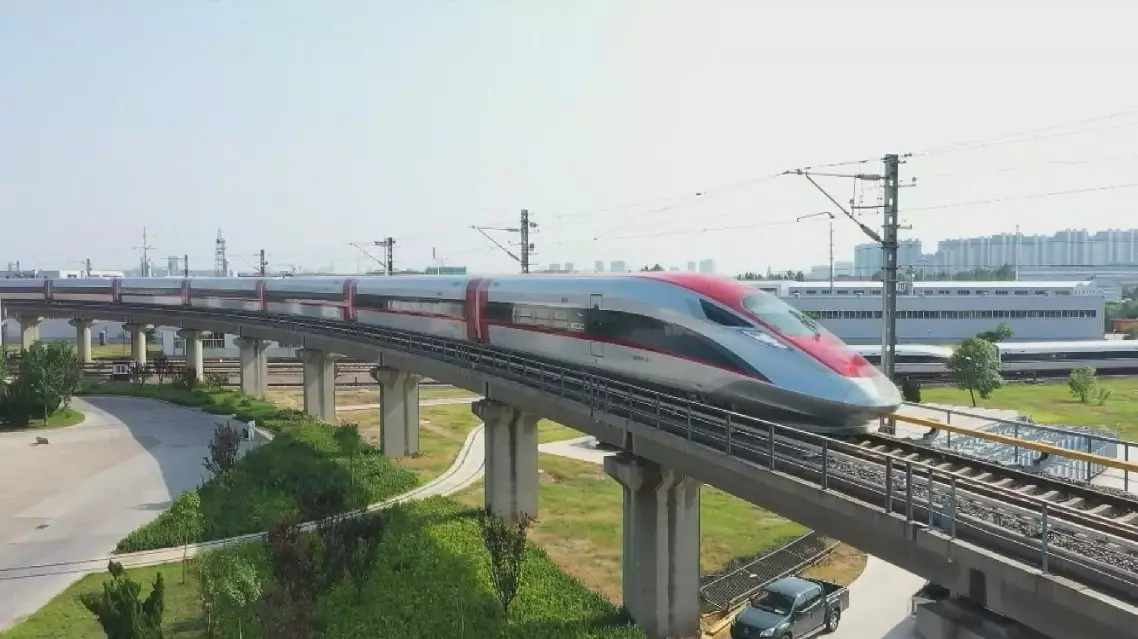
The Jakarta-Bandung High-Speed Railway (HSR) has facilitated convenient local travel, while bringing new opportunities for economic development along its route following its inauguration in Indonesia last year.

As a flagship project of the Belt and Road cooperation between China and Indonesia, the high-speed railway not only signifies China's maiden deployment of its entire high-speed rail system abroad, but also marks the first high-speed railway in Indonesia and even in Southeast Asia.

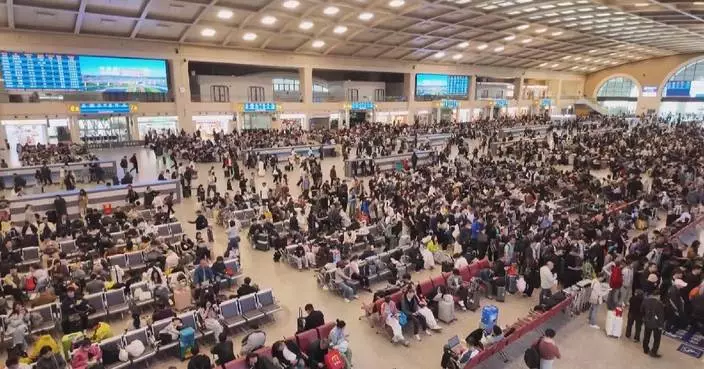
Celebrating its first anniversary on Thursday, the railway transported 5.79 million passengers over the past year, with the highest daily occupancy rate hitting 99.6 percent.

With a top design speed of 350 kilometers per hour, the 142.3-kilometer high-speed rail connects Indonesia's capital Jakarta with the renowned tourist destination of Bandung and reduces the travel time between the two cities from three hours to about 40 minutes.

Nowadays, taking snapshots with the high-speed train models, speed display screens, and even attempting the art of balancing coins on the train's window sills trend on social media in Indonesia, becoming must-do experiences for high-speed rail passengers.

"The Jakarta-Bandung high-speed railway has greatly facilitated travels. I live in Jakarta, but my office is in Bandung. It's a half-an-hour ride. It really saves travel time compared to taking a private car," said a passenger named Diah.

The high-speed railway has significantly boosted local tourism by attracting foreign visitors, fostering growth in the country's tourism industry.

"I think it is convenient because it also attracts people to go to interconnecting cities very quickly. So, it will somehow promote tourism. I myself am from Malaysia, and I'm intrigued to try, so that's why I came around a few months ago to try the first time. And since then I tried a few times more," said Najib, a tourist.

Leveraging China's successful high-speed rail construction experiences, the joint Chinese-Indonesian builder has placed paramount importance on ecological preservation, enhanced organization on surveying, design, and construction, strengthened safety and quality controls, which ensured the project processing in an orderly and effecient manner.

During its construction, a large amount of Indonesia-produced materials such as cement were purchased, boosting domestic economic growth. In addition, 51,000 local job opportunities were created, and 45,000 Indonesian workers were trained.

"Before this, we underwent theoretical training for about five to six months at a training school. Then we continued learning here. The learning is divided into three stages. The first stage is observation, and we just watch. Then Chinese engineers gave us guidance and assistance. In the third stage, we carried out inspection and maintenance on our own, but under the supervision of teachers," said Mohamed Habib, a maintenance engineer.

"The maintenance standards for the Jakarta-Bandung high-speed railway are high, so we are working hard to make sure that the trains maintain the current operational excellence, so that there are no interruptions," said Padipta, another maintenance engineer.

As a hallmark project of the Belt and Road Initiative, the Jakarta-Bandung high-speed railway is set to catalyze the establishment of the the Jakarta-Bandung high-speed railway economic belt. It also plays a pivotal role in deepening practical cooperation between China and Indonesia and accelerating the realization of a shared community between the two nations.
Jakarta-Bandung High-speed Rail facilitates travel, spurs economic growth in Indonesia
Jakarta-Bandung High-speed Rail facilitates travel, spurs economic growth in Indonesia
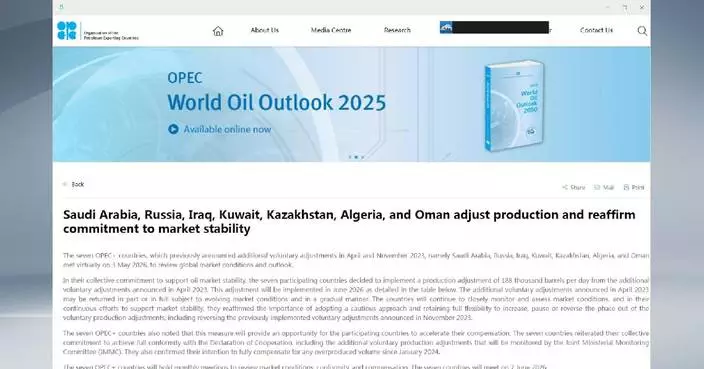
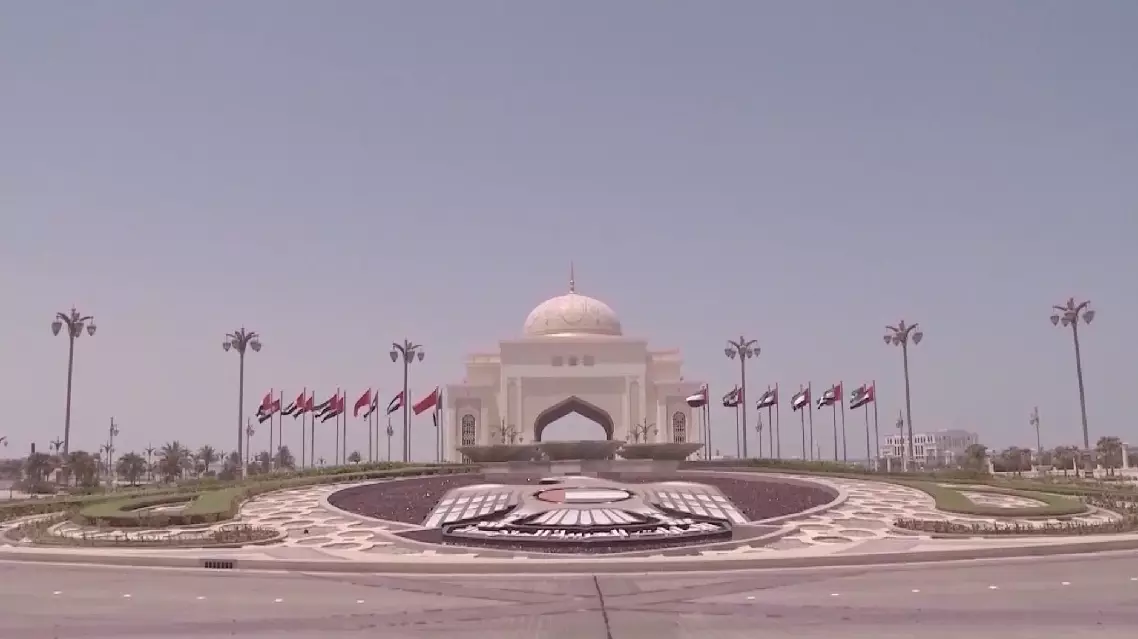
The United Arab Emirates' (UAE) exit from the Organization of the Petroleum Exporting Countries (OPEC) and the broader OPEC+ is unlikely to jolt oil markets in the short term, but sets the stage for lower prices once the Iran conflict ends and Gulf exports resume, experts said.

Effective Friday, the UAE formally withdrew from OPEC in a move poised to reshape global oil markets. The decision came amid heightened geopolitical tensions driven by the ongoing Iran conflict.

The UAE Energy Minister Suhail Al Mazrouei said the timing was chosen to cause the least market disruption. But analysts say the exit reflects the UAE's long-simmering frustrations over production quotas that no longer align with its capacity.

"It gives the UAE flexibility to move from a quota within OPEC of 3.3 million barrels a day to 5 million barrels a day in 2027. It won't radically change the pricing. It will make more energy available. So, it will take some of the price pressures off," said John Defterios, senior advisor for APCO Worldwide, a global advisory firm, and also senior fellow at the Center for Energy and Materials of the World Economic Forum.

While immediate market impact remains muted amid wartime volatility, experts anticipate meaningful shifts once regional stability returns.

"It has no impact right now, because obviously oil prices right now depend on the state of the war and whether exports can start freely through the Gulf and so on. But assume, once the war is over and a normal transit resumes, I would expect the UAE will move quickly to increase production and try to refill some of that storage that was drained. And that should mean, in general, lower prices for oil importers, for oil consumers. In the longer term, yes, I think also probably it means lower prices," said Robin Mills, CEO of Qamar Energy, a Dubai-based independent consultancy company.

The UAE's departure highlights structural tensions within OPEC+. As a low-cost producer with billions invested in upstream expansion, Abu Dhabi increasingly chafed against collective quotas.

However, other members, including Iraq and Kazakhstan, also sought higher production allowances.

"This pressure has been building up for some time. But Saudi Arabia was also in a difficult position. If it agreed to grant higher production levels to the UAE, then it would have to grant them to Iraq as well. Kazakhstan wanted more [allowance as well]. Everybody wants special treatment," said Mills.

Strategically, the move aligns with the UAE's broader vision to diversify its economy.

"They made this announcement ahead of a very important forum, Make It In the Emirates, which displays what the UAE is doing in terms of diversification outside of oil and gas. So, they want that revenue from oil and gas -- the extra 50 billion dollars a year to go into greater diversification. It's advanced manufacturing, it's artificial intelligence, it's the next wave of financial services, and it is trade," said Defterios.

The exit also signals a broader recalibration of legacy energy institutions in a world confronting new climate imperatives, geopolitical fragmentation, and energy transition pressures.

"I do think it shows definitely a world in which there's a new energy reality, there's a new climate reality, there's a new geopolitical reality. And these legacy institutions have to adapt. And if they don't, then of course, their members will either leave or at least won't take them seriously," said Mills.

UAE's OPEC exit long expected, may ease oil prices after Iran war ends: experts

UAE's OPEC exit long expected, may ease oil prices after Iran war ends: experts

Recommended Articles