The World Calligraphy Museum in Ryazan, Russia stands as a unique institution showcasing calligraphy from dozens of Asian countries. It serves as a bridge connecting diverse cultures and traditions, uniting civilizations under one roof.
The museum, the only one of its kind in Russia and one of the few globally, is solely devoted to the art of calligraphy.
"This museum has no equivalents. In China, some think there is only Chinese calligraphy, in the Arab world - that there is only Arabic calligraphy. But it turns out that the world is so diverse in terms of this form of art. What we have created is unprecedented. Many people have heard or read something about calligraphy but have not seen it with their own eyes. Particularly, few people have had the opportunity to walk around the gallery and have a good understanding of regional calligraphy," said Alexey Shaburov, director and founder of the museum.
The museum features distinctive collections of Russian and Chinese calligraphy.
This year marks the 75th anniversary of the establishment of China-Russia diplomatic relations, the museum has curated a special exhibition highlighting Chinese culture.
Additionally, the museum conducts regular calligraphy classes providing a deeper immersion into Chinese cultural practices and also offers Chinese language lessons.
"When teaching the Chinese language, the most important aspect is hieroglyphs. They seem complex, but through art, Russian students can understand Chinese characters and realize that it's the easiest part in learning the Chinese language," said Wei Rongchen, a calligraphy and Chinese language teacher.
Every year the number of Russians interested in learning the Chinese language and calligraphy continues to grow, and the students here not only enjoy but appreciate the master classes being offered.
"Of course, the whole culture of the Chinese language is very interesting, but calligraphy has made me curious. My calligraphy teacher shows me how to write. I study under his guidance, it’s really interesting, just like the Chinese language," said a student.
"It's my first time here, but I really liked the drawings by the professionals. It's very beautiful and I think you can learn it for a very long time, and it's very beautiful. I don’t think everybody can create such pieces," said another student.
The museum houses an extensive collection of over 3,500 exhibits from more than 70 countries, engaging in scientific studies and translating works of calligraphers into Russian and English.
The allure of calligraphy knows no bounds, evolving as an art form cultivated globally over centuries.
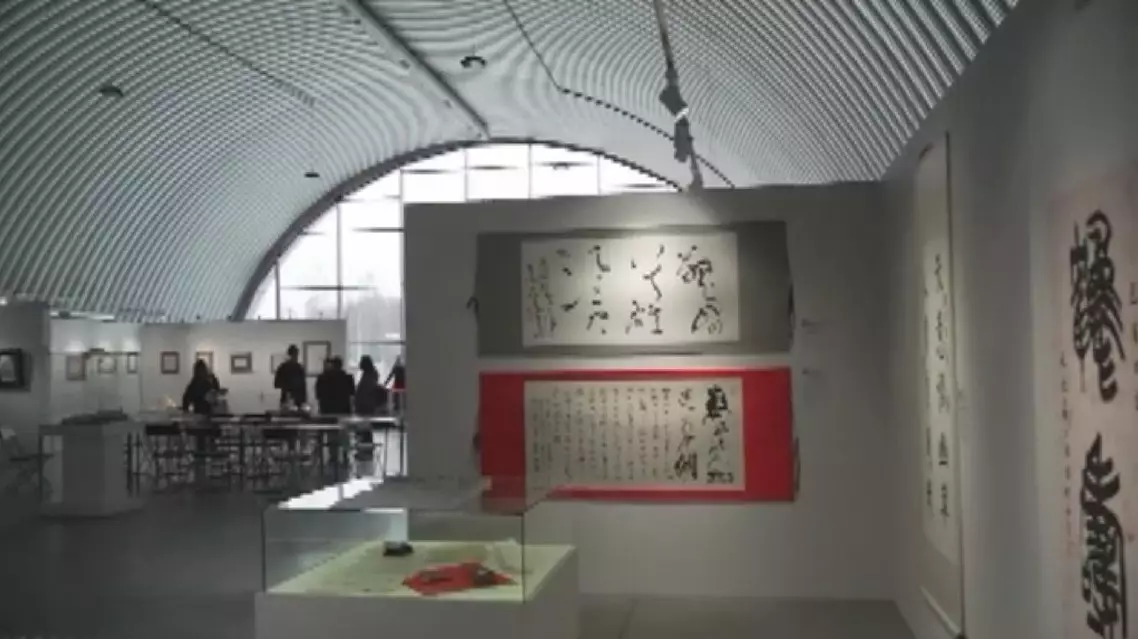
Calligraphy museum in Russia showcases diverse cultures across Asia
Displaced people from southern Lebanon are returning to their homes as a 10-day ceasefire between Israel and Lebanon took effect, while it seems a tremendous task to rebuild ruined homes.
Nearly 38,000 Lebanese homes have been destroyed or damaged since early March in the conflict between Israel and Hezbollah.
Besides the southern district of Beirut, Nabateih is not an exception to Israel's heavy bombardment north of the Litani River. People there have been suffering during the war. As the ceasefire came into effect, it seems they will continue to suffer as they rebuild the city.
Fifty percent of all the damaged buildings in Lebanon in this latest conflict are in Nabatieh Province. It stretches from the Israeli border to north of the Litani River, where its capital, Nabatieh, is located.
Fadl Hodroj is fixing a security grille damaged by an Israeli bomb.
"Israel was very aggressive. They bombed a lot of residential buildings. They strike buildings with enough force to damage the entire surroundings, an entire district, or the markets. In all villages, you will find the same kind of destruction. No one else does this except for Israel; their main goal is to harm the people and destroy their livelihood. They think they will force us out of the south, but we will stand strong and rebuild it again and again. In the end, this land is ours," said Fadl Hodroj, a repairman.
Fadl's comments resonate in the streets of this quiet city, which once had a population of 90,000. Although there is a ceasefire, few have returned. Ibrahim Sarhan is one of them.
"The house was a mess, with scattered aluminum and glass. But overall, as long as the building is standing, we thank God. A home is not the walls, but the memories -- images that move with you from one room to the other. A young boy who was just two years old, now he’s 30, 40 or 50. Then his kids now roam between the same walls. This is a family house, just like any other family in the south, it contains warmth. Also, the neighbors stand next to each other during the hard times and help one another," said Ibrahim Sarhan, a Nabatieh resident.
Sarhan texted his mother a picture of her favorite chair and table on the balcony, where she had her morning coffee. He didn't show her these visuals of his best friend spraying two containers of air freshener.
They couldn't dare open the fridge because of the intense smell of rotten meat and poultry, so they threw it away.
"The fridge was always loaded with food because we could have a sudden visit from another family. We would start cooking on the spot and prepare you a hot meal without wasting time running to the store for ingredients. Now, it's all rotten and gone bad. God willing, we will get a new fridge soon," Sarhan said.
More than 7,000 buildings have been either demolished or heavily damaged there, making Nabateih second to Beirut in terms of destruction.
More than a million people have been displaced. The few who still live here are wondering and waiting to see if the 10-day temporary truce will continue.
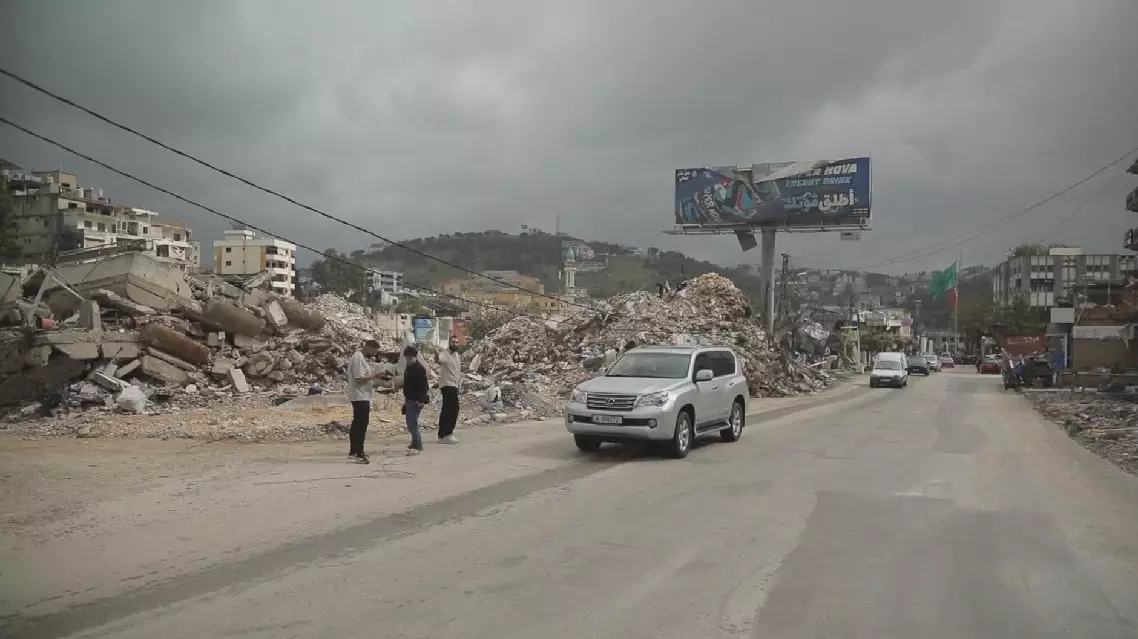
Displaced Lebanese return home for reconstruction