China's first fully integrated automobile testing ground has started trial operation on Saturday in Shangrao City, east China's Jiangxi Province, marking a significant milestone for the country's automotive industry.
The sprawling 4.11 million-square-meter facility boasts over 65 kilometers of test tracks, including a high-speed loop, dynamic plaza, and intelligent connected vehicle testing area, encompassing 16 testing modules and 118 specialized road types.
Designed to accommodate testing a wide range of vehicles, from traditional fuel-powered cars to new energy vehicles, and from passenger cars to commercial trucks and buses, the testing ground offers comprehensive evaluation capabilities.
The intelligent driving test area utilizes China's homegrown BeiDou Navigation Satellite System (BDS) and 5G technology to provide nearly 100 functional test scenarios for autonomous and connected vehicles, offering comprehensive technical support for signal perception, data analysis, and the entire testing process.
Yao Jie, deputy secretary-general of the China Association of Automobile Manufacturers, emphasized the significance of the facility.
"It is a fully integrated testing ground, which plays a very positive role in improving the overall testing capabilities of China's automobile industry, provides new opportunities for regional economic growth, and is also of great significance to improving the technological development of China's independent brands and the progress of China's automobile industry chain," said Yao.
Often referred to as the industry's benchmark, automobile testing grounds are essential for evaluating vehicle performance, conducting prototype tests, and refining designs post-production. This new facility incorporates innovative designs and intelligent systems to enhance precision in testing.
"Our test car can reach a top speed of over 309 kilometers per hour on this flat road, which is very helpful for us to test the high-speed endurance of the vehicle," said Dong Yanshi, an automotive test engineer.
The testing ground also boasts a nearly 8-kilometer high-speed loop with a maximum speed of 330 kilometers per hour and a maximum banking angle of 44.43 degrees, allowing for comprehensive testing of vehicle performance and safety as such high-speed testing conditions mean that even minor surface irregularities can pose significant safety risks.
"We have deployed more than 187,000 control data along the highway, using special construction techniques for curved paving to achieve millimeter-level road surface smoothness," said Liu Guowang, engineer of Shangrao Automobile Comprehensive Test Field of China First Highway Engineering Group.
Additionally, the facility features roads with 11 different slopes ranging from 7 percent to 60 percent, along with artificial ice surfaces to simulate driving conditions in rain, snow, and ice.
Sound testing is also a focus, with a specialized "noise road" designed to analyze abnormal sounds emitted by vehicles. Two reflective walls are strategically placed to enhance sound concentration for better analysis by engineers.
"With these two walls, the sound can be better concentrated and reflected to the test engineer, making it easier for him to analyze the cause of the abnormal noise, including the car's chassis, engine and other abnormal noise conditions," said Gu Julong, director of Shangrao Automobile Comprehensive Test Field of China First Highway Engineering Group.
As the automotive industry moves towards intelligent connectivity, the intelligent connected vehicle testing area, using 5G and Beidou technologies, features advanced scenarios such as elevated bridges and tunnels for assessing smart vehicle functionalities in sensing, computing, decision-making, and execution in GPS-challenging environments.
Additionally, a comprehensive virtual simulation scene library comprising over 1,000 typical test scenarios enables pre-road simulation testing, resulting in multiple patents in intelligent connected vehicle technologies, and solidifying its position as a leading facility for automotive development in China.
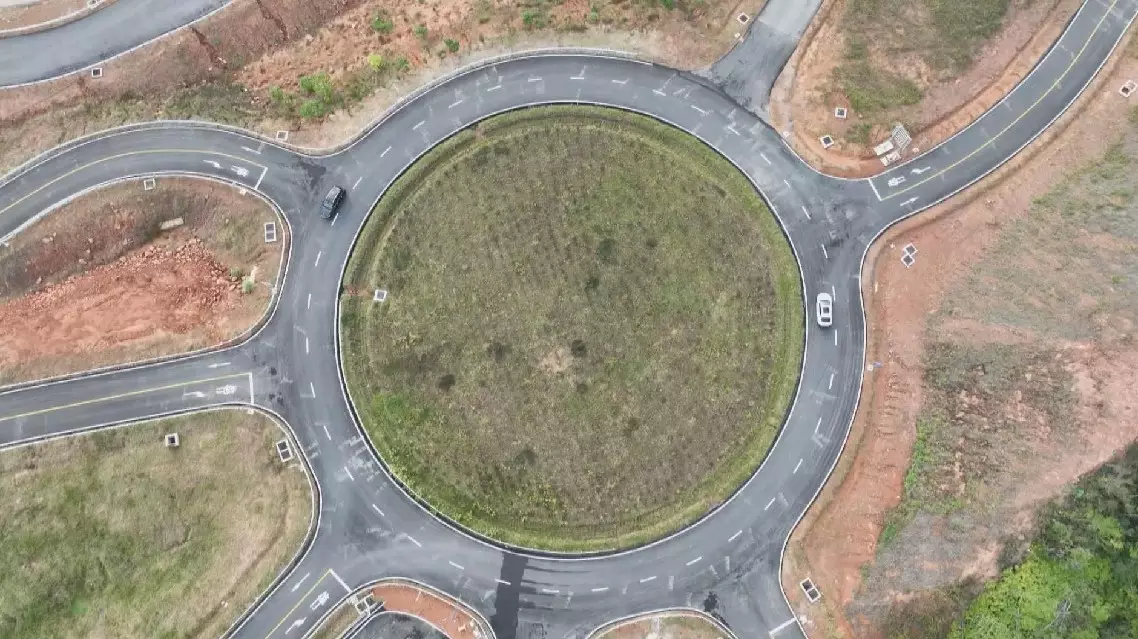
China's first fully integrated vehicle testing ground starts trial operation