U.S. President Donald Trump said on Friday that he estimates a deal with Iran will be signed "in the next day or two."
Trump said in an interview with Israel's Channel 12 News that the United States and Iran will probably meet over the weekend to finalize a deal to end the war. "The Iranians want to meet and make a deal," he said.
He said "the naval blockade on Iran is helping to make a deal. I will not lift it until we make a deal," adding that "the biggest part of this deal is that it will make Israel safer. This deal is good for Israel."
According to the channel, one component of the deal under discussion is that the United States will release 20 billion U.S. dollars in frozen Iranian funds.
In exchange, Iran would give up its stockpile of enriched uranium, and would be only allowed to have nuclear research reactors to produce medical isotopes, all above ground.
Trump also stressed that Israel must stop the strikes on Lebanon, saying, "They can't keep blowing up buildings. I'm not going to allow that."
Also on Friday, Trump said in a phone interview with Bloomberg that a deal to end the U.S.-Israeli war with Iran is mostly complete as talks over a lasting peace deal will "probably" be held this weekend in Pakistan.
Trump said in the phone interview that Iran agreed to suspend its nuclear program indefinitely, and will not receive any frozen funds from the United States.
"Most of the main points are finalized. It'll go pretty quickly," Trump said.
Asked if he would travel to Pakistan to sign the potential deal, Trump said: "I may."
Trump again denied that the moratorium on Iran's nuclear program would expire after 20 years. "No years, unlimited," Trump said.
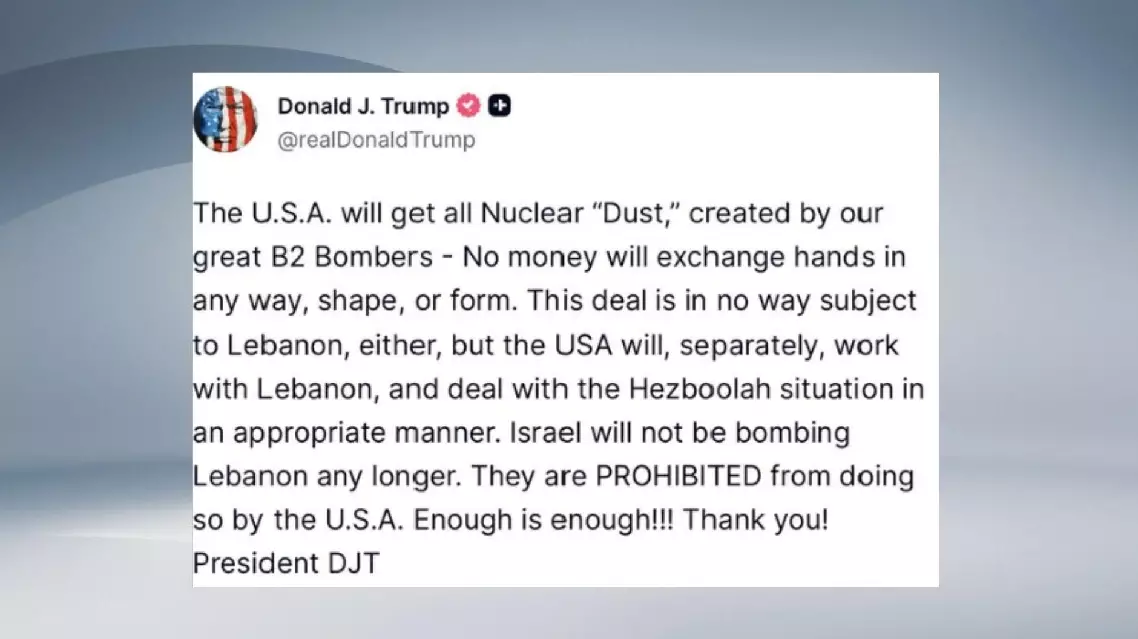
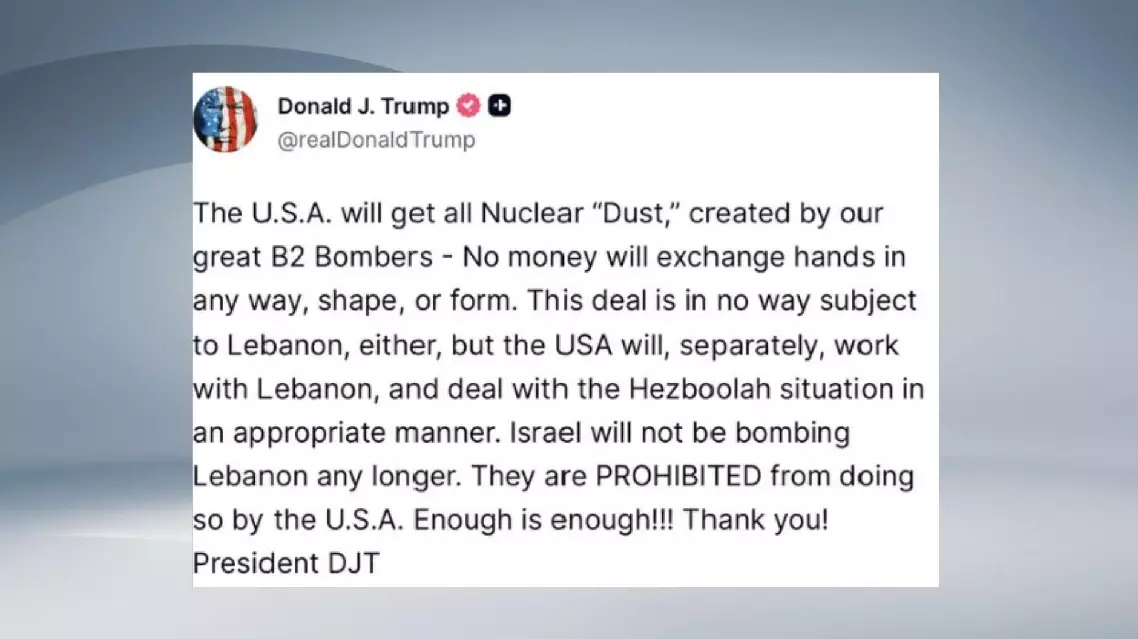
The United States will get all of Iran's nuclear "dust" with no money having exchanged hands "in any way, shape, or form," Trump wrote on social media earlier on Friday. Multiple Western media outlets have interpreted Trump's reference to nuclear "dust" as meaning Iran's stockpile of enriched uranium.
Iran has yet to comment on any deal beyond the reopening of the Strait of Hormuz, nor on claims made by Trump that Tehran had offered concessions, including over the key issue of its nuclear program.
If the United States continues its naval blockade of the Strait of Hormuz, Iran will consider it a violation of the ceasefire between the two countries and will close the waterway, the semi-official Tasnim news agency reported Friday, citing an informed source close to the Supreme National Security Council.
The Iranian side has yet to respond to the media report on the enriched uranium issue.
The United States and Iran had their first round of negotiations in Pakistan's Islamabad last weekend to ease tension in the Middle East. The talks, which failed to produce an agreement, took place after a ceasefire was announced on April 8 between Iran, the United States, and Israel, following 40 days of fighting.
Iran tightened control over the Strait of Hormuz after the United States and Israel launched joint attacks on the country on Feb. 28. The United States also imposed a naval blockade on the strait following the failed negotiations in Islamabad.
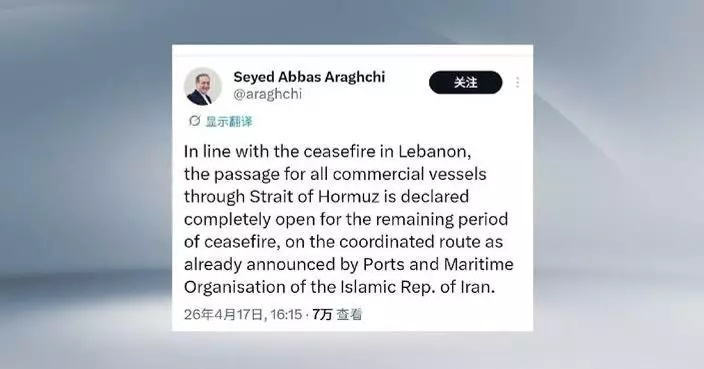
Earlier on Friday, both Washington and Tehran confirmed that the strait had been completely open for all commercial vessels. However, Trump said on Truth Social that the U.S. naval blockade would "remain in full force." In response, Iran warned of closing the waterway again if the U.S. blockade continues.
Trump says may sign deal with Iran "in the next day or two": Israeli media
Trump claims peace deal with Iran mostly complete: report
Political observers from across the Taiwan Strait have applauded the policy measures newly unveiled by the Chinese central government to boost exchanges and cooperation between the mainland and the island region.
The central government on April 12 rolled out 10 policies and measures -- spanning inter-party communication, infrastructure, travel, trade and culture -- aimed at boosting cross-Strait exchanges and cooperation.
The announcement by the Taiwan Work Office of the Communist Party of China (CPC) Central Committee followed a meeting between Xi Jinping, general secretary of the CPC Central Committee, and Cheng Li-wun, chairwoman of the Chinese Kuomintang (KMT) party, the first such top-level meeting between the two political parties across the Taiwan Strait in a decade.
Atop the 10 initiatives announced by the mainland is a proposal to explore a regular communication mechanism between the CPC and the KMT.
In addition to exploring the establishment of a regularized communication mechanism between the CPC and the KMT, more of these policy measures concern specific issues related to people's livelihood, precisely addressing the actual needs of various sectors in Taiwan, especially grassroots communities, youth, and small and medium-sized enterprises.
"For example, the catches of Taiwan's deepsea fishing vessels can be shipped directly to the mainland, and Taiwan's agricultural products can also enter the mainland market, which are both cases of expanded integrated development. In addition, Kinmen and Matsu can be connected with the coastal areas of Fujian Province in terms of access to water, electricity and gas supply, and construction of cross-sea bridges. There are also plans for Xiamen's Xiang'an airport to be jointly used with Kinmen. All these are concrete steps that further deepen integrated development," said Wu Yongping, dean of the Institute for Taiwan Studies at Tsinghua University.
Among the 10 policy measures is one for resuming individual travel to Taiwan for residents of Shanghai and Fujian. Taiwanese tourism and business operators believe that compared to approving group tours earlier, the mainland's willingness to directly promote the resumption of individual travel pilot programs sends a stronger signal of openness and demonstrates greater goodwill.
Recent data indicate increasing cross-Strait exchanges. In the first quarter of this year, applications for travel passes for Taiwan residents to enter or leave the mainland rose by 11.8 percent year on year, while visits by Taiwan residents to the mainland increased by 27.6 percent. First-time applicants -- many under the age of 45 -- have also grown in number.
"The Democratic Progressive Party (DPP) has gone too far in manipulating its so-called 'anti-China,' 'resentment toward China,' and 'resistance to China" tricks, which has backfired. More and more young people feel that there's no need to deliberately 'demonize' the mainland -- they want to see for themselves what the mainland is really like. Over the past couple of years, we've seen many people go to the mainland and use various forms of audio-visual media to share the truth about the mainland's progress with more Taiwan people around them," said Wang Bing-chung, a political commentator in Taiwan.
"Many of these individuals are Taiwan youth who previously supported the DPP. Because they were deceived in the past, they now carry a strong sense of anger and feel compelled to take personal action to debunk the lies they were fed. Under these circumstances, I believe it is an inevitable historical trend for compatriots on both sides of the strait to grow closer," he said.
Political observers across Taiwan Strait laud central gov't policies on boosting ties