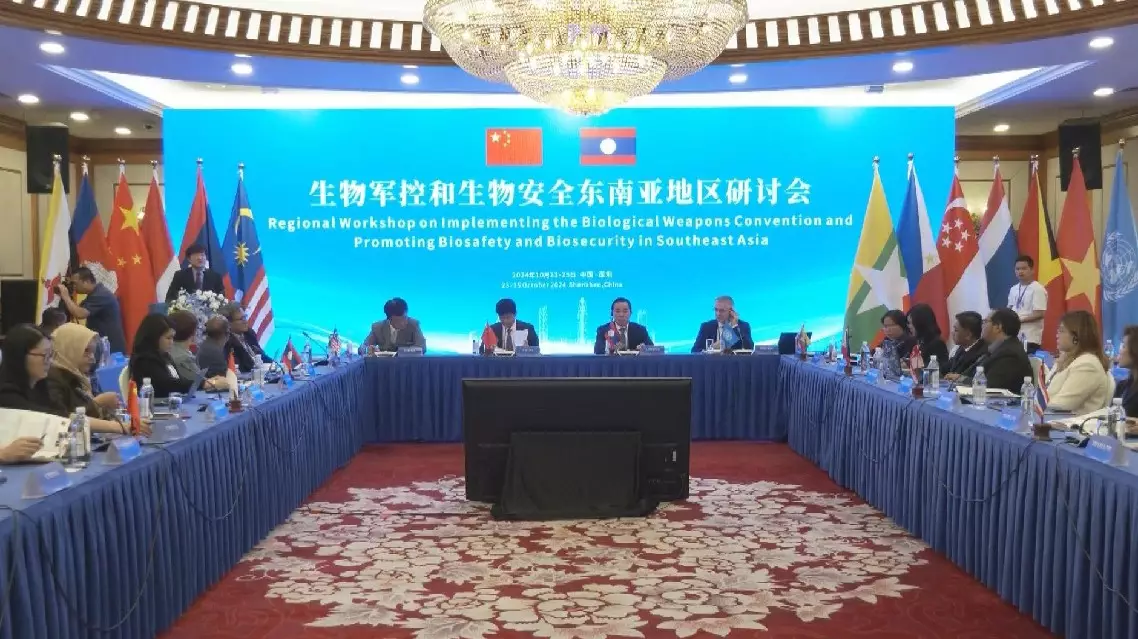
Experts emphasized the importance of strengthening biosafety, biosecurity, and international cooperation on biological arms control on the sidelines of a recently concluded Regional Workshop on Implementing the Biological Weapons Convention and Promoting Biosafety and Biosecurity in Southeast Asia.
The event, held from Wednesday to Friday in Shenzhen, in China’s southern Guangdong Province, aimed to strengthen regional coordination and collaboration in biosecurity.
Co-hosted by China and the Lao PDR, with support from the United Nations Office of Disarmament Affairs, the workshop brought together government officials and experts from China and 11 Southeast Asian countries.
Speaking with Chinese state broadcaster China Media Group (CMG) on the sidelines of the event, Qian Jun, dean of the School of Public Health at Sun Yat-sen University (Shenzhen), said that biosafety and biosecurity are of great significance to individuals and countries alike.
"Biosecurity is highly relevant to the lives of ordinary people. The primary aspect of biosecurity involves infectious diseases, including human infectious diseases, animal diseases, and plant diseases. Other aspects include the application of biotechnology, laboratory biosafety and invasive alien species, all of which are closely linked to public welfare and are very important. Biotechnology is often referred to as a 'double-edged sword'; it has civilian uses but can also be exploited in extreme ways. Biosafety is no longer just an issue for specific sectors but has become an important component of overall national security," said Qian.
China attaches great importance to biosecurity. It has not only incorporated biosecurity into its national security strategy, promulgated and implemented the Biosecurity Law, but has also issued biosecurity strategies and policies and improved its biosecurity work systems and mechanisms.
An important effort to promote biosecurity lies in the control of biological weapons, which, along with nuclear and chemical weapons, constitute major components of weapons of mass destruction.
In an interview with CMG, Li Fujian, deputy director of the Global Biosafety Governance Research Center at China Foreign Affairs University, said that two conventions—the 1925 Geneva Protocol, which prohibits the use of chemical and biological weapons in war, and the Biological Weapons Convention, which forbids the development, production, acquisition, transfer, stockpiling, and use of biological and toxin weapons—together form a basic framework for biological arms control.
"With the development of biotechnology, biological weapons are becoming more and more complex, such as genetic weapons, cyber-biosecurity attacks, and so on. Some new forms of biological weapons have emerged. Countries recognize the importance, complexity, and global nature of biosecurity and the destructiveness of biological weapons. Therefore, they are calling for efforts to strengthen global governance and international cooperation in the field of biosecurity," Li noted.
Experts stress importance of biosecurity, int'l cooperation on biological arms control