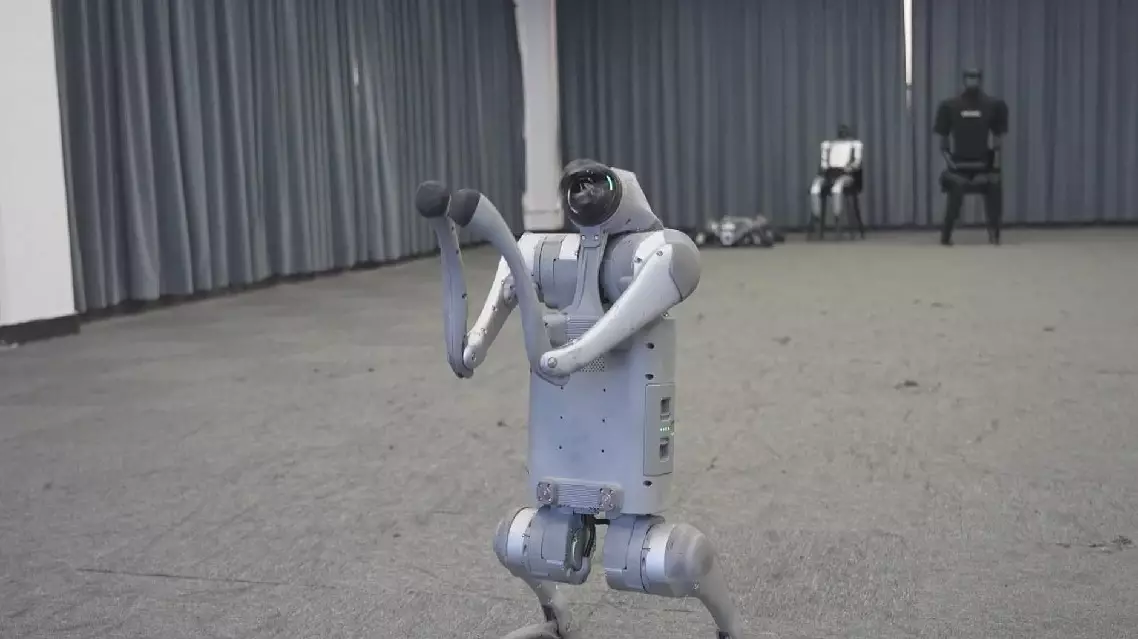
China's quadruped robot industry, though still at an early stage of sci-tech breakthrough and commercial application promotion, is focusing on tackling such technological challenges as short battery duration and low intelligent proficiency, industry insiders say.
Several enterprises and scientific research institutions in China are engaging in research and development and production of quadruped robots, which have been provided with application scenarios including patrols and examinations at chemical industrial parks and fire rescue scenes.
Capital city Beijing has deployed six quadruped robots, or robot dogs, in underground cable tunnels for regular patrols and examinations.
Robot dogs developed by Unitree Robotics based in Hangzhou, capital city of east China's Zhejiang Province, are undergoing weight-bearing climbing tests on Mount Tai, a UNESCO World Heritage Site in east China's Shandong Province. Their mission is to free human porters from the longstanding challenge of garbage removal on Mount Tai.
"Each robot dog is capable of carrying a maximum load of 120 kg without doing moves. While moving on the Mount Tai, each can carry a weight of 40 to 45 kg. A robot dog can operate for four to six hours on a single charge, and we can change the battery very quickly," said Jin Da, marketing manager of Unitree Robotics.
These robots are designed to excel in rough terrain, move steadily on slippery surfaces, climb stairs with ease, and cross obstacles like wooden barriers and platforms up to 40 cm high.
Insiders said the industry is focusing on extending the battery duration and lifting the intelligent proficiency of quadruped robots to higher levels.
"In fact, short battery duration is now a technical bottleneck in the development of quadruped robots. Our robot has 12 electric joints with high power density, and its battery duration is around two to three hours. That's not enough for operating in many special environments," said Fan Chunhui, deputy director of the research and development center on robots and core components under the 21st research institute of China Electronics Technology Group Corporation.
"Along with the improvement of artificial intelligence technologies, the quadruped robots can change from model-driven to data-driven, and like self-driving cars, the quadruped robots will be capable of autonomously perceiving the physical environment and interacting with the physical environment more intelligently," said Li Yunji, engineer with the center.
Experts said China's quadruped robot sector also needs to reduce production costs by means including using homemade components and parts such as sensors and laser radars.
Data show that China is the world's largest producer of robots. In 2023, China produced 7.833 million service robots -- marking a 21.3 percent increase from the previous year.
Also in 2023, the output of industrial robots in China reached 430,000 sets, nearly 73 percent of the global total.
China's quadruped robot industry focuses on battery duration, intelligent proficiency: insiders