Skip to Content Facebook Feature Image

Chinese astronaut overcomes challenges to fulfill spaceflight dream

China

China

China

Chinese astronaut overcomes challenges to fulfill spaceflight dream

2024-10-29 17:34 Last Updated At:22:47

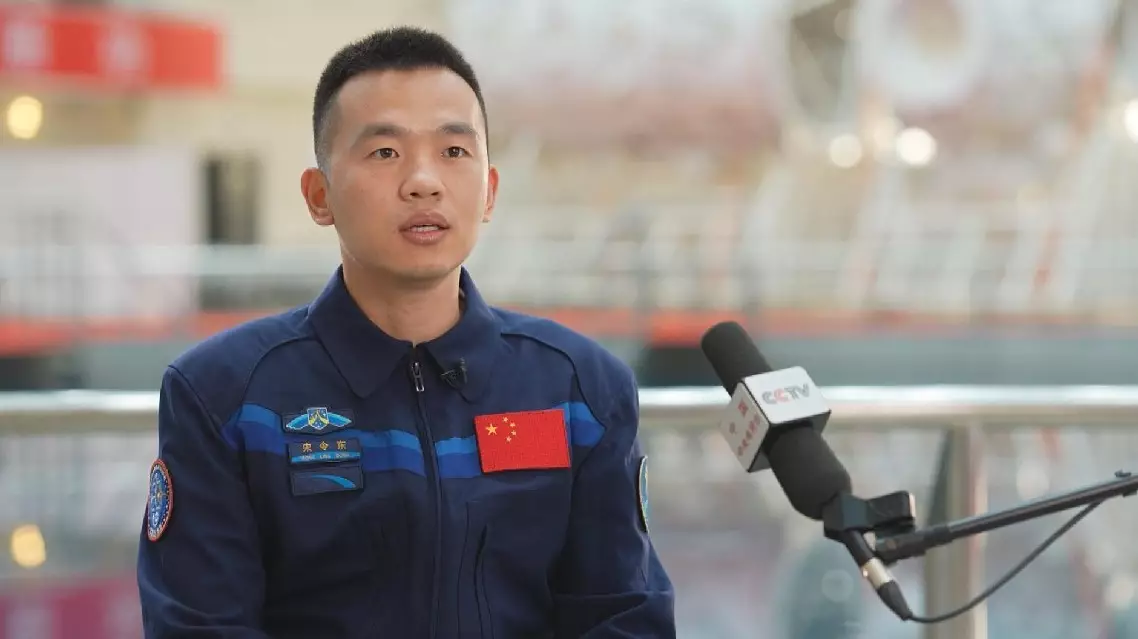
Song Lingdong, one of the astronauts set to board China's Shenzhou-19 crewed spaceship, has overcome motion sickness and persevered through rigorous training in anticipation of fulfilling his dream of spaceflight as he and his teammates prepare for liftoff on Wednesday.

China's Shenzhou-19 crewed spaceship is scheduled to launch at 04:27 Wednesday (Beijing Time) from the Jiuquan Satellite Launch Center in the country's northwest, the China Manned Space Agency (CMSA) announced on Tuesday.

The crew members are astronauts Cai Xuzhe, Song Lingdong and Wang Haoze, with Cai Xuzhe as the commander.

The three astronauts will take over command of China's Tiangong space station from the Shenzhou-18 crew currently in orbit and will spend about six months in space.

Song, a skilled pilot, is set to embark on the journey as a member of China's first group of astronauts born in the 1990s to join the space station crew.

Born in August 1990 in Caoxian County, east China's Shandong Province, Song's path to space began when he enlisted as a pilot in 2008. In 2020, he was selected as a member of China's third batch of astronauts.

His journey has been marked by determination and a passion for flying.

After starting his flying career in 2016, Song found deeper meaning in his work while soaring above China's stunning landscapes.

In 2018, he seized an opportunity to join the astronaut selection process, motivated by a desire to challenge himself and contribute to China's space exploration efforts. In order to make that dream a reality, he persisted through difficult training regiments. "I really want to challenge myself and give it a try when it comes to realizing my own potential by contributing to the space program. My biggest challenge has to be the spinning chair training, as I believe it is a routine training for both our flying career and my journey to become an astronaut. I've struggled with motion sickness since I was a child, whether in cars or on boats, but I've persevered through it all," said Song.

After a rigorous selection process involving preliminary, final and re-selection assessments, Song was enrolled in China's third batch of astronauts in September 2020.

After years of systematic study and training, covering everything from enhancing fundamental theoretical knowledge, physical capabilities and mental resilience to adaptation to the space environment, Song was ultimately selected, along with Cai and Wang, as part of the Shenzhou 19 crew.

Song expressed gratitude for the opportunities young Chinese people like him have been given to realize their dreams.

"In this era, it's easy if you're willing to settle for mediocrity and just go with the flow. But if you want to make something of yourself, to achieve something meaningful, I believe you need to persevere and stay intensely focused on one thing. I also think it's the strength of our country that has given us all young people born in the 1990s the opportunities to pursue and fulfill our dreams. So, I truly feel that the saying 'the harder you work, the luckier you get' reflects the spirit of our time, and I believe I am one of its lucky ones in this era," he said.
Chinese astronaut overcomes challenges to fulfill spaceflight dream

Chinese astronaut overcomes challenges to fulfill spaceflight dream
Japanese Prime Minister Sanae Takaichi's political stunts both at home and abroad cannot whitewash Japan's World War II (WWII) aggression, but instead expose the schemes of the country's far-right forces to incite bloc confrontation and promote remilitarization, says a China Media Group commentary published on Sunday.

An edited English version of the commentary is as follows:

In recent days, Takaichi has faced fierce criticism both domestically and internationally.

Her political stunt of kneeling in front of the Tomb of the Unknown Australian Soldier to lay flowers at the Australian War Memorial in Canberra during her visit to Australia further exposed her multiple political calculations to the international community.

Choosing to kneel in front of a tomb in Australia, Takaichi was not regretting for Japan's aggression and atrocities during World War II.

This act not only reveals the distorted world outlook of Japanese politicians, but also exposes their attempts to mislead public opinion, whitewash the crimes of WWII aggression, instigate bloc confrontation, and push for military buildup.

From "fawning diplomacy" during her U.S. visit in March to the recent kneeling show during her visit to Australia in May, Takaichi has been trying to cultivate a friendly image towards the West.

Geopolitically speaking, Japan's far-right forces are trying to expand their military and breach from the restraints of the pacifist constitution by exaggerating external threats. To this end, they are making every effort to exploit geopolitical conflicts and draw neighboring countries, especially Western countries, into bloc confrontation.

Since the end of WWII, Japanese leaders have never apologized to the people of victim countries such as China, the Republic of Korea, and the Democratic People's Republic of Korea. Many Japanese politicians have even tried every means to justify the war crimes.

In particular, Takaichi has questioned the 1995 Murayama Statement, denied the Nanjing Massacre, visited the notorious Yasukuni Shrine annually for many consecutive years, and revived military rank titles during WWII, such as "taisa."

On the issue of Japan's history of aggression, Takaichi's insidious move cannot deceive the world.

Takaichi's political stunts both at home and abroad are a provocation against WWII victim countries in Asia and other regions.

This cannot conceal Japan's remilitarization attempt or the reality that " neo-militarism" is spreading and becoming a threat.

All countries that have suffered from Japanese militarist aggression should remain highly vigilant and united, and work together to safeguard the outcomes of WWII victory, so that historical tragedies never repeat themselves.

Takaichi's political stunts cannot whitewash Japan's history of aggression, remilitarization attempt: commentary

Takaichi's political stunts cannot whitewash Japan's history of aggression, remilitarization attempt: commentary

Recommended Articles