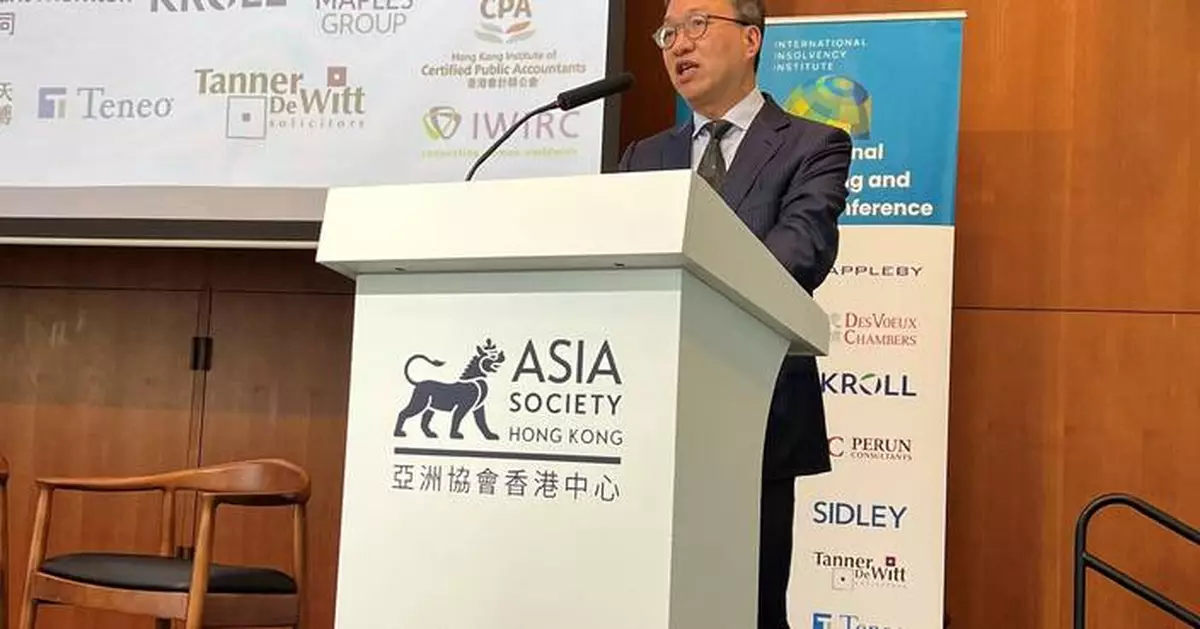
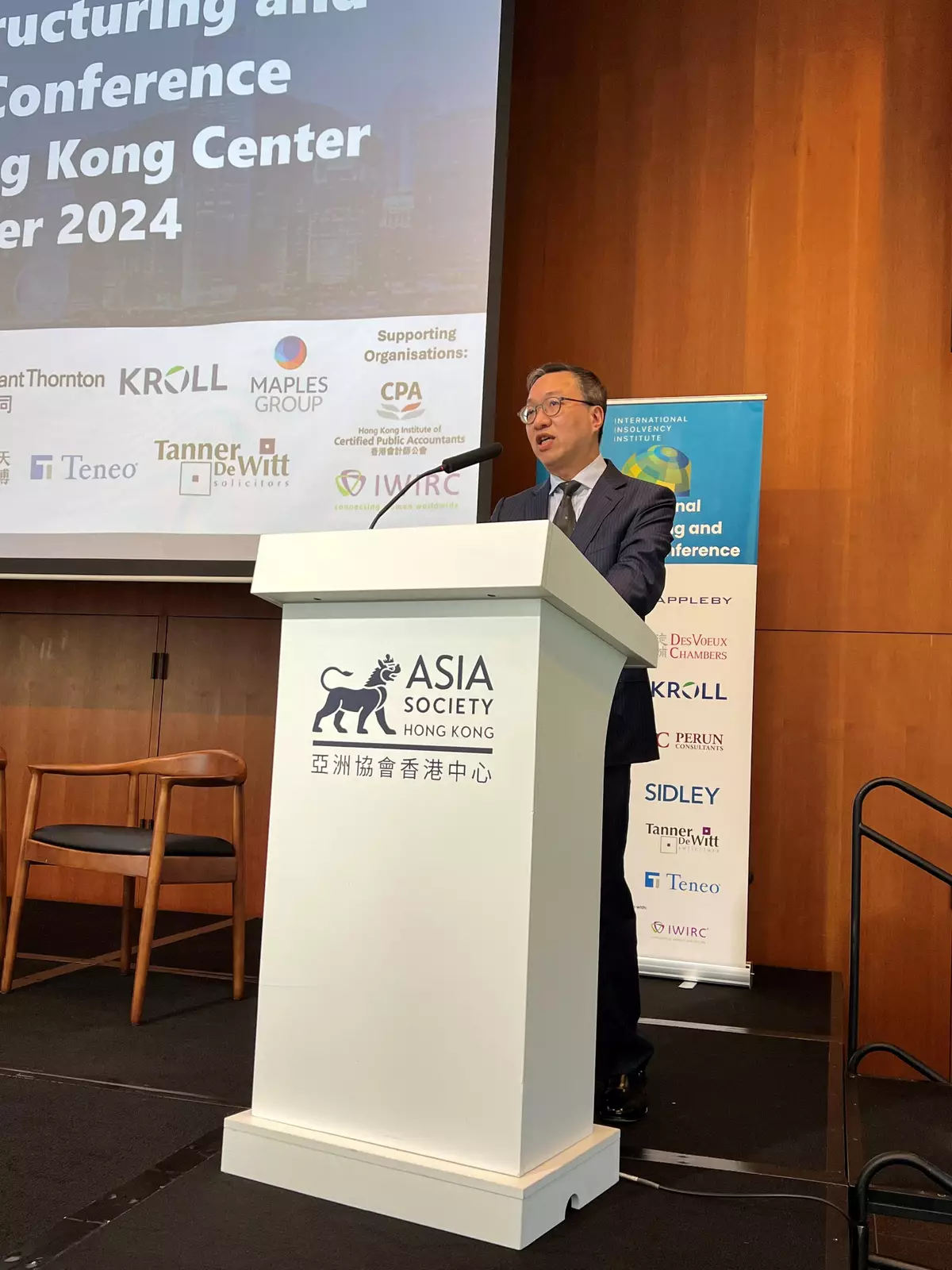
Speech by SJ at Regional Restructuring and Insolvency Conference
Following is the speech by the Secretary for Justice, Mr Paul Lam, SC, at the International Insolvency Institute Regional Restructuring and Insolvency Conference today (November 1):
Distinguished guests, ladies and gentlemen,
Introduction: the story of Red Lobster
Good afternoon. First of all, I would like to express my gratitude to the International Insolvency Institute for organising this conference, and for inviting me to address this distinguished audience on a topic that concerns the sustainability of the economy.
Regardless of your professions: judges, academics, R&I (restructuring and insolvency) professionals, lawyers, accountants and so on, we share two things in common right at this moment - first, interest in the R&I development aside; second we all just had lunch. Therefore, I think I might start with a story which combines R&I development and food.
I am sure you are aware of Red Lobster, a chain restaurant founded in 1968 in the United States (US). It expanded to Canada in 1983, known for its affordable seafood, Cheddar Bay biscuits and family-friendly atmosphere. Red Lobster used to employ about 2 000 employees across a number of provinces in Canada. It used to have a branch in Causeway Bay, Hong Kong, where I went a couple of times.
Hard hit by the pandemic, the parent company of Red Lobster filed for Chapter 11 bankruptcy protection in the US in May this year. A US bankruptcy judge gave conditional approval for the restructuring plan, including a provision that the plan had to be approved by the Canadian court.
In September, a court in Toronto granted an order that recognises and gives effect to the restructuring plan as approved by the US bankruptcy judge. As a result, all 27 restaurants of Red Lobster in Canada can remain open; and the employees can keep their jobs. Red Lobster now has a breathing space to revive its business for the benefit of all stakeholders.
While all sorts of stigma may be associated to terms like "bankrupt", "liquidation", "執笠" and "結業", the story of Red Lobster and many others speak for themselves that the restructuring and insolvency regime is very important for business sustainability and helps to maintain a healthy commerce and trade ecosystem. It helps genuinely viable businesses that happen to fall into difficult times to rehabilitate, and ensures that other businesses could have an orderly exit from the market while their owners can have a fresh start.
Cross-border insolvency in Hong Kong
Given Hong Kong's status as an international finance hub with major cross-border investments, having a majority of companies listed on the Stock Exchange incorporated in offshore countries but having substantive assets and operations on the Mainland, the importance to develop cross-border R&I that paves the way for a harmonised, modernised and interoperable regime cannot be over-emphasised.
Hong Kong has not adopted the UNCITRAL Model Law on Cross-Border Insolvency as part of our procedure for winding up. We have not enacted legislation to deal with cross-border insolvency matters either. However, our common law has established that, upon receipt of a formal letter of request from a foreign court, Hong Kong court can recognise foreign insolvency proceedings and provide assistance in accordance with the principle of modified universalism. By deploying the common law cross-border insolvency process, our court has, in practice, allowed or followed certain UNCITRAL Model Law's provisions to provide for access to the Hong Kong court, and the recognition and assistance of foreign R&I proceedings.
Access
As to access to the Hong Kong court, foreign companies and creditors may apply to commence winding-up proceedings in Hong Kong. Foreign liquidators may also apply to seek sanctions of restructuring proposals to bind creditors in Hong Kong. The Hong Kong court accedes to such applications if three core requirements are satisfied. I am sure you're very familiar with these requirements that I would like to take the opportunity to reiterate what they are:
(a) first, the company applied to be wound up has sufficient connection with Hong Kong;
(b) second, there is a reasonable possibility of benefit to the applicant if the company is wound up in Hong Kong; and
(c) lastly, there are creditors within the jurisdiction.
The first core requirement of "sufficient connection" is similar to the requirement of "Centre of Main Interest" (COMI) under the UNCITRAL Model Law. And some even say that it is less stringent than COMI because the mere presence of significant assets would suffice to satisfy the "sufficient connection" requirement.
Recognition and assistance
When dealing with applications for recognition or assistance under the common law, the Hong Kong court accedes to such applications if the foreign liquidator can establish that:
(a) first, the foreign proceeding is a process of collective enforcement of debts for the benefit of the general body of creditors;
(b) second, the foreign proceeding is conducted in the company's COMI; otherwise,
(i) the foreign liquidator is only seeking the court's assistance to recognise his authority to represent the company to provide certain managerial assistance; or
(ii) the foreign liquidator is only seeking other limited and carefully prescribed assistance by the court, which assistance is justified on practical grounds;
(c) third, the order sought is necessary for the administration of the foreign winding up and for the performance of the functions of the foreign liquidator; and
(d) fourth, the order sought is consistent with the substantive law and public policy of the Hong Kong court.
Recognition and assistance of foreign insolvency proceedings under Hong Kong's common law can undoubtedly benefit foreign liquidators and creditors. Foreign liquidators may obtain a range of orders to support their investigations and expand the pool of assets available for distribution to foreign creditors. Examples include freezing and seizure of assets, books and accounts located in Hong Kong; and also oral examination of officers located in Hong Kong.
In Re Bridge Global decided earlier this year, an order was granted for recognition and assistance in aid of a foreign liquidator's investigation into an alleged fraud. The Honourable Madam Justice Linda Chan, whose sharing we will have the honour to hear later this afternoon, made an order in that case for production of documents against third parties. The principles laid down in Kong Wah Holdings, a Court of Final Appeal case about a local liquidator applying under s286B of the Companies (Winding Up and Miscellaneous Provisions) Ordinance for a Hong Kong court's order to produce books and papers relating to the company under winding up, were reaffirmed in Re Bridge Global to apply with equal force when a foreign liquidator relies on the common law to seek a similar order from the Hong Kong court.
Co-operation mechanism on insolvency between the Mainland and Hong Kong
I wish to turn to an important issue peculiar to Hong Kong, namely, cross-border insolvency involving Mainland and Hong Kong elements. In recent years, we have witnessed an increasing number of winding-up proceedings in Hong Kong of companies with Mainland connections, and also liquidation proceedings on the Mainland involving Mainland companies with Hong Kong connections.
In May 2021, the Department of Justice signed the Record of Meeting on Mutual Recognition of and Assistance to Bankruptcy (Insolvency) Proceedings (RoM) with the Supreme People's Court (SPC) of the People's Republic of China. Before that, while recognition of and assistance to Mainland bankruptcy administrators were available in Hong Kong under our common law, there was no legal basis on the Mainland for granting similar recognition of or assistance to Hong Kong liquidators and provisional liquidators.
The new mechanism signifies a breakthrough, whereby Hong Kong liquidators and provisional liquidators may apply to the Mainland courts in the three pilot areas for recognition of insolvency and debt restructuring proceedings in Hong Kong, and also for assistance to perform their duties on the Mainland, such as taking over the debtor's property, investigating into the financial position of the debtor, and participating in legal actions and arbitrations on behalf of the debtor.
Very importantly, the RoM features debt restructuring using a scheme of arrangement sanctioned by the Hong Kong court. Before the mechanism, there had been no legal framework which facilitates co-ordinated and court supervised debt restructuring in both the Mainland and Hong Kong. This is no longer the case. The express coverage of debt restructuring through schemes of arrangement, arguably, offers a higher degree of certainty compared to the Model Law on Cross-border Insolvency.
I have to emphasise that Hong Kong remains to be the only jurisdiction which has established with the Mainland a co-operation mechanism for corporate insolvency and restructuring. This is a strong testimony to the vitality and unique advantages under the principle of "one country, two systems". With a comprehensive legal mechanism for mutual legal assistance with the Mainland in place in this area, Hong Kong has further strengthened its status as a leading international financial centre.
Alongside with Record of Meeting, the SPC promulgated an opinion to provide detailed guidance to the relevant Mainland courts, and has designated Shanghai, Xiamen and Shenzhen as the three pilot areas.
By now, the Hong Kong Court of First Instance has, under the Record of Meeting, approved a total of eight applications to be submitted to the Mainland courts for recognition and assistance in Hong Kong's winding-up proceedings: three to Shenzhen Intermediate People's Court, another three to the Shanghai No. 3 Intermediate People's Court, and two to the Xiamen Intermediate People's Court.
For illustration, I would like to highlight the recent case of Re Hong Kong Lee Yuan International Group Limited in which the liquidators of the Company sought recognition and assistance from the Mainland court in aid of the Company's liquidation. In July 2024, the Honourable Madam Justice Linda Chan issued a letter of request to the Xiamen Intermediate People's Court on the basis that all the applicable principles pursuant to the RoM have been met. Among other things, the court is satisfied that Hong Kong has been the COMI of the Company continuously for more than six months; and the recognition and assistance sought is necessary to enable the liquidators to carry out their functions as the Company's liquidators on the Mainland, especially in Xiamen, one of the pilot areas. COMI generally means the place of incorporation of the debtor by default. At the same time, the court also take into account other factors, including the place of principal office, the principal place of business, the place of principal assets etc of the debtor.
While as at to date, the Xiamen court has yet to approve the recent application in Re Hong Kong Lee Yuan International Group, there have already been three cases where the Hong Kong liquidators were recognised by the Shanghai, Shenzhen and Xiamen courts respectively.
I wish to deal with the reverse situation, in particular, the question whether the Hong Kong court will recognise and assist liquidation proceedings on the Mainland if the debtor's COMI is located outside the three pilot areas on the Mainland? In this regard, it must be clarified that the mechanism under the Record of Meeting does not serve as the exclusive channel through which an application for recognition and assistance of Mainland insolvency proceedings has to be made.
In Hong Kong, the jurisdiction to recognise and assist liquidators appointed by a court in other jurisdictions, including the Mainland, is based on the common law. In other words, the mechanism under the Record of Meeting does not limit Hong Kong court's jurisdiction to provide recognition and assistance only to the three pilot areas. In fact, there have been four cases in which the Hong Kong court recognised orders made by Mainland courts outside the pilot areas in namely Hainan, Beijing, Guangzhou and Guangxi.
Going forward, we would continue to maintain an open dialogue with stakeholders of both Hong Kong and the Mainland on issues relating to the implementation of the Record of Meeting, including the possible of expanding the three pilot areas to other cities on the Mainland.
I would like to take this opportunity to share with you the upcoming Hong Kong Legal Week that will kick start next Monday. Of particular interest to this distinguished audience will be the programme on next Thursday, November 7, where a panel of legal practitioners will share their practical experiences on various mutual legal assistance arrangements between the Mainland and Hong Kong, including the one on insolvency matters that I have just mentioned. I would therefore invite you to join us in this annual flagship event of the Department of Justice.
Concluding remarks
On this note, I wish you all a very fruitful afternoon and very constructive discussion. Thank you very much.
Speech by SJ at Regional Restructuring and Insolvency Conference Source: HKSAR Government Press Releases