Recently, officials from the Central Government have engaged in multiple discussions with British consortia in Hong Kong, including Swire, HSBC, and Jardine Matheson. They underscored the government's unwavering commitment to accurately and comprehensively implement the principle of "one country, two systems," thereby supporting Hong Kong's unique status and advantages while ensuring a free, open, and regulated business environment. These officials encouraged sustained and significant investment in both Hong Kong and the Mainland.
On October 30, Cui Jianchun, Special Commissioner of the Ministry of Foreign Affairs in Hong Kong, met with Swire Group's Chief Executive Officer, Merlin Swire, and other representatives. Cui expressed gratitude for Swire's long-term commitment to both the Mainland and Hong Kong, emphasizing its crucial role in promoting the prosperity and stability of the region. He urged Swire to seize new opportunities arising from China’s deepening reforms and enhanced openness, fostering greater investment cooperation with both the Mainland and Hong Kong, and contributing positively to the healthy and stable development of China-UK relations.
Merlin Swire responded by affirming Hong Kong's continued unique advantages. He reiterated Swire Group's strong support for "one country, two systems," expressed optimism regarding Hong Kong’s development prospects, and committed to expanding investments in the region while promoting Hong Kong’s success story internationally to bolster its global appeal.
Xia Baolong, Director of the Hong Kong and Macao Affairs Office of the CPC Central Committee, has been meeting with leaders of British groups over the past six months to advocate for increased investment. On October 28, Xia met with Jardine Matheson Holdings' Executive Chairman, Benjamin Keswick, in Beijing. He expressed hopes that Jardine Matheson would enhance the international community's understanding of Hong Kong and build confidence through its collaborative development examples within the region. Xia commended the group for its positive outlook on the future of both China and Hong Kong and its active involvement in the reform and economic development of both.
Xia reiterated the Chinese government's steadfast commitment to the principles of "one country, two systems," "Hong Kong people governing Hong Kong," and a high degree of autonomy, affirming that these will remain unchanged for the long term. He stated that since Hong Kong's return, the original capitalist system, including the common law framework, has remained intact, and the lifestyle of Hong Kong residents has not altered. The Central Government will continue to support Hong Kong in reinforcing its status as an international financial, shipping, and trading hub.
Notably, Xia met with British consortia twice within a month. On October 18, he also engaged with HSBC Group Chairman, Mark Tucker, and his delegation in Beijing. Xia praised HSBC for its enduring optimism regarding the development of China and Hong Kong, emphasizing that the "one country, two systems" policy remains resolute, supporting Hong Kong's unique advantages and fostering a conducive business environment. He urged HSBC to play an active role in contributing to China’s high-quality development and high-level opening up, thereby enhancing Hong Kong's prosperity.
Following these discussions, HSBC took prompt action. On October 24, the bank announced its direct involvement in the RMB Cross-border Payment System (CIPS). The next day, David Liao, Co-Chief Executive of HSBC Asia Pacific, stated at the Swift International Banking Operations Conference in Beijing that this initiative, driven by customer demand, would facilitate overseas corporate clients' ability to trade and invest in Renminbi, thereby reducing costs and indicating significant potential for the global growth of the Renminbi.
As early as last year, Xia Baolong met with CLP Group Chairman, Michael Kadoorie, in Beijing, and with Swire Group CEO, Merlin Swire, in Shenzhen. Over the past year, Central Authorities have actively engaged with established British consortia to understand their perspectives and encourage greater investment in both Hong Kong and the Mainland. UK-funded consortia have responded positively, signalling their intent to increase investments in both regions and expressing optimism regarding their development prospects.
Ariel
** 博客文章文責自負,不代表本公司立場 **
History was made in global finance this week. Boston Consulting Group (BCG) released its 2026 Global Wealth Report on Wednesday (27 May), revealing that Hong Kong's cross-border wealth management assets reached US$2.95 trillion — a 10.7% year-on-year surge. That figure edged past Switzerland's US$2.94 trillion by roughly US$10 billion, making Hong Kong the world's largest cross-border wealth management center for the first time.
The milestone triggered a global media storm. More than 600 overseas reports followed the release, with the Associated Press, the Financial Times, Bloomberg, Reuters, and Canada's National Post all turning their focus to this defining shift in the global wealth management landscape.
Hong Kong's lead over Switzerland is slim — but the growth gap is not. Bloomberg noted that Hong Kong overtook Switzerland by a narrow margin, driven by an influx of capital from the Chinese Mainland and a rebound in Hong Kong's local stock market. What matters far more, though, is trajectory: BCG projects that cross-border wealth managed in Hong Kong will grow at roughly 9% per year between 2025 and 2030, compared to only about 6% for Switzerland.
Bloomberg goes further. By 2030, the gap in assets under management between the two centers is forecast to widen to nearly US$600 billion. Today's slim lead is not a finish line — it is the opening lap of a far larger structural shift.
Two core drivers explain Hong Kong's rise. The Financial Times focused on the diversification appetite of wealthy investors from the Chinese Mainland. Post-pandemic, investors sought to spread assets across jurisdictions to hedge against geopolitical risk — and a surge of that capital flowed into Hong Kong, helping it topple Switzerland's long-standing status as the traditional safe haven.
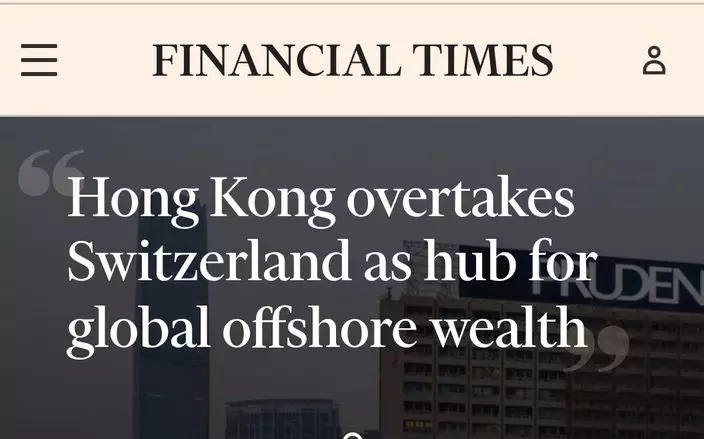
Financial Times coverage of the report.
Reuters added the numbers: wealth from China and a boom in IPOs in 2025 drove Hong Kong's cross-border assets to US$2.95 trillion.
BCG report co-author Michael Kahlich cuts to the structural point. "What ultimately matters is client proximity," he said. His view: two hubs are now forming in global wealth management — Singapore and Hong Kong serving Asia, and Switzerland, the United Kingdom, and the United States serving the West. Hong Kong's rise, in other words, is not simply about beating Switzerland. It reflects a structural migration of the global wealth management center of gravity towards Asia — a shift BCG describes as "unlikely to be reversed."
This development has prompted deep soul-searching in Switzerland. The FT quoted a UBS banker based in Zurich who questioned whether Switzerland had done enough to actively defend its position in wealth management — or had simply been coasting on the strength of its stable environment. Reuters noted that while Switzerland's growth rate is slower, its client base is more diversified, spanning regions across the globe. That breadth could prove a resilience advantage, whereas Asia's hubs remain heavily reliant on growth from the Chinese market.
BCG acknowledges that Switzerland retains unique value in navigating geopolitical uncertainty — particularly in attracting safe-haven flows amid ongoing instability in the Middle East. Yet BCG's own projections expose a key tension: diversification may bring stability, but against the backdrop of Asian wealth growing at roughly 9% per year, Switzerland risks a continued relative decline if it does not actively adapt.
Across international media coverage, one competitive advantage of Hong Kong was repeatedly emphasized — its connectivity function under "One Country, Two Systems." The Associated Press highlighted how Hong Kong's close ties with the Mainland market have driven its wealth management business. Reuters likewise noted that Hong Kong "is cementing its role as China's gateway to global markets."
This is more than a geopolitical dividend — it reflects deliberate policy work. Hong Kong issued a family office policy statement in 2023, followed by tax incentives and the New Capital Investment Entrant Scheme. Financial Secretary Paul Chan Mo-po stated after the report's release that Hong Kong's free, open, transparent, and predictable economic policies — alongside a stable and secure investment environment — are attracting a growing number of ultra-high-net-worth individuals and family offices to set up in the city. By end-2025, more than 3,380 single-family offices were operating in Hong Kong, up more than 25% from two years prior.
A slim lead is a warning signal as much as a trophy. The Hong Kong Economic Journal editorial noted that while Hong Kong surpassing Switzerland is a testament to the advantages of "One Country, Two Systems," Singapore is closing the gap at an annual growth rate of 10.3%, and Switzerland still holds the resilience of a diversified client base. Whether Hong Kong can sustain its position depends on its ability to broaden its global client base while consolidating its role as China's gateway.
A century-old wealth management order is witnessing a profound "East rising, West declining" moment. Hong Kong's displacement of Switzerland with US$2.95 trillion in cross-border wealth management assets is not merely a triumph for one city — it is a reflection of a shifting tide in the direction of global capital flows.
Yet, the real contest is not today's margin; it is the gap in growth rates that will decide the winner over the coming decade. As BCG put it, the future of wealth management centers is not about who offers the best safe haven — it is about who can stay closest to clients. And Asia is rapidly becoming the place where those clients are.