Speech by DSJ at Asia-Pacific International Private Law Summit 2024 (with photo/video)
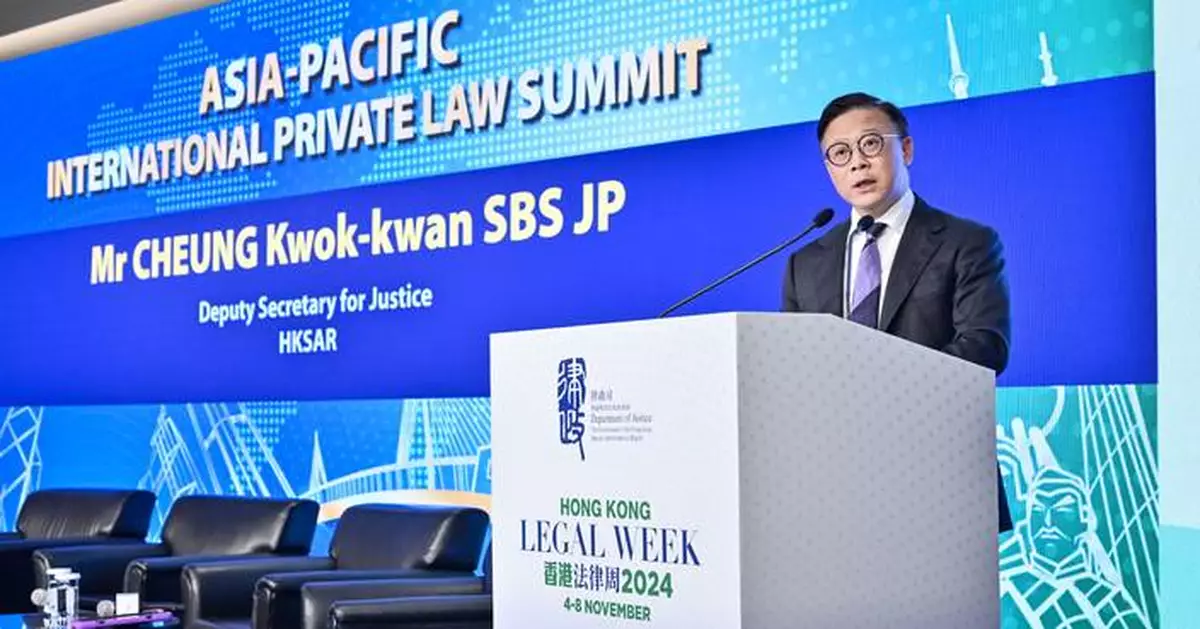
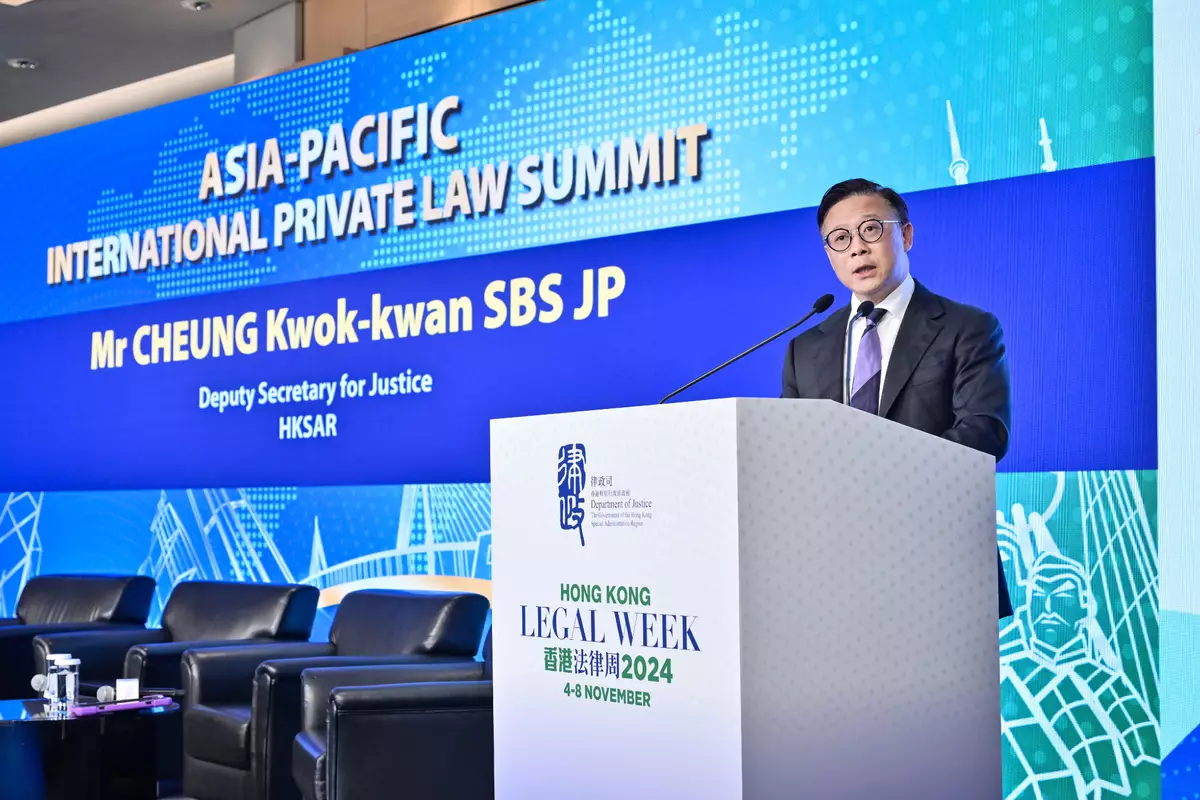
Following are the closing remarks by the Deputy Secretary for Justice, Mr Cheung Kwok-kwan, at the Asia-Pacific International Private Law Summit 2024 under Hong Kong Legal Week 2024 today (November 4):
Professor Ignacio Tirado (Professor Ignacio Tirado, Secretary-General of the International Institute for the Unification of Private Law (UNIDROIT), distinguished guests, ladies and gentlemen,
It is a great honour for me to deliver the closing remarks of the Asia-Pacific International Private Law Summit 2024, a remarkable event co-organised by UNIDROIT and the Department of Justice of the Hong Kong Special Administrative Region.
I am especially delighted to see Ignacio and Anna (the Deputy Secretary-General of UNIDROIT, Professor Anna Veneziano) again in person today. It brings back my memories of my visit to UNIDROIT's Secretariat in the beautiful city of Rome last year, where I attended an insightful conference co-organised by UNIDROIT and the Chinese Embassy in Italy. I still recall the generous hospitality extended to me by Ignacio and Anna during my visit. I sincerely hope that we have been able to reciprocate that same warmth and hospitality during your time here in Hong Kong.
Today's Summit has been nothing short of inspiring. We have been privileged to hear insightful presentations from distinguished officials, industry players and experts from Hong Kong and overseas, including high-level officials from several renowned international organisations of UNIDROIT, Asian Infrastructure Investment Bank and the Hague Conference on Private International Law. We are also honoured to have had a senior official from Mongolia to share her insights, which have further enriched our discussions.
The quality and depth of these presentations have been commendable, addressing critical issues pertinent to the evolving landscape of international private law. The topics explored by our expert panellists are both timely and relevant not only to Hong Kong, but also to the Asia-Pacific region and beyond. I am confident that the insights shared today will contribute significantly to ongoing discussions within our legal communities and other stakeholders.
As we reflect on today's Summit, one overarching theme has particularly stood out, that is the importance of legal certainty and predictability. In an increasingly globalised world, where cross-border transactions are growing in volume and complexity, the harmonisation and modernisation of private law are more important and essential than ever. Reducing legal uncertainties is not merely an academic or technical exercise. It directly benefits businesses by enabling them to operate with greater confidence and facilitating smooth cross-border commercial activities. Legal certainty and predictability fostered by international private law will therefore be a "springboard to opportunities" for the Asia-Pacific region, as encapsulated in the theme of today's Summit.
Panel 1: Harnessing Opportunities from Digital Assets, Tokenisation and Carbon Credits
In our first panel, we delved into the need for a consistent approach to the legal treatment of digital assets across jurisdictions.
The advent of technologies such as distributed ledgers has paved the way for cryptocurrencies and other digital assets, which are now integral to various sectors of our economy and financial markets.
In order to unlock the potential of the digital economy, a clear and certain legal framework is vital. Such clarity instils trust in technology, ensures platform resilience and protects the rights of consumers and businesses alike. In this context, the UNIDROIT Principle on Digital Assets and Private Law which provides a common framework addressing legal issues related to the holding, transfer and use of digital assets, are particularly relevant to Hong Kong and the Asia-Pacific.
Today's discussion offered much to consider about integrating international principles with local laws in each jurisdiction to achieve harmonisation and consistency. As an international financial hub, Hong Kong is committed to promoting the integration of real economy and digital economy, and fostering the development of the digital economy.
Panel 2: Unleashing Economic Potential Through Secured Transaction Law Reform in the Asia-Pacific Region
The benefits and role of harmonised secured transactions law in promoting economic growth across the Asia-Pacific region was discussed in Panel 2.
Secured transactions are essential for businesses seeking access to credit and working capacity. As a leading international trading hub with a robust legal system, Hong Kong is the prime destination for Mainland and overseas enterprises establishing their international headquarters to manage offshore trading and supply chain operations. In fact, Hong Kong ranks at the top globally in terms of international trade and business legislation according to the World Competitiveness Yearbook 2024 by the International Management Development Institute.
Our experts in Panel 2 examined the importance of international instruments supporting secured transactions, while exploring UNIDROIT's contribution to secured transactions law, such as the Convention on International Interests in Mobile Equipment and its various Protocols, as well as the recent adopted Model Law on Factoring. Such efforts are crucial for enhancing access to credit for businesses across the Asia-Pacific Region to unleash our economic potential.
Panel 3: Gateway to International Investment and Sustainability
The experts at Panel 3 brought our attention to the need for reducing legal uncertainties surrounding international investment contracts for both states and private investors.
In this regard, the panel introduced the UNIDROIT's ongoing international investment project, which seeks to modernise, harmonise and standardise international investment contracts by developing clear guidance to foster consistency in these vital agreements. It also addresses recent developments in international investment law, such as the increasing focus on corporate social responsibility and sustainability.
These topics are of particular relevance to Hong Kong, given its role as an important gateway between China and the global markets. Hong Kong's unique arrangements with Mainland China enhance its appeal as a jurisdiction for international investment and arbitration. Investments from Hong Kong into Mainland China enjoy the substantive protections offered by the investment agreement under the Mainland and Hong Kong Closer Economic Partnership Arrangement. Moreover, we are the first common law jurisdiction where parties involved in arbitrations seated in Hong Kong can seek interim measures from Mainland courts, such as asset preservation.
This synergy between Hong Kong's legal infrastructure and its strategic relationship with Mainland China not only bolsters investor confidence but also further strengthens Hong Kong's position as a leading centre for international legal and dispute resolution services within the Asia-Pacific region.
Panel 4: Building Bridges by Strengthening Engagement in the Asia-Pacific Region
Finally, Panel 4 discussed building bridges to strengthen engagement and capacity building has been identified as a key to strengthening engagement in the Asia-Pacific region. This involves not only improving legal infrastructure but also developing skilled professionals capable of handling the complexities of international private law.
The Panel highlighted the significance of legal co-operation and legal talents development. Capacity building initiatives among international organisations and Asia-Pacific economies are crucial in equipping our region's government officials, practitioners and other stakeholders with the skills and knowledge needed to navigate the complex international legal landscape. Amid the growing demand for legal expertise driven by increasing international trade, these initiatives foster collaboration and nurture skilled legal professionals, thereby improving access to justice regionally and beyond.
Hong Kong is deeply committed to enhancing its status as a regional hub for capacity building. With a strong pool of legal and dispute resolution professionals who possess extensive international experience, the Department of Justice has been actively involved in organising and supporting various training and development programmes across different areas of law and practice. For example, we have co-organised or supported multiple editions of the Investment Law and Investor-State Mediator Training and the China-AALCO Exchange and Research Program on International Law in Hong Kong.
As noted by our Secretary for Justice during his opening remarks, the Hong Kong International Legal Talents Training Academy will be officially launched this Friday, and we warmly invite all of you to join us to witness this significant moment. Building on our strong foundation in capacity-building and our close collaboration with UNIDROIT and other international organisations, the Academy will regularly offer practical training courses, seminars and international exchange programmes aimed at promoting collaboration among legal professionals, judges and government officials throughout Asia Pacific and beyond. Already in the pipeline for the Academy is to support the organisation of the Second Edition of The Hague Academy of International Law's Advanced Course in Hong Kong.
Conclusion
Ladies and gentlemen, it is my pleasure to announce that we have successfully concluded the Asia-Pacific International Private Law Summit 2024. The success of this Summit is a testament to the collective efforts and dedication of UNIDROIT, my colleagues at the Department of Justice, and your active participation. I extend my heartfelt gratitude to everyone who contributed to making this Summit a resounding success.
As we wrap up today's event, we also mark the end of the first day of the Hong Kong Legal Week 2024. We warmly welcome you all to participate in the exciting events we have prepared for you throughout this week.
Thank you once again! I wish you all an enriching experience throughout the Hong Kong Legal Week 2024. For those visiting abroad, I hope you enjoy your time in Hong Kong.
Speech by DSJ at Asia-Pacific International Private Law Summit 2024 Source: HKSAR Government Press Releases