Skip to Content Facebook Feature Image

China raises seven major tasks to develop smart agriculture

China

China

China

China raises seven major tasks to develop smart agriculture

2024-11-04 19:41 Last Updated At:23:37

China has rolled out plans to develop smart agriculture by giving prominence to the completion of seven major tasks by 2028 in terms of precision planting, digitalized cultivation and intelligent livestock breeding and fisheries.

Released by the Ministry of Agriculture and Rural Affairs, the plans include guidelines and action items that focus on significantly improving the application of smart agriculture. Key areas of emphasis include promoting precision planting of major grains, digitizing agricultural equipment, and enhancing intelligent livestock breeding and fisheries.

"We have orchestrated a monitoring network consisting of remote satellites, drone surveillance and ground screening, enabling real-time and comprehensive monitoring of agricultural meteorology, soil moisture content, and environmental factors such as pests and diseases. This greatly improves our ability to monitor and forecast agricultural disasters," said Wang Yaozong, director of the Department of Market and Informatization at the Ministry of Agriculture and Rural Affairs.

For the first time, the construction of public service capacity for smart agriculture has been proposed. To support this initiative, relevant authorities will build a big data platform for agriculture and rural affairs and develop a range of models and tools to promote the digital transformation of farmers and agricultural businesses at low costs.

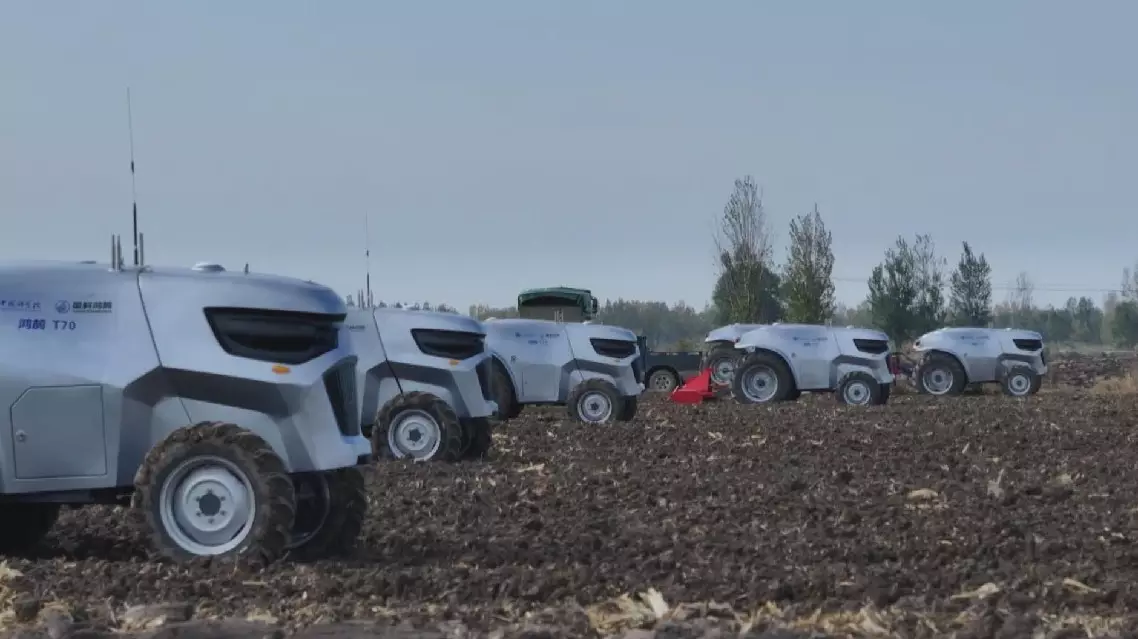
In Xiong'an New Area, Hebei Province, a smart farm called Fuxi Farmland has been implemented in various cities across China.

Utilizing big data and artificial intelligence (AI), engineers can manage grain planting by controlling remote unmanned machines from a control center located 20 kilometers away, while accessing real-time information about crops through a large monitoring screen.

"The smart agricultural machines are equipped with various intelligent control systems. Following the pre-set routes, they can operate accurately according to our pathways, with support from the BeiDou Navigation Satellite System, all initiated through an app on a mobile phone or smart terminal," said Bi Zhiqiang, an engineer at the Institute of Computing Technology, Chinese Academy of Sciences.

Besides serving sowing and planting links, smart equipment also enhances breeding efficiency by creating models based on big data to optimize processes. To date, Fuxi Farm has been established in several provinces, facilitated by the deepening integration of technologies such as the Internet of Things and AI with agriculture.
China raises seven major tasks to develop smart agriculture

China raises seven major tasks to develop smart agriculture

China is willing to open its original technologies to the whole world and share the fruits of innovation with all people, Foreign Ministry spokesman Lin Jian said Friday at a press conference in Beijing.

Lin noted that innovation has become a keyword for China's economic and social development.

The Recommendations of the Central Committee of the Communist Party of China (CPC) for Formulating the 15th Five-Year Plan for National Economic and Social Development adopted in October 2025 mentioned "innovation" 61 times, Lin said.

In recent years, according to the spokesman, China has seen major sci-tech achievements emerge thick and fast, and its global innovation index ranking has risen from 34th in 2012 to 10th in 2025.

"China has long regarded science and technology as the primary productive force. Through strengthened conceptual guidance, policy direction and institutional reforms, it has effectively leveraged its market and talent advantages, enabling enterprises to become the main actors of innovation. Through persistent and long-term efforts, China has forged a successful path with technological innovation leading industrial innovation, and industrial upgrading, in turn, promoting technological iteration. This has made innovation a fundamental driving force behind China's economic development," said Lin.

Lin said while competition may accompany the process of innovation, it is by no means the goal of innovation.

"China's innovation is notably open and open-source, in pursuit of mutual benefit and win-win outcomes. China's space station has attracted the participation of 23 institutions from 17 countries for its first batch of cooperation projects. China's FAST (Five-hundred-meter Aperture Spherical Radio Telescope) is open to observation applications from scientists worldwide. China has initiated the establishment of a global artificial intelligence (AI) cooperation organization and proposed the AI+ International Cooperation Initiative, and is committed to promoting open, inclusive, and beneficial AI development for all. DeepSeek is open to global developers in an open-source manner for use and improvement. These are just a few examples among many," Lin said.

"China is willing to share original technologies and innovation scenarios with the world. Through open cooperation, it aims for mutual empowerment and common growth, ensuring that the fruits of innovation better benefit all humanity," he said.

China willing to open its original technologies to world: FM spokesman

China willing to open its original technologies to world: FM spokesman

Recommended Articles