
Skip to Content Facebook Feature Image

Lee Maniscalco, CEO of Haymarket Media, Inc. Announces Coming Leadership Transition

News

Lee Maniscalco, CEO of Haymarket Media, Inc. Announces Coming Leadership Transition
News

News

Lee Maniscalco, CEO of Haymarket Media, Inc. Announces Coming Leadership Transition

2024-11-05 01:13 Last Updated At:01:20

NEW YORK--(BUSINESS WIRE)--Nov 4, 2024--

After 14 years as Chief Executive Officer of Haymarket Media, Inc., Lee Maniscalco will be stepping away from that role within the next year and taking on a new set of responsibilities with the company.

This press release features multimedia. View the full release here: https://www.businesswire.com/news/home/20241104210328/en/

He will remain CEO through the end of June 2025 and will then stay on as a corporate non-executive Board member and strategic advisor. Haymarket has retained an executive recruitment firm to conduct a search for his replacement.

Maniscalco, who joined Haymarket in 2001 to head up a fledgling medical publication business, has led the organization through an era of significant growth and transformation. Over the past two and a half decades, annual revenues for the New York City-based operation have grown from $15 million to $130 million. A company that had 30 employees at the turn of the 21st century has 430 today.

“It has been a privilege and an honor to have an opportunity to lead this company, and I am grateful to all of you for helping to make Haymarket Media what it is today,” Maniscalco said in an email to employees, followed by a Town Hall meeting. “Together we have built a dynamic, ambitious and highly successful business with a welcoming, energizing culture that values imaginative thinking and collaborative work.”

Haymarket Media, Inc. is home to more than 30 leading brands in health care, medical education, business marketing & communications, and elder care, including Haymarket Medical Education, Medical Professionals Reference (MPR), Medical Marketing and Media (MM+M), PRWeek and McKnight’s Long-Term Care News.

Kevin Costello, Global Chief Executive at Haymarket Media Group, said: "I want to thank Lee for his incredible 25 years with Haymarket, 14 of them as CEO of our US operations, leaving a profound legacy. Under his leadership, Haymarket Media has transformed into a remarkable, hugely reputable business, trusted and valued by our clients, audiences and partners, who love our content for its specialized information and expert insight.”

Lord Michael Heseltine, who founded Haymarket in the UK in 1957, added, “Lee will have his name in lights when the history of Haymarket is written. He has been central to the creation of what is virtually half the company. He has brought experience, energy, vision and a sense of quality to the task. I am so glad he will remain associated with the company built on the foundations he laid.”

Maniscalco cited a number of milestones in Haymarket’s progress:

“We have embraced the digital revolution and built a robust, web-savvy, multi-platform technological capability,” Maniscalco noted. “We introduced Haylo, a platform to put the power of data to work across the organization. And we expanded our traditional publication businesses with industry-leading live and virtual events, conferences and awards programs. Along the way, we’ve consistently won national awards for editorial and design excellence.”

“Many of you joined me early on, having faith and confidence in a pioneering venture. Regardless of how long you have been with us, each and every one of you has contributed significantly to our success. The journey would not have been possible without a total team effort,” Maniscalco said.

Costello added, “I am deeply grateful to Lee for his achievements and dedication to our business and to have had the pleasure of working with him for all these years. His contributions have set the course for continued success, and I am pleased to say it's not goodbye as I look forward to his ongoing influence and expertise.”

Maniscalco expressed his gratitude to the founders and leaders of the global parent company. “We have a strong organization dedicated to an equally strong set of values,” Maniscalco said. “I am proud of our accomplishments and ready for a new chapter. Haymarket is robust and healthy and poised to continue on its impressive growth trajectory.”

Maniscalco’s career also includes 17 years with Thomson Medical Economics, primarily in executive positions.

About Haymarket Media Inc.(US)

Haymarket Media, Inc. is an award-winning specialist content and information company. With more than 30 market-leading media brands, Haymarket offers unmatched expertise and insight through balanced, relevant, original content across a spectrum of media channels. Haymarket is home to highly regarded health care professional brands such as The Clinical Advisor, Dermatology Advisor, and MPR (Medical Professionals Reference) among a portfolio of HCP-focused, specialty-specific websites, as well as the esteemed business media titles including PRWeek, MM+M (Medical Marketing and Media), Campaign and McKnight’s Long-Term Care News.

Haymarket Media, Inc. is the US division of Haymarket Media Group. Haymarket Media Group is a privately-owned media, data and information company, shaping a better future with remarkable content for specialist audiences across the world. The company has 1,300 employees across offices in the UK, US, Canada, Hong Kong, Singapore, India, Germany and the Netherlands. Haymarket’s portfolio consists of more than 70 market-leading brands including Campaign, Third Sector, What Car?, MyCME and Asian Investor. Through live, digital, print, education, data, tech services, video and audio, Haymarket’s brands inspire, inform and empower clients and communities internationally.

Lee Maniscalco (Photo: Business Wire)

Lee Maniscalco (Photo: Business Wire)

SAN FRANCISCO (AP) — Wildlife crews are no longer actively searching for two juvenile gray wolves who were part of a pack that killed dozens of cows and calves last summer in Northern California’s Sierra Valley, an official said Tuesday.

The two wolves were members of the Beyem Seyo pack that in 2025 killed or injured at least 92 calves and cows in a seven-month period, according to a report released last week by two researchers with the University of California, Davis.

Wolves in the state are protected under California law and the federal Endangered Species Act. Under former President Joe Biden, officials said they planned a first-ever national recovery plan for wolves, but President Donald Trump’s administration ended that initiative in November.

In October, the California Department of Fish and Wildlife announced it had euthanized four gray wolves — three adults and a juvenile — from the Beyem Seyo pack after “an unprecedented level of livestock attacks across the Sierra Valley” by a single wolf pack since the canids returned to the state. It also said it planned to capture and relocate the remaining two wolves to wildlife facilities to prevent their behavior from spreading to other wolves in California.

Gray wolves primarily prey on wild animals like deer and elk, not livestock, but the pack became used to killing cows and calves, the department said.

“These wolves had become habituated to preying on cattle, a feeding pattern that persisted and was being taught to their offspring which would leave to form their own packs and could teach them the same cattle-preying behavior,” the department said at the time.

But following weeks of searching for the remaining two wolves, officials have “reduced efforts to capture” them, Katie Talbot, CDFW Deputy Director of Public Affairs, said in a statement.

“Despite best efforts from CDFW’s expert wolf biologists and law enforcement officers, we have not been able to find or get close enough to these young wolves to safely capture them,” Talbot said.

“We remain hopeful our continued remote monitoring will allow for sightings that will lead to safe capture of these juveniles,” she added.

Talbot said that CDFW crews will be working this week on capturing wolves and collaring them throughout the state, including in the Sierra Valley.

Wildlife officials tried for months to prevent the pack from attacking farm animals by using drones, nonlethal bean bags, installing flags or rope to deter them and having officers in the field 24 hours a day, seven days a week, but their efforts failed.

“The efforts that the (CDFW) made were tremendous and heroic but it was too late,” said Amaroq Weiss, senior wolf advocate for the Center for Biological Diversity.

She said that cattle ranchers in the area should have been taking proactive prevention measures for years, including increased human presence around the cattle, keeping the livestock bunched up instead of letting them loose on large grazing pastures, and calving at the same time of year that deer and elk are birthing so wolves have a source of wild prey.

“Ranchers in California have been on notice that wolves were coming since late December 2011, when we got our first wolf. They have been on notice they would establish packs since 2015,” when the first pack was confirmed in Siskiyou County, Weiss said.

Gray wolves were eradicated in California early in the last century because of their perceived threat to livestock, with the last known native wolf killed in 1924 in Lassen County. Since their reintroduction in Idaho and at Yellowstone National Park in the mid-1990s, they’ve proliferated throughout the West. The recovering population has meant increasing conflict with ranchers.

“It was a horrible summer here for everybody and the emotional strain was probably worse than the financial strain for most people. They did the right thing. We couldn’t go on living the way we were living,” said Rick Roberti, a cattle rancher in Plumas County and president of the California Cattlemen’s Association, who lost several animals.

Economist Tina Saitone and researcher Tracy Schohr said in UC Davis’ quarterly agricultural economics update released Friday that the Beyem Seyo pack killed more livestock than the entire wolf population of Montana killed in 2024 and the killings of farm animals by the wolves in Wyoming in 2023.

In Montana, the state’s 1,100 wolves killed 54 domestic animals in 2024, and Wyoming’s 352 wolves killed 49 livestock in 2023, the scientists said.

In California, about 70 gray wolves were responsible for 175 livestock kills between January and October of last year, with the Beyem Seyo pack responsible for half the killings, according to CDFW data.

Roberti said the attacks on livestock in Plumas and Sierra counties left many ranchers angry. He said he would like to see certain areas in the state declared “special zones” where people are allowed to hunt wolves that attack livestock.

“We’re pretty much in unison about thinking that it would help if we started taking out the ones that are just killing cattle and are too habituated to man or they’re not afraid of us,” he said.

The predators are a long way from recovery, Weiss said, adding that killing them is not a long-term solution.

“The scientific literature is pretty conclusory that killing wolves to resolve conflicts with livestock is not a solution. It can actually be counterproductive. It can result in there being more conflicts with livestock,” she said.

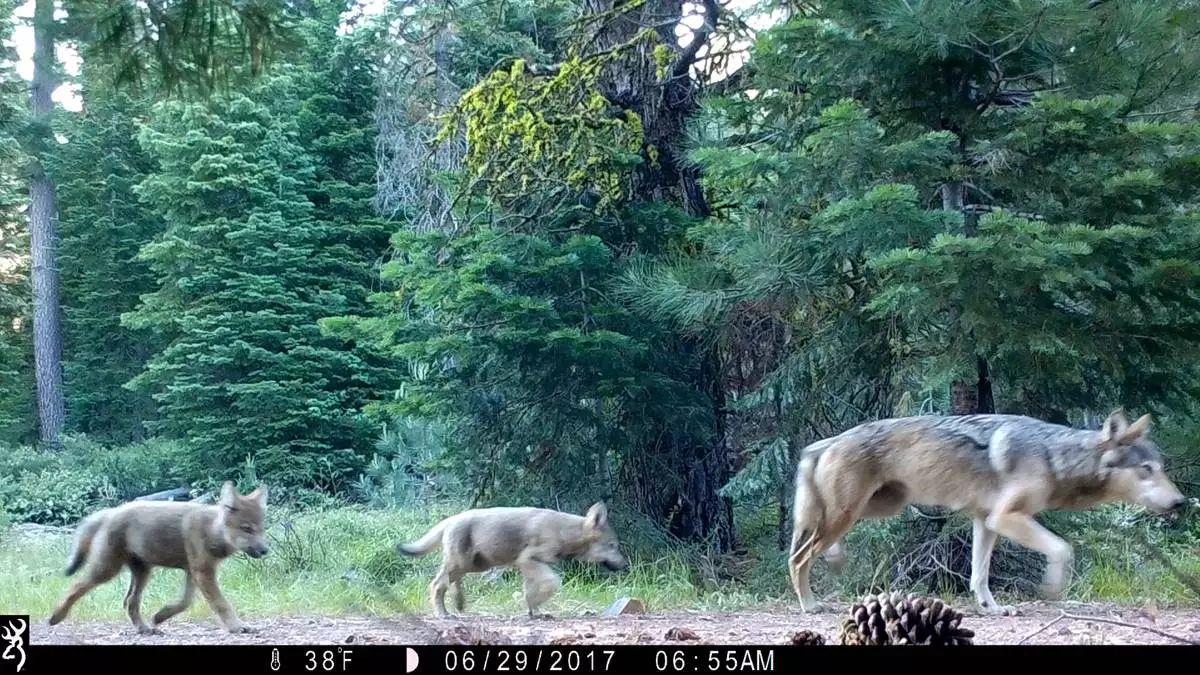
FILE - This remote camera image provided by the U.S. Forest Service shows a female gray wolf and two of the three pups born in 2017 in the wilds of Lassen National Forest in northern California on June 29, 2017. (U.S. Forest Service via AP, File)

FILE - This remote camera image provided by the U.S. Forest Service shows a female gray wolf and two of the three pups born in 2017 in the wilds of Lassen National Forest in northern California on June 29, 2017. (U.S. Forest Service via AP, File)

Recommended Articles