Remark: The following article was written on October 13, 2024 11:51
Sebastien Lai, the son of Lai Chee-ying, founder of Next Digital, recently visited the UK to meet with UK officials, hoping to raise his father's case with the British Foreign Secretary before the latter's upcoming visit to China.
On Friday, October 11th, Sebastien Lai attended a “Reporters Without Borders” event in London and revealed that the British Foreign Secretary, David Lammy, did not meet with him. He only met with Catherine West, Under-Secretary of State at the Foreign Office, on Tuesday.
According to a Reuters report on Wednesday, David Lammy will visit China next week in an attempt to reset UK-China relations.
Caoilfhionn Gallagher KC, the British barrister leading Lai’s so-called “overseas legal team”, stated that the British government should make Lai's release a condition for renegotiating relations with the Chinese government.
Informed sources suggest that if the British government makes Lai's release a prerequisite, restarting UK-China relations would be impossible. David Lammy's avoidance of Sebastien Lai indicates an unwillingness to jeopardize these relations. It is estimated that during his visit to China, David Lammy will, at most, routinely mention Lai's case as a formality, without pursuing any concrete results.
Furthermore, in an interview with the Voice of America (VOA), Sebastien Lai reiterated the claim that his father is unable to receive Holy Communion in prison. He told VOA that he believes this is a form of mental torture, as Lai has been in solitary confinement for nearly four years, and religion is important to him. He expressed sadness at his father's inability to receive Communion and considered it as absurd.
The origin of this rumor stems from the recent actions of “Hong Kong Watch”, closely associated with Lai, and his “overseas legal team”. They have been heavily publicizing claims that Lai is being subjected to solitary confinement and denied human rights, including the right to receive Holy Communion. Lai's “overseas legal team” even filed an urgent appeal with the UN Special Rapporteur on Torture, creating a “prisoner abuse” incident in Hong Kong.
There were questions about whether the situation in Hong Kong was truly that exaggerated, and whether prisoners in Hong Kong were so deprived of their human rights. It was learned that it was Lai himself who requested solitary confinement and also decided not to receive Holy Communion.
The Correctional Services Department (CSD) was contacted about the rumors, including whether Lai had requested solitary confinement and indicated his intention not to receive Holy Communion. Confirmation was sought from the CSD on whether Lai had made these requests.
CSD responded that it handles the custodial arrangements for persons in custody in accordance with the Prisons Ordinance, relevant laws, and established mechanisms. If a person in custody requests for protection and wishes to be removed from association with other inmates, and CSD considers that there are reasonable grounds for believing it is desirable to do so for the maintenance of good order or discipline, or in the interests of the prisoner, the institution management will make appropriate arrangements accordingly. In addition, if a person in custody wishes to receive religious services, including worship and Holy Communion, they can make arrangements through chaplains of CSD. Conversely, if an inmate chooses not to receive Holy Communion, the CSD will respect their wishes. The CSD stated that it has handled Lai's case in accordance with the aforementioned mechanisms.
The CSD's response is sufficiently clear that it refers to Lai, confirming that they arranged solitary confinement for Lai based on his own request. Regarding the Holy Communion, the CSD also acted according to Lai's will.
Following the CSD's response, Robertsons, the law firm representing Lai in the national security case, issued a statement clarifying that Lai is receiving appropriate treatment in prison. They stated that Lai is aware he is able to receive Holy Communion through special arrangements with the CSD, requiring a priest to hold a Mass specifically for him. Due to the inconvenience of this arrangement, he has not yet made such a request.
This statement from Robertsons confirms that Lai is not being mistreated and has not requested to receive Holy Communion.
However, Sebastien Lai and Hong Kong Watch continue to ignore this clarification, propagating the narrative in the UK that the denial of Communion is a form of mental torture. VOA also continues to report this false information.
Informed sources suggest that Robertsons felt compelled to issue a clarification because if Lai knowingly spreads misinformation, it could not only be considered criminal libel but also detrimental to his case. This effectively distances Lai from these false allegations of mistreatment.
However, Lai's son and organizations like the Hong Kong Watch continue to spread the false narrative of Lai being forced into solitary confinement and denied Holy Communion, creating a false impression of prisoner abuse in Hong Kong. The continued dissemination of such misinformation by VOA raises serious questions about its journalistic ethics.
Ariel
** 博客文章文責自負,不代表本公司立場 **
History was made in global finance this week. Boston Consulting Group (BCG) released its 2026 Global Wealth Report on Wednesday (27 May), revealing that Hong Kong's cross-border wealth management assets reached US$2.95 trillion — a 10.7% year-on-year surge. That figure edged past Switzerland's US$2.94 trillion by roughly US$10 billion, making Hong Kong the world's largest cross-border wealth management center for the first time.
The milestone triggered a global media storm. More than 600 overseas reports followed the release, with the Associated Press, the Financial Times, Bloomberg, Reuters, and Canada's National Post all turning their focus to this defining shift in the global wealth management landscape.
Hong Kong's lead over Switzerland is slim — but the growth gap is not. Bloomberg noted that Hong Kong overtook Switzerland by a narrow margin, driven by an influx of capital from the Chinese Mainland and a rebound in Hong Kong's local stock market. What matters far more, though, is trajectory: BCG projects that cross-border wealth managed in Hong Kong will grow at roughly 9% per year between 2025 and 2030, compared to only about 6% for Switzerland.
Bloomberg goes further. By 2030, the gap in assets under management between the two centers is forecast to widen to nearly US$600 billion. Today's slim lead is not a finish line — it is the opening lap of a far larger structural shift.
Two core drivers explain Hong Kong's rise. The Financial Times focused on the diversification appetite of wealthy investors from the Chinese Mainland. Post-pandemic, investors sought to spread assets across jurisdictions to hedge against geopolitical risk — and a surge of that capital flowed into Hong Kong, helping it topple Switzerland's long-standing status as the traditional safe haven.
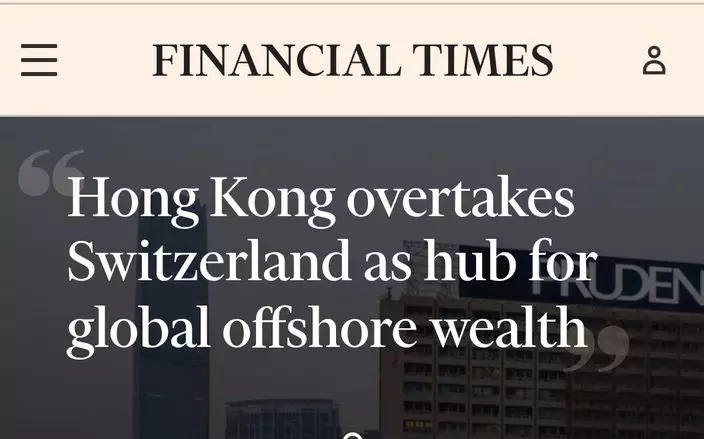
Financial Times coverage of the report.
Reuters added the numbers: wealth from China and a boom in IPOs in 2025 drove Hong Kong's cross-border assets to US$2.95 trillion.
BCG report co-author Michael Kahlich cuts to the structural point. "What ultimately matters is client proximity," he said. His view: two hubs are now forming in global wealth management — Singapore and Hong Kong serving Asia, and Switzerland, the United Kingdom, and the United States serving the West. Hong Kong's rise, in other words, is not simply about beating Switzerland. It reflects a structural migration of the global wealth management center of gravity towards Asia — a shift BCG describes as "unlikely to be reversed."
This development has prompted deep soul-searching in Switzerland. The FT quoted a UBS banker based in Zurich who questioned whether Switzerland had done enough to actively defend its position in wealth management — or had simply been coasting on the strength of its stable environment. Reuters noted that while Switzerland's growth rate is slower, its client base is more diversified, spanning regions across the globe. That breadth could prove a resilience advantage, whereas Asia's hubs remain heavily reliant on growth from the Chinese market.
BCG acknowledges that Switzerland retains unique value in navigating geopolitical uncertainty — particularly in attracting safe-haven flows amid ongoing instability in the Middle East. Yet BCG's own projections expose a key tension: diversification may bring stability, but against the backdrop of Asian wealth growing at roughly 9% per year, Switzerland risks a continued relative decline if it does not actively adapt.
Across international media coverage, one competitive advantage of Hong Kong was repeatedly emphasized — its connectivity function under "One Country, Two Systems." The Associated Press highlighted how Hong Kong's close ties with the Mainland market have driven its wealth management business. Reuters likewise noted that Hong Kong "is cementing its role as China's gateway to global markets."
This is more than a geopolitical dividend — it reflects deliberate policy work. Hong Kong issued a family office policy statement in 2023, followed by tax incentives and the New Capital Investment Entrant Scheme. Financial Secretary Paul Chan Mo-po stated after the report's release that Hong Kong's free, open, transparent, and predictable economic policies — alongside a stable and secure investment environment — are attracting a growing number of ultra-high-net-worth individuals and family offices to set up in the city. By end-2025, more than 3,380 single-family offices were operating in Hong Kong, up more than 25% from two years prior.
A slim lead is a warning signal as much as a trophy. The Hong Kong Economic Journal editorial noted that while Hong Kong surpassing Switzerland is a testament to the advantages of "One Country, Two Systems," Singapore is closing the gap at an annual growth rate of 10.3%, and Switzerland still holds the resilience of a diversified client base. Whether Hong Kong can sustain its position depends on its ability to broaden its global client base while consolidating its role as China's gateway.
A century-old wealth management order is witnessing a profound "East rising, West declining" moment. Hong Kong's displacement of Switzerland with US$2.95 trillion in cross-border wealth management assets is not merely a triumph for one city — it is a reflection of a shifting tide in the direction of global capital flows.
Yet, the real contest is not today's margin; it is the gap in growth rates that will decide the winner over the coming decade. As BCG put it, the future of wealth management centers is not about who offers the best safe haven — it is about who can stay closest to clients. And Asia is rapidly becoming the place where those clients are.