The stunning beauty of Laji Mountain in northwest China's Qinghai Province has attracted a growing number of visitors with its breathtaking sunrise, snow-capped peaks and sea of clouds, ushering in a boom in winter tourism.
Tourists usually departed at early hours in a day and drove along the mountain road from the foot of the mountain towards the Laqi Mountain Pass viewing platform.
Cars were already lined up in a long queue just two or three kilometers from the destination.
On the viewing promenade, many tourists took out their phones and cameras, ready to capture the most beautiful moment of the sunrise.
Laji Mountain, located in Guide County, Hainan Tibetan Autonomous Prefecture, the eastern part of Qinghai Province, marks the boundary between the Loess Plateau and the Qinghai-Tibet Plateau. With an elevation ranging from 3,500 to 4,000 meters, its unique altitude and geographical position create the majestic and spectacular landscapes in Laji Mountain.
"The majority of visitors to Laji Mountain are students from within Qinghai Province, as well as self-driving tourists from nearby provinces. On average, about 1,000 tourists visit the mountain daily to watch the sunrise, enjoy the sea of clouds, and admire the snow-capped peaks. Since the end of October this year, the total number of visitors has reached approximately 20,000," said Wu Yan, deputy director of Tourism Development Management Committee of Guide County.
The best spot to watch the sunrise at Laji Mountain is a viewing platform located at the mountain pass.
Visitors typically need to set out around 04:00, driving along a winding mountain road for about 30 minutes to reach the platform.
On both sides of the winding road, three to four kilometers before and after the platform, tourists' vehicles are parked along the way, causing traffic congestion and posing potential safety hazards.
"We have organized three teams - our traffic police, the traffic patrol team, and the local police station - to begin patrolling every morning at 04:30. These teams work together to ensure the smooth flow of traffic on the road and to guarantee the safety of parking for the visitors," said Kong Deyan, deputy head of traffic police brigade, Guide County’s Public Security Bureau.

Laji Mountain attracts streams of tourists with breathtaking sunrise
China unveiled a large wind-assisted propulsion system for ships in the coastal city of Dalian, northeast China's Liaoning Province, on Friday, marking a major leap forward for the country in the field of high-end vessel marine environmental protection equipment.
The wind-assisted propulsion system - rotating sail system (WAPS-RSS), is developed by Luoyang Ship Material Research Institute of China State Shipbuilding Corporation Limited (CSSC).
The system's rotor has diameter of 5 meters, is 35 meters high, and weighs 150 tons.
Experts say that the system can efficiently capture wind energy while the ship is sailing, providing additional thrust for the vessel.
On average, it can save fuel consumption by 5 to 25 percent for large ocean-going vessels, and lower carbon emissions accordingly.
It relies on the Magnus effect, which is much like a loop in table tennis, featuring a rapidly spinning sphere that causes the surrounding air to rotate. Pressure decreases on the side with faster airflow and increases on the side with slower airflow, creating a lateral pressure difference that generates lateral thrust.
"Standing on the deck, the powerful thrust generated by its rotation assists the ship's sailing. Our system - the world's largest rotary sail - reaches a maximum rotational speed of 180 revolutions per minute and can generate a maximum of 355 kilonewtons of thrust. Additionally, the system's intelligent control integrates multiple sensors to detect real-time wind and ship conditions. Through smart algorithms, it automatically adjusts to maintain optimal performance at all times, maximizing the utilization of wind energy," said Guo Yu, vice president of SunRui Marine Environment Engineering Company Limited under Luoyang Ship Material Research Institute.
Not only does the system's performance meet international advanced standards, but the project team has also overcome a series of engineering challenges, including the fabrication of giant composite structures, complex system integration, and intelligent coordinated control.
Compared with mainstream international technological approaches, it offers greater production efficiency and cost advantages.
Currently, the system has secured its first batch of orders and will complete actual vessel applications as scheduled.
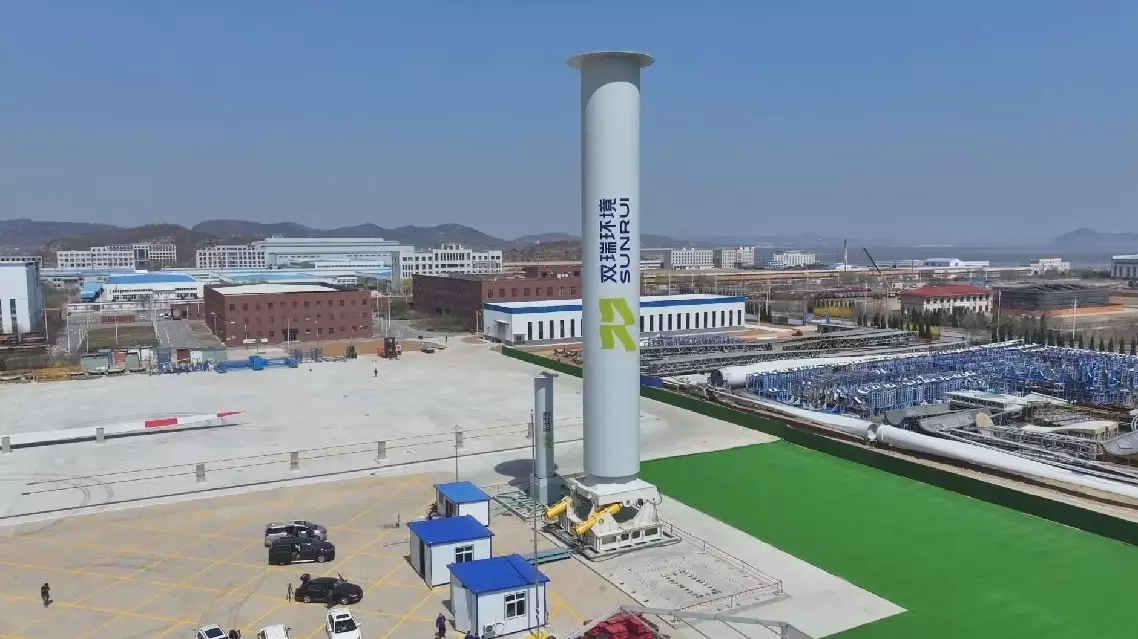
China unveils large wind-assisted propulsion system for ships