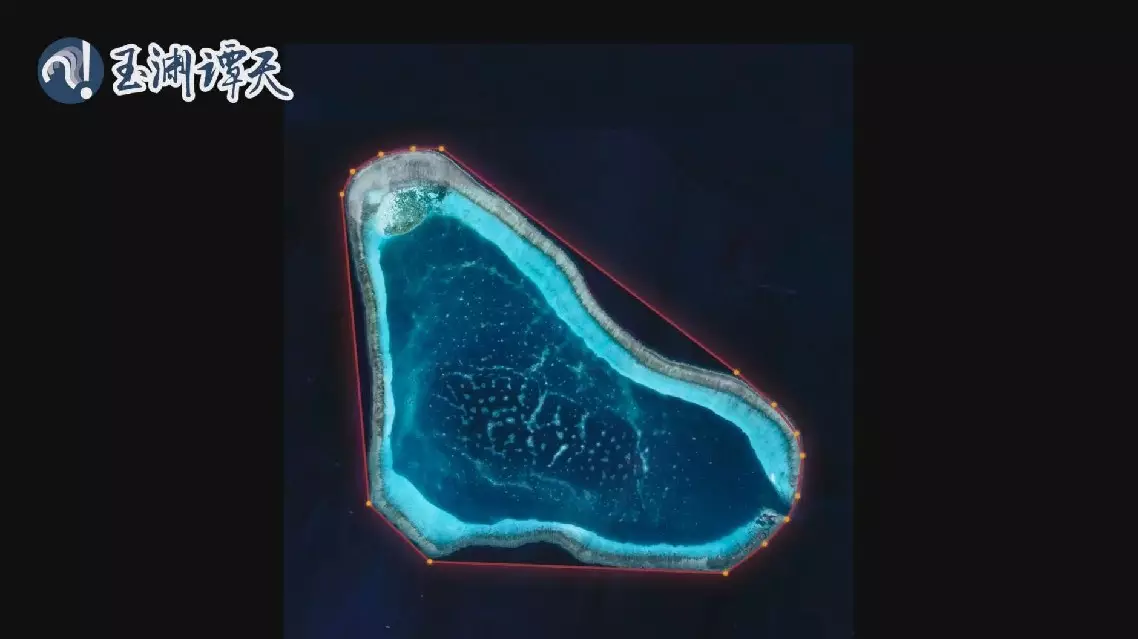
China's release of baselines for the territorial sea adjacent to Huangyan Dao (Huangyan Island) on Sunday has seriously countered infringement actions by the Philippines, said a military law expert Monday.
In an exclusive interview with Yuyuantantian, a social media account affiliated with China Media Group, Chai Lidan explained the legal basis for China's pursuit of its maritime rights and interests and refuted the Philippine unscrupulous move.
The full text of Chai's commentary is as follows:
"Yesterday, China announced the baselines for the territorial sea adjacent to Huangyan Dao, which not only further clarified China's claims regarding maritime rights and interests in the South China Sea, but also responded with a counterattack on the Philippines.
On Friday, the so-called 'Maritime Zones Act' and 'Archipelagic Sea Lanes Act' were signed into law by Philippine President Ferdinand Marcos Jr. It stands to reason that every country has the right to formulate its own domestic laws. But the legislation of the Philippines has seriously infringed on China's territorial sovereignty and maritime rights and interests. To put it simply, these two ‘acts’ are used by the Philippine government as a cover for its illegal claims under the guise of 'domestic legislation'.
The so-called 'Maritime Zones Act', based on the illegal award of the South China Sea arbitration, is a direct violation of China's territorial sovereignty and maritime rights and interests in the South China Sea in disguise. The illegal award of the South China Sea arbitration attempted to include China's Huangyan Dao and most of China's Nansha Qundao and its adjacent maritime areas into the Philippines’ marine area. However, the award was an international arbitration initiated unilaterally by the Philippines without the consent of the Chinese government. The arbitral tribunal overstepped its jurisdiction and made an award in violation of the law, which is illegal, null and void. Naturally, China does not accept or recognize the award, nor will it accept any claims or actions based on the award.
In addition, the Philippines claimed that some islands and reefs of China's Nansha Qundao are artificial islands in the so-called South China Sea arbitration, and 'all artificial islands constructed within the Philippine exclusive economic zone shall belong to the Philippine government' in the so-called 'Maritime Zones Act'. In such a way, the Philippines forcibly listed some of China's islands and reefs including the Meiji Jiao as its own resources and attempted to challenge China's claims of sovereignty over the above-mentioned islands and reefs. It is an abuse of 'exclusive economic zone' concept regulated in the United Nations Convention on the Law of the Sea.
In fact, the territory of the Philippines is defined by a series of international treaties. Both the Huangyan Dao and Nansha Qundao are beyond the limits of the Philippine territory. It is daring of the Philippines to try to steal China's territory in the South China Sea with just one domestic law.
As for another act, The 'Archipelagic Sea Lanes Act' which only sets out three sea lanes does not fulfill the obligations of the Convention on archipelago states to open all normal passages through archipelagic waters and detracting the freedom of navigation rights that other countries should enjoy.
In fact, the Philippines has been infringing on China's territorial sovereignty and maritime rights and interests in the South China Sea through various means. The Philippines' move of enacting the so-called 'Maritime Zones Act' and the 'Archipelagic Sea Lanes Act' not only failed to fulfill the obligations that an archipelagic country is asked to, but also violated China's legitimate rights and interests in the South China Sea. This time, China will pursue the matter stirred up by the Philippines, which abuses the law and plays the 'legal card' randomly in the international community, to the end in every way."
China reacts to new Philippine maritime laws by releasing baselines for Huangyan Dao: expert