China's Tianzhou-8 cargo spacecraft brought over 80 products for 36 scientific experiments to the orbiting Tiangong space station to support subsequent space science projects and application tests.
The payload for experimental use, weighing around 460 kg, includes 18 cargo bags and one set of cell life support device, covering experimental units and samples and other support materials.
"The 36 scientific experiments to be conduced during the Shenzhou-19 mission cover fields such as life science, fluid dynamics, combustion, and materials science, with a special focus on life science experiments. We will also bring fruit fly and mouse embryo. It will develop for 7.5 days, which corresponds to the developmental process of a long-term embryo after implantation. In fact, we hope to provide theoretical basis and pave the way for the long-term survival and reproduction of humanity in space," said Zhang Wei, researcher at the Technology and Engineering Center for Space Utilization of the Chinese Academy of Sciences.
In terms of space materials science, the Shenzhou-19 crew will conduct over 10 experiments via the container-free materials lab cabinet and the high-temperature material science lab cabinet. In addition, research on protective materials for thin-film solar cells will be carried out using the extravehicular exposure platform.
For the first time, a brick made of synthetic lunar soil will be brought aboard the space station and subject to an exposure experiment to test whether it could be used to construct buildings on the moon. It is expected that the lunar soil brick will be returned to Earth by the end of next year, following the experiment.
"What we are most concerned with are: first, its mechanical properties, as they are most closely related to building structures; second, its thermal properties, particularly how well it performs in terms of insulation and heat resistance; third, the impact of radiation on it. We want to know if these lunar bricks can withstand the exposure to cosmic radiation," said Zhou Cheng, professor, National Center of Technology Innovation for Digital Construction, Huazhong University of Science and Technology.
Astronauts will also test the space application of latest technologies. That includes in-orbit verification of the adjustable radiation resistance of new-type storage chips.
China launched the cargo craft Tianzhou-8 from the Wenchang Satellite Launch Center on Friday night to deliver supplies for its orbiting Tiangong space station.
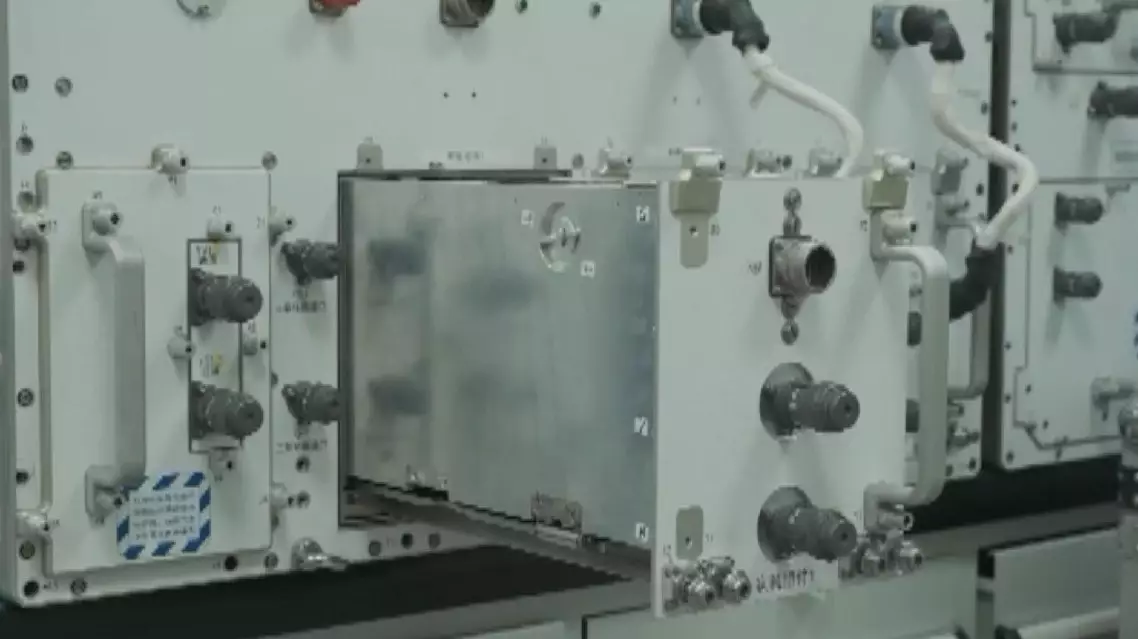
Tianzhou-8 cargo spacecraft sends over 80 experimental items into space