The week-long 15th China International Aviation and Aerospace Exhibition, which ends in Zhuhai City of south China's Guangdong Province on Sunday, has seen a notable increase in the number of international exhibitors, with many using the event as a launchpad to showcase their new technologies and expand their presence in China's rapidly growing aviation market.
The number of overseas exhibitors at this year's airshow, held from Nov 12 to 17 in Zhuhai, a coastal city in Guangdong Province, increased by 104 percent compared to the previous edition. A total of 1,022 companies from 47 countries and regions showcased cutting-edge innovations across various aviation sectors, from aircraft to engines.
"Zhuhai [Airshow] is an airshow like the big other European ones, which I happen to know. We're using Zhuhai Airshow to sign contracts. We have signed a variety of supplier contracts and we also use it to promote our business," said Erik Buschmann, Chief Operating Officer of Airbus's China branch.
The airshow, also known as Zhuhai Airshow, also featured exhibitors from the just-concluded 7th China International Import Expo (CIIE), held from Nov 5 to 10 in Shanghai, offering new opportunities for participants to grow their businesses in China's expansive market, with GE Aerospace being a prime example.
"We've secured orders at both the CIIE and the Zhuhai Airshow. At the CIIE, we signed deals worth 2.2 billion U.S. dollars with multiple airlines, and at this airshow, we're set to close contracts totaling 1.9 billion U.S. dollars," said Guo Xinyang, an exhibitor of the GE Aerospace.
Industry leaders highlighted the immense potential of China's aviation market, which continues to offer significant opportunities for international companies. They also expressed eagerness to deepen their involvement in China's rapidly expanding aerospace and aviation sectors.
"The China aerospace market for us is fascinating. And to open up and welcome suppliers and partners from other parts of the world is very important for us," said an exhibitor.
"The policies of China for aviation and aerospace became [have become] more open for [companies], [which] means more business for companies," said a staff member of the China-Italy Chamber of Commerce.
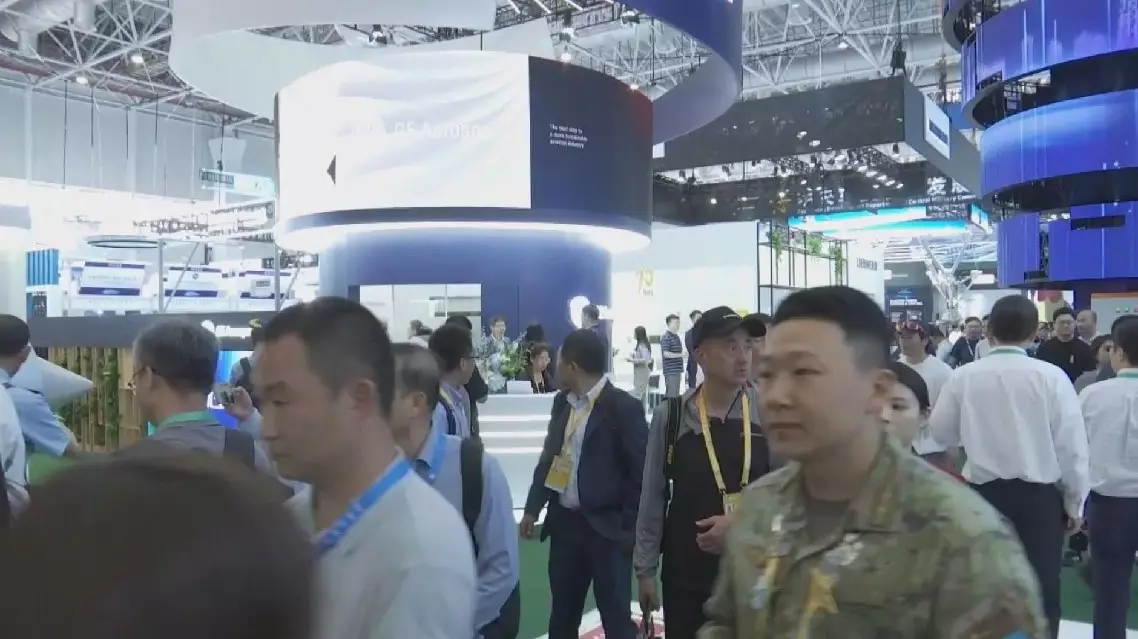
Rising number of international exhibitors seize immense opportunities at Airshow China
Cities across China are experiencing a significant tourism boom as the three-day Qingming Festival holiday coincides with the first-ever student spring breaks in multiple cities, creating an extended travel period for many families.
Qingming Festival, or Tomb-Sweeping Day, falls on April 5 this year. It is a traditional Chinese festival for honoring the deceased and paying tribute to ancestors. The holiday also provides a short break for Chinese citizens as they engage in outdoor activities and sightseeing. The Qingming Festival holiday will last from April 4 to 6.
In addition, primary and secondary school students in several regions are going to enjoy their first-ever spring break to head beyond the classroom for travel and engaging in a wide range of activities. In some areas, the spring break takes place just before the three-day Qingming Festival in early April, while in others it extends into the five-day May Day holiday, allowing students to combine leave into six- to eight-day mini-breaks.
With spring in full bloom, many families are venturing into nature to enjoy the spring scenery and experience the spring atmosphere in mountains and fields.
At Maoshan Forest World, a scenic spot in Changzhou, east China's Jiangsu, families from surrounding cities such as Nanjing, Nantong, and Zhenjiang are coming in groups. They interacted with adorable animals and experienced digging for bamboo shoots. Under the guidance of the staff, children identified and dug bamboo shoots, experiencing the joyful moments of labor.
"I want my child to get closer to nature, feel the breath of spring, and experience the joy of labor," said Deng Jie, a tourist.
During the holiday, traveling to famous destinations featured in textbooks has become a popular choice for many families.
In east China's Zhejiang Province, several scenic spots have introduced free admission for primary and secondary school students. At the Yanguan Ancient Town in Haining, many students can experience the spectacular sight of magnificent tidal waves of Qiantang River described in textbook.
"We just rode a bamboo raft and are going to watch the Qiantang River tidal bore tomorrow," said Zhao Ziyu, a tourist.
Integrating educational content with holiday vibes, study tours remain popular during the holiday.
At the Wujiangzhai Scenic Spot in Zunyi, southwest China's Guizhou Province, after watching an ethnic performance, many young visitors went to a lantern shop to experience making intangible cultural heritage lanterns. From constructing bamboo frames to pasting paper and coloring, a teacher guided them step by step, and the visitors incorporated the scenic area's landscapes and their own life expectations into their creations.
In Liangdancheng (city of nuclear bombs), the site where China's first atomic and hydrogen bombs were designed, in Zitong County of Mianyang, southwest China's Sichuan Province, a large number of students visited the local aerospace science and technology museum. In the interactive experience area, students operated simulated spaceflight equipment, acting as little astronauts exploring a virtual universe. By wearing Mixed Reality (MR) glasses, they can observe the mysteries of planets up close.
Spring break coincides with Qingming holiday, fueling tourism boom across China