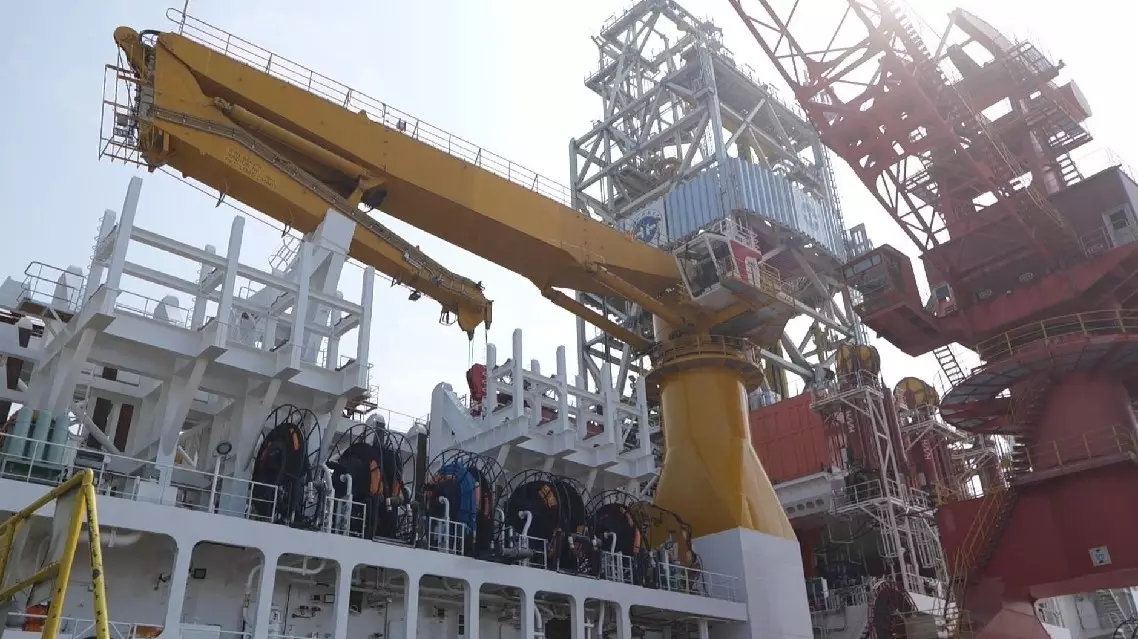
China's newly-commissioned deep-ocean drilling vessel, Meng Xiang, is set to push the boundaries of scientific exploration into the deeper ocean with a maximum drilling depth of 11 kilometers.
As China's first homegrown deep-sea drilling vessel, it measures 179.8 meters in length and 32.8 meters in width, with a displacement of 42,600 tonnes. It boasts a range of 15,000 nautical miles, a self-supportability for 120 days, and a capacity to accommodate 180 people.
Commissioned in the southern Chinese metropolis of Guangzhou on Sunday, the vessel is the first in the world that integrates the functions such as deep-ocean scientific drilling, oil and gas exploration, and natural gas hydrate investigation and trial extraction.
"It is the first hydraulic lifting rig in the world that is capable of both oil and gas exploration and core sampling. It can drill to depths of 11,000 meters and is smart and highly integrated. It contains a core sample system designed by the Chinese people that handles the collecting tools, automated transfer, and storage. It also has versatile drill bits suitable for different rocks, from the soft rock to the hard rock in deep sea. Its capabilities meet the third generation, or the latest, international standards and requirements of 11,000 meters of ocean drilling. It is the most advanced and highly integrated drilling system," said Wang Mingxin, a member of the vessel's manufacturing supervision team of Guangzhou Marine Geological Survey under China Geological Survey.
The vessel also features nine advanced laboratories, covering areas such as geology, paleomagnetism, microbiology, and ocean science.
"The lab on the deep-sea drilling vessel of Meng Xiang is currently the largest one among scientific research ships. It covers almost all major disciplines in ocean science, including environmental monitoring of the atmosphere and water, basic geology, chemistry, and biological analysis," said Zhou Yang, a member of the vessel's manufacturing supervison team of Guangzhou Marine Geological Survey under China Geological Survey.
According to Zhou, researchers can analyze the distribution and species information of micro-organisms found in sediment or rock samples to determine the age of the strata and the sedimentary environment in the lab for microbiology.
Zhou also said that the laser microscope on the vessel has an optical resolution of over 1,000 times and can precisely capture two-dimensional and three-dimensional structural information of organisms.
"It is a mobile national laboratory in some way. For certain analyses that require timely processing, a fast and accurate analysis can be done on board, preventing from changes to samples, which may occur when transporting samples back to the shore. After the first two sea trials, it has been confirmed that the performance of all onboard equipment is much better than expected," said Zhou.
Traditionally, human activities and scientific exploration have been limited to the Earth's crust, which averages 15 kilometers in thickness. Beneath the crust lies the mantle, a crucial layer linking the surface to the core.
China's new deep-ocean drilling vessel revolutionizes deep-sea scientific research