China's Qinling Station, the country's fifth research base in Antarctica, has seen steady improvements in its infrastructure, bolstering the country's scientific endeavors in the polar region.
The station, located on the Inexpressible Island in the Ross Sea, was officially inaugurated in February. Covering an area of 5,244 square meters, the station is in a shape resembling the Southern Cross constellation, a unique design to honor Zheng He, a legendary admiral, navigator and diplomat in the Ming Dynasty (1368-1644).
The first group of 34 members from China's 41st Antarctic expedition team, has recently arrived at the station, carrying out tasks such as equipment activation and power restoration, while preparing for the main team's arrival.
Wang Zhechao, leader of the station, explained that temporary facilities, including a diesel-powered generator room, are already operational to provide electricity to the advance team.
Additionally, the station's seawater desalination system is functioning smoothly, providing fresh water for all team members.
Work on setting up an oil storage system is also advancing, with the installation of an 88-cubic-meter tank currently underway. Once completed, the station will have eight such tanks to ensure a steady fuel supply.
"The green containers behind me are used for transporting supplies to Antarctica for the station's construction. All construction materials were delivered in these containers. Once construction is completed, all debris and waste will be transported back in them to China for harmless disposal, in line with China's green construction and sustainable research initiatives," he added.
China's 41st Antarctic expedition team set off from Guangzhou City, south China's Guangdong Province, on Nov 1, taking the research icebreakers Xuelong and Xuelong 2, or Snow Dragon and Snow Dragon 2, as well as cargo vessel Yong Sheng.
In the coming months, researchers will build the supporting infrastructure for the Qinling Station, investigate the impact of climate change on the Antarctic ecosystem, and conduct international research and logistics cooperation.
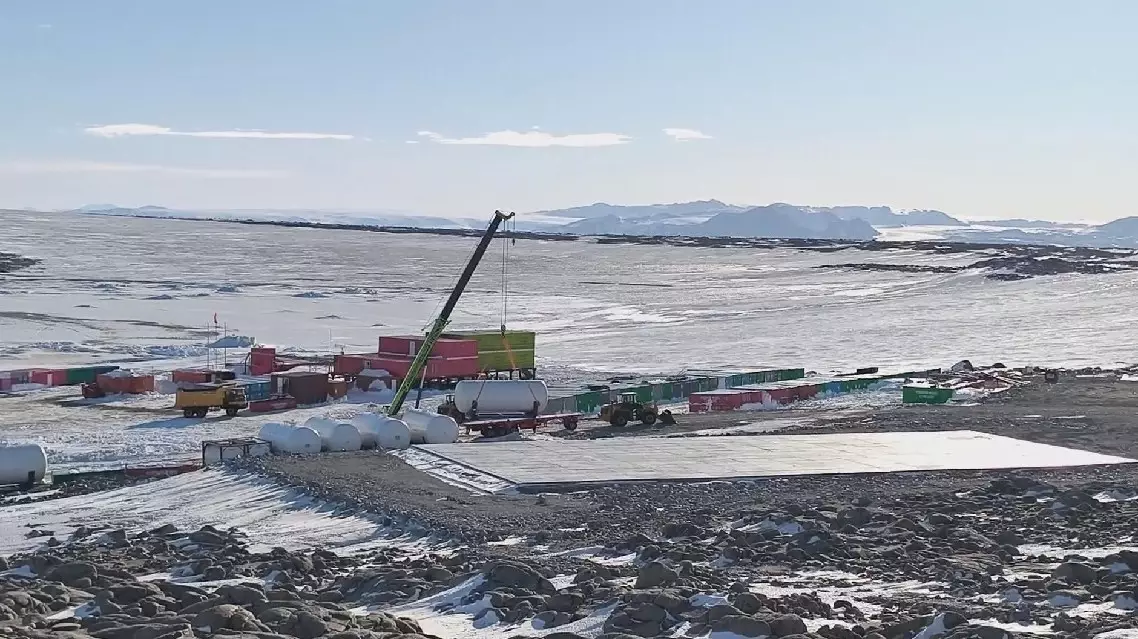
Qinling Station's infrastructure continues to improve, advancing China's Antarctic research