A CCTV documentary shows the efforts and achievements of the people in Xinjiang's Taklamakan Desert in desert control and tree planting through comparison of satellite images spanning 10 years.
Over the past decade, people of all ethnic groups have laid 33,680 hectares of grass grids in the Taklamakan Desert. A total of 11,840 square kilometers of artificial afforestation have been completed, and 2 billion trees have been planted.
Qiemo County is a small town surrounded by desert with a population of over 70,000. The desert here once approached the city at a speed of three to five meters per year.
Over the past decade, changes have continued to occur. People in the county have laid over 6,200 hectares of grass grids in the desert, equivalent to more than 8,700 standard football fields.
The satellite images released in the documentary shows that in 2014, the county was desolate covered with desert; ten years later, it is almost covered with green.
Due to the terrain, the sandstorms in Qiemo moves from east to west all the way to Minfeng County in Hotan Prefecture. In recent years, more than 40,000 people in Minfeng County have planted over 3,700 hectares of trees in the Taklamakan Desert, built 1,600 hectares of farmland shelter belts, and planted 10.656 million plants for sand control.
Another area severely affected by sandstorms in Hotan is Yutian County. In the process of fighting against sandstorms, the local people have developed their unique model of sand control - growing plants such as haloxylon ammodendron and tamarix tamarisk in terraced fields.
Cele County, west of Yutian, is the most severely affected area in Hotan by wind and sand. In recent years, local people have taken the initiative to join the team of sand control, and have planted 21.4828 million trees and 164,500 mu of cash crops such as walnuts and red dates in the desert.
In 1986, the forest coverage rate of Kekeya, a small town in Aksu Prefecture, was only 8 percent, but now it has reached an astonishing 73 percent. So far, nearly 4 million people in Aksu have participated in voluntary tree planting.
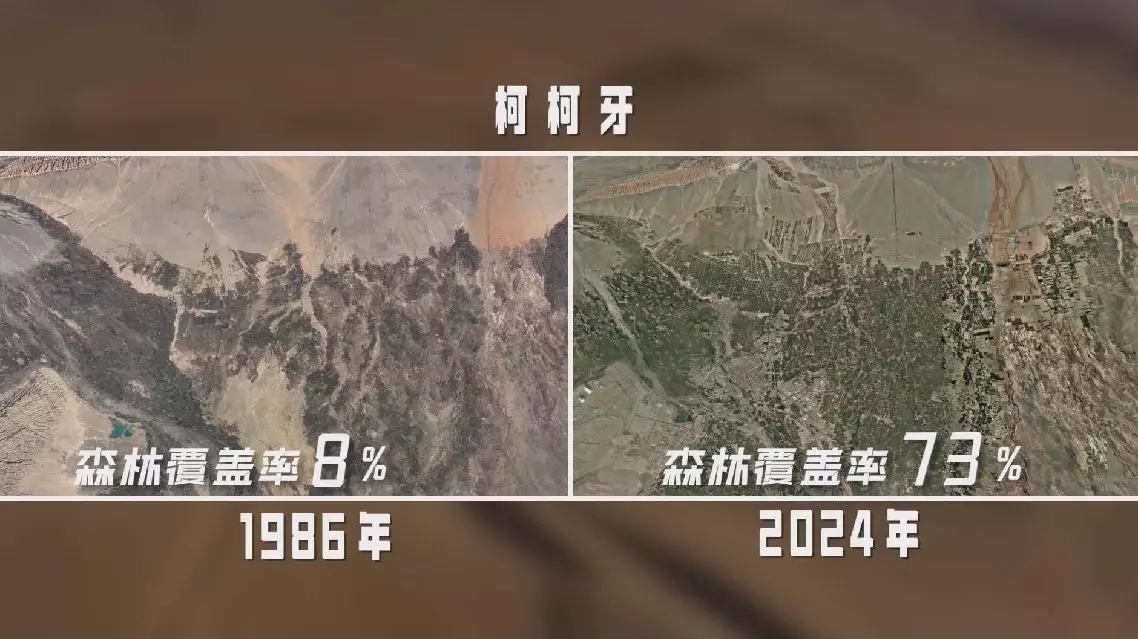
Satellite images show people's efforts, achievements in desert control in Xinjiang
China's Minister of Commerce Wang Wentao outlined the key priorities of the 32nd Asia-Pacific Economic Cooperation (APEC) Ministers Responsible for Trade Meeting, which opened on Friday in Suzhou, East China's Jiangsu province.
In an interview with CGTN ahead of the two-day meeting, Wang said free trade, digital cooperation and green economy are high on the agenda of the meeting.
"The key areas include advancing regional economic integration and the Free Trade Area of the Asia-Pacific, supporting the World Trade Organization (WTO) in strengthening digital cooperation and developing green economy. At present, the international situation is marked by intertwined turbulence and chaos, with intensified geopolitical instability. The rise of unilateralism and protectionism poses serious challenges to the international economic and trade order, disrupting global and Asia-Pacific development. Against this backdrop, all parties have higher expectations for this trade ministers' meeting, hoping that it can build consensus and deliver outcomes," Wang said.
This year marks China's third time hosting the APEC meetings and the 35th anniversary of its membership.
By 2025, China had become the largest trading partner of 13 APEC economies. Trade between China and APEC economies reached 3.7 trillion U.S. dollars, accounting for 57.8 percent of China's total foreign trade.
China has signed 24 free trade agreements or economic and trade arrangements with 31 countries and regions, including 15 APEC economies. In recent years, China has also completed upgrades of free trade agreements with APEC economies such as Singapore and Peru.
The minister said that China has always been a firm supporter and an important contributor to APEC.
"We have actively shared our vast market and development opportunities with all parties. China's door to the world will only open wider and wider. Facing the common challenges, China will continue to fulfill its responsibilities as a major country, further deepen reform, expand high-standard opening-up, and continue to provide new opportunities for the Asia-Pacific region and the world with its new achievements in Chinese modernization," the minister said.

China's Commerce Minister outlines priorities for 32nd APEC trade ministers' meeting