The Taklimakan Desert, known as the "Sea of Death," has been completely encircled with a sand-blocking green belt stretching 3,046 km, said local authorities in northwest China's Xinjiang Uygur Autonomous Region.
On Thursday morning, several tree species, including Populus euphratica (more commonly known as "desert poplar"), sacsaoul and red willow, were planted on sandy land in Yutian County on the southern edge of the desert, marking the completion of the final stretch of the green belt, according to the Xinjiang regional forestry and grassland bureau.
The Taklimakan covers 337,600 square kilometers and its circumference measures 3,046 km, making it the largest desert in China and the second-largest drifting desert in the world.
It has taken more than 40 years to fully enclose the desert with a green belt. By the end of 2023, a nearly completed belt connected scattered oases, leaving only the final, most challenging section.
This final stretch, approximately 285 kilometers long, runs through the southern part of the desert and faces the most severe wind and sand hazards. Since this year, Xinjiang has taken targeted and scientific measures to close this gap.
"This section in our county accounts for 77 percent of the 285 kilometers of the unprotected desert area and the task is extremely challenging. By mobilizing the people and combining engineering and biological methods for desert control, we have successfully completed the encirclement today," said Deng Xiaobo, Party secretary of Hotan Prefecture Forestry and Grassland Bureau of Xinjiang.
Alongside the green belt, efforts have been made to promote the development of sand-terrain industries, such as the growing of cistanche, a desert plant used in Chinese herbal medicine, and other crops, to benefit local residents.
"Next, we will continue to expand the width of the protective barrier, focusing on creating a haul of landmark projects for sand prevention and control and firmly lock the Taklimakan Desert in place to prevent the spread of sand sources," said Wang Gang, deputy director of the desertification control division under Xinjiang Regional Forestry and Grassland Bureau.
The Taklimakan Desert control project is a part of China's Three-North Shelterbelt Forest Program (TSFP), the world's largest afforestation program to tackle desertification.
The TSFP was launched in 1978 and is scheduled to be completed by 2050.
In June 2023, China proposed to turn the TSFP into a fully functional and unbreakable "green Great Wall" and ecological security barrier in northern China.
Since 1978, China has expanded its afforestation area by 32 million hectares under the TSFP. The afforestation area under the program is projected to encompass over 4 million square kilometers across 13 provincial-level regions by 2050, accounting for 42.4 percent of the country's total land area.
Over the past 46 years, the forest coverage rate of the TSFP-covering areas has risen from 5.05 percent to 13.84 percent. Progress has been made in desertification and soil erosion control, while about 30 million hectares of farmland have been protected.
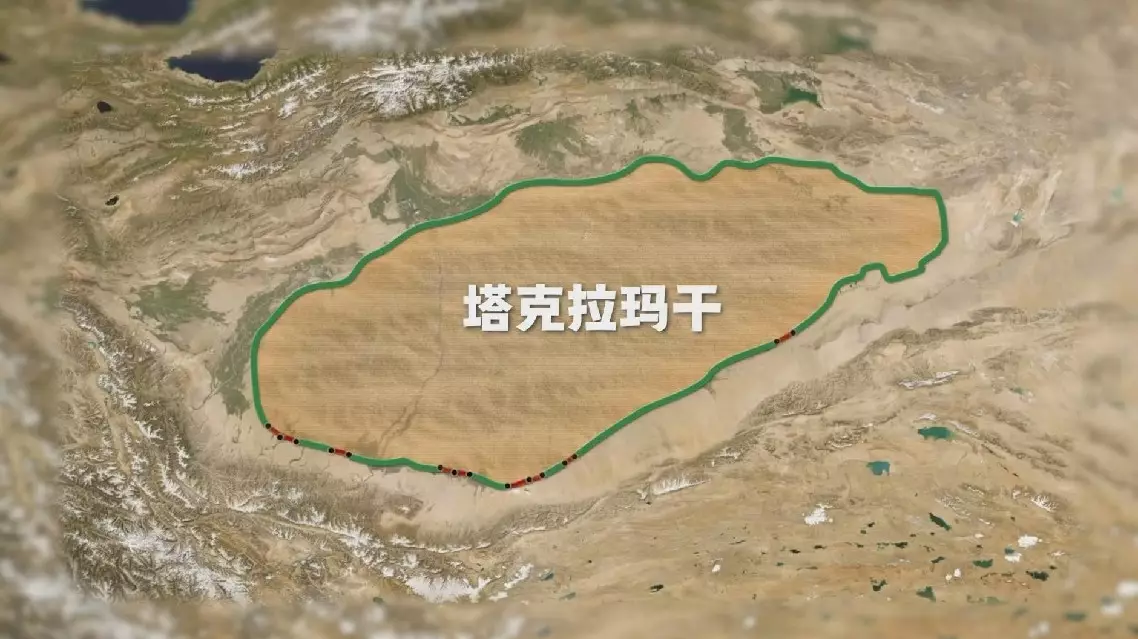
China's largest desert fully encircled with green belt