China has built over 4,000 kilometers of new oil and gas pipelines this year, as part of its efforts to improve energy security.
On November 12, an inter-city and provincial pipeline network interconnection project, as one of China's key oil and gas infrastructure projects, officially started operation in east China's Shandong Province, which is set to secure gas supply across the province.
On Monday, PipeChina announced that China's single largest natural gas pipeline, the China-Russia east-route natural gas pipeline, is fully operational, marking that the country has officially built four strategic oil and gas channels in the northwestern, northeastern and southwestern regions as well as at sea.
Construction of new oil and gas pipelines has also begun in southwest and northeast China, and the first section of the country's West-East Gas Pipeline 4 has become operational, signaling that China is progressing in building the new natural gas pipeline network featuring "five vertical and five horizontal" major pipelines during the 14th Five-Year Plan period (2021-25).
"PipeChina has vigorously promoted the construction of oil and gas pipeline infrastructure, with a number of national key projects having their construction paced up or being put into production. This year, the mileage of new oil and gas pipelines has exceeded 4,000 kilometers. During the 14th Five-Year Plan (period), the total mileage of pipelines built has exceeded 16,000 kilometers, setting a historical record," said Liu Haichun, deputy general manager of the engineering department at PipeChina.
At present, the total mileage of China's long-distance oil and gas pipeline network is about 190,000 kilometers, and the total mileage of major oil and gas pipeline network exceeds 100,000 kilometers.
With gas transmission capacity increasing 76 percent from 223 billion cubic meters in 2020 to the current 394 billion cubic meters, China's national gas and oil pipeline network is capable of transporting more than one billion cubic meters of gas each day.
"In terms of guaranteeing the security of our entire energy supply, the construction of the pipeline network offers a strong support and brings huge social and economic benefits to the socioeconomic development along the lines. The scale of these projects has also effectively driven the technological progress of related machinery, materials, building materials industries of our country, and also played a positive role in boosting our new quality productive forces," said Huang Weihe, an academician of the Chinese Academy of Engineering.
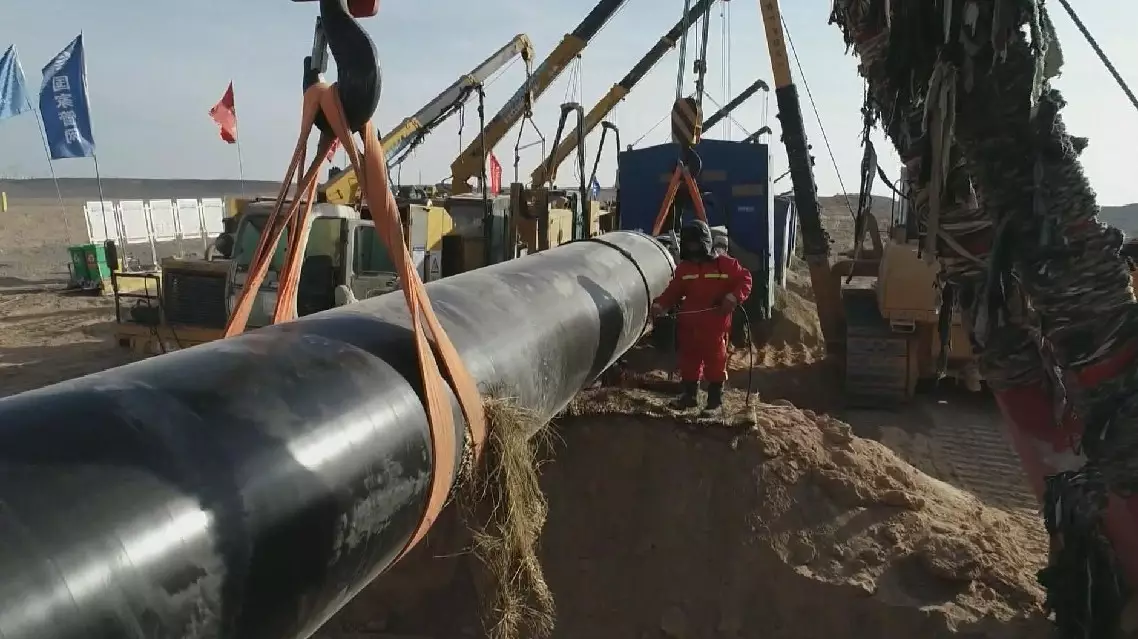
China builds 4,000-km plus new oil, gas pipelines