PARIS--(BUSINESS WIRE)--Dec 9, 2024--
Orange and La Poste announce the first innovative initiative to extend the lifespan of network equipment used during the Paris 2024 Olympic and Paralympic Games. This collaboration aligns with the Corporate Social Responsibility (CSR) strategies of both companies, aimed at minimising the environmental impact of digital technology. It is also a key aspect of the Paris 2024 legacy, which focuses on repurposing equipment for other sites and uses after the Olympic Games.
This press release features multimedia. View the full release here: https://www.businesswire.com/news/home/20241209892742/en/
A large-scale, responsible approach
Several thousand Wi-Fi terminals and other advanced telecom equipment used at the Olympic and Paralympic sites will be reused by La Poste at key locations in Paris and other local communities. For instance, the Maison de l’Innovation in Nantes, set to house over 800 IT professionals from La Poste, will benefit from this next-generation equipment. These devices have been used for only a short period of time and have been thoroughly verified to ensure performance, availability, and durability.
These modern devices will improve the network’s operational efficiency for La Poste employees, providing better connectivity and a high level of service both indoors and outdoors. The integration of this equipment will also play a crucial role in supporting digitalisation and new uses, facilitating smoother operations of IT tools.
Shared ambitious commitments
Orange and La Poste share a common vision and are actively committed to adopting more responsible and sustainable practices. The initiative to extend the lifespan of telecom equipment has already been successfully implemented on Orange infrastructure for La Poste. This latest initiative demonstrates the commitment of both companies to accelerate their CSR objectives and raise awareness within the ecosystem to reduce carbon footprints and make informed choices.
Orange and La Poste share the same net-zero carbon goal by 2040. Both companies have established more responsible practices to purchase circuits, particularly in IT environments. Orange offers eco-designed products and second-hand network equipment to its consumer and business customers. Meanwhile, La Poste, as a mission-driven company, is committed to ethical, inclusive, and economical digital practices. It has also adopted a responsible digital policy aimed at optimising the use of natural and non-renewable resources. This policy focuses on extending the lifespan of its IT equipment through repair and reuse.
“In the face of scarce resources and the increasing digitalisation of services, La Poste Group is committed to reducing the environmental footprint of its tools and applications. The reuse of network equipment deployed by Orange for the Olympic Games is an opportunity that perfectly aligns with our desire to promote responsible digital practices,” says Philippe Bajou, Secretary General of the La Poste Group and President of La Poste Group Immobilier.
“The Olympic Games Paris 2024 have been a unique opportunity to showcase our technical expertise and a true demonstration of the solutions offered to our business clients. I am proud that this top-quality equipment finds a second life with La Poste. This partnership illustrates our commitment to a sustainable and connected future. At Orange Business, we are dedicated to helping our clients and partners in their environmental transition and reducing their carbon footprint,” adds Aliette Mousnier-Lompré, CEO of Orange Business.
About Orange
Orange is one of the world’s leading telecommunications operators with revenues of 39.7 billion euros in 2023 and 128,000 employees worldwide at 30 September 2024, including 71,000 employees in France. The Group has a total customer base of 292 million customers worldwide at 30 September 2024, including 253 million mobile customers and 22 million fixed broadband customers. These figures have been restated to account for the deconsolidation of certain activities in Spain following the creation of MASORANGE. The Group is present in 26 countries (including non-consolidated countries).
Orange is also a leading provider of global IT and telecommunication services to multinational companies under the brand Orange Business. In February 2023, the Group presented its strategic plan "Lead the Future", built on a new business model and guided by responsibility and efficiency. "Lead the Future" capitalizes on network excellence to reinforce Orange's leadership in service quality.
Orange is listed on Euronext Paris (symbol ORA).
For more information on the internet and on your mobile: www.orange.com, www.orange-business.com and the Orange News app or to follow us on X: @orangegrouppr.
Orange and any other Orange product or service names included in this material are trademarks of Orange or Orange Brand Services Limited.
About La Poste Group
La Poste is a public limited company, a subsidiary of the Caisse des Dépôts and the State. The La Poste Group is organized into four branches: Mail and Parcel Services, Public and Digital Services, Geopost, and La Banque Postale, which, along with its subsidiary CNP Assurances, is the 11th largest bancassurer in the Eurozone. The La Poste Group carries out four public service missions that shape its identity: universal postal service, regional development, banking accessibility, and the transport and distribution of the press. Committed to its territorial presence, the La Poste Group relies on its extensive network of human and digital proximity services, the largest in France. This network consists of 37,300 service points, including 17,700 contact points (post offices, municipal postal agencies, merchant post relay points) and nearly 19,600 access points for postal services (Pickup relays and lockers, Professional Spaces). La Poste delivers over 15 billion items worldwide each year (letters, advertising mail, and parcels), six days a week. In 2023, the group achieved a revenue of €34.1 billion, with 44% coming from international operations, and employs 233,000 employees in more than 60 countries across five continents, including over 179,000 in France. As part of its strategic plan "La Poste 2030, committed to you," the public company aims for profitable and responsible growth in France and internationally, relying on a robust multi-activity model. A mission-driven company since 2021, a leader in ecological transition and sustainable finance, the group aims for "net zero emissions" by 2040.
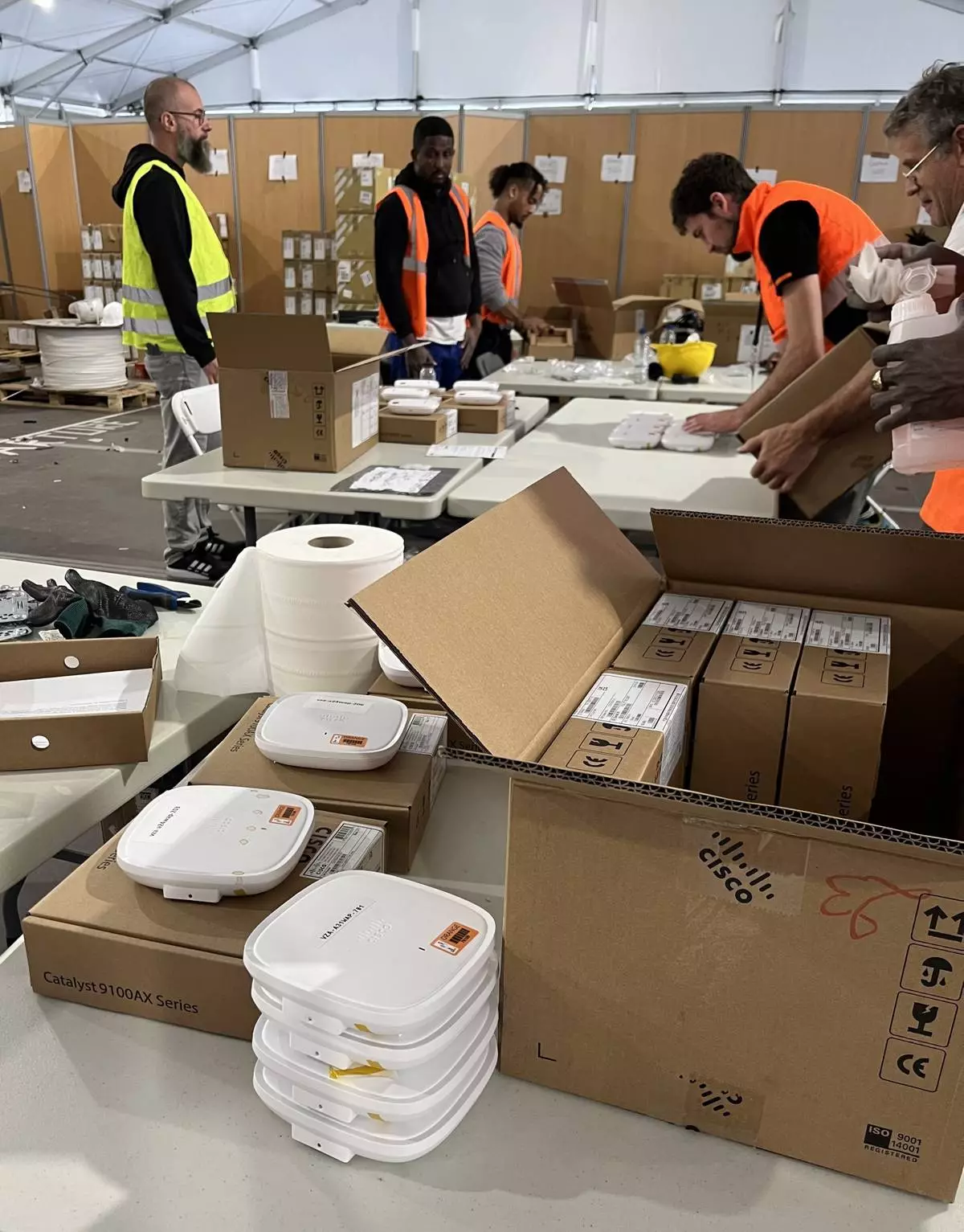
This collaboration aligns with the Corporate Social Responsibility (CSR) strategies of both companies, aimed at minimising the environmental impact of digital technology (Photo credit: Orange Business Services)

JERUSALEM (AP) — Aid deliveries into Gaza are falling far short of the amount called for under the U.S.-brokered ceasefire, according to an Associated Press analysis of the Israeli military’s figures as humanitarian groups say the shortfall is severely impacting the strip's 2 million people.
Under the October ceasefire deal between Israel and Hamas, Israel agreed to allow 600 trucks of aid into Gaza a day.
However, Israel’s own figures suggest that an average of only 459 trucks a day have entered the Gaza Strip between Oct. 12, when the flow of the aid restarted, and Sunday, according to an AP analysis. COGAT, the Israeli military body in charge of coordinating aid entry, provided the figures.
COGAT said that roughly 18,000 trucks of food aid had entered Gaza from when the ceasefire took effect until Sunday, amounting to 70% of all aid that had entered the territory since the truce.
This means that COGAT estimates that including the rest of the aid — items that are not food, such as tents and medicines — a total of just over 25,700 trucks have entered Gaza. That is well under the 33,600 trucks that should have gone in by Sunday, under the terms of the ceasefire.
In response to the AP analysis, COGAT insisted Wednesday the number of trucks entering Gaza each day was above the 600 mark but refused to elaborate why the figures don't match or provide raw data on truck entry.
COGAT used to give daily figures of trucks entering Gaza during the war but stopped doing so when the ceasefire began. Rights groups say that is because it controls the crossings and has sole access to track how much aid and commercial goods are entering Gaza.
The United Nations and aid groups have often said the amount of aid entering Gaza is far lower than COGAT claims.
The U.N. says only 6,545 trucks have been offloaded at Gaza crossings between the ceasefire and Dec. 7, amounting to about 113 trucks a day. That's according to its online database. The U.N. figures do not include aid trucks sent by organizations not working through the U.N. network.
A Hamas document on Saturday provided to the AP put the amount of total aid trucks that have entered since the truce at 7,333.
This week, the U.N. office for humanitarian affairs, known as OCHA, stressed a “dire” need for more aid for Gaza, saying Israeli restrictions on aid have bottlenecked recovery efforts.
Humanitarian groups say lack of aid has had harsh effects on much of Gaza's residents, most of whom were forcibly displaced by war. Food remains scarce as the Palestinian territory struggles to bounce back from famine, which hit parts of Gaza during the war.
Starving mothers in Gaza are giving birth to malnourished babies, some of whom have died in hospital, according to a recent report by UNICEF. As winter rains pick up, displaced families living in tents have been left exposed to the elements and without supplies to cope with floods and the biting cold.
“Needs far outpace the humanitarian community’s ability to respond, given persistent impediments,” a UNICEF report said on Monday. “These obstacles include insecurity, customs clearance challenges, delays and denials of cargo at the crossings, and limited routes available for transporting humanitarian supplies within Gaza.”
Israel temporarily stopped all aid entry at least once in response to alleged Hamas violations of the truce. Israel said that Hamas has failed to return the bodies of the hostages in the time period established by the ceasefire, while Hamas has said it struggled to find the bodies due to the destruction left by Israel in the Palestinian territory.
Hamas has also accused Israel of violating the ceasefire terms because of the slow flow of aid, continued closure of the Rafah crossing and ongoing deadly strikes on Gaza.
Since the U.S.-brokered ceasefire began on Oct. 10, the price for a 12-kilogram (26.5 pound) cylinder of cooking gas has shot up to 1,314 shekels ($406), about 18 times what it was before the war.
That has left many residents relying on firewood for both cooking and to stay warm as temperatures plunge ahead of winter, including the 23-member Abed family in the northern city of Jabaliya.
“We are living under the rubble and sleeping on torn sheets. We collect some firewood, and cut sponges to start a fire,” Marwan Abed, 62, told the AP from under the crumbling concrete of his house. He said firewood is the only way “to keep the children warm” and to prepare coffee.
Israel is demanding Palestinian militants return the remains of the final hostage, Ran Gvili, from Gaza. Prime Minister Benjamin Netanyahu's office said Wednesday that Gvili’s return was a condition of moving to the second phase of the ceasefire.
“Once phase one is completed, phase two will begin,” it said.
Hamas militants and Red Cross crews continued to comb the ruins of Gaza City for the final body this week. The militant group Islamic Jihad claimed it had handed over the last hostage body in its possession.
On Tuesday, Hamas called for more international pressure on Israel to open key border crossings, cease deadly strikes on the territory and allow more aid into the strip.
Regional leaders have said time is critical for the ceasefire agreement as mediators seek to push the truce into its second, more complicated phase.
Meanwhile, President Donald Trump said Wednesday he would name members “early next year” to a panel tasked with governing Gaza and overseeing reconstruction under a two-year, renewable U.N. mandate, Trump had previously said he would name members to the so-called “Board of Peace,” a key element of the ceasefire deal, by the end of 2025. He did not detail why the timeline for naming board members has shifted.
“It is going to be one of the most legendary boards ever, everybody wants to be on it,” Trump said. He added that kings, prime ministers and presidents have asked to be included on the board.
The director of the Shifa hospital in Gaza, Mohamed Abu Selmiya, said doctors received on Wednesday the body of a 17-year-old Palestinian teenager who had been run over and crushed to death by an Israeli tank in the Jabaliya refugee camp in northern Gaza.
Asked about the incident, Israel’s military said it had killed a militant on Wednesday who had crossed the so-called Yellow Line — which divides the Israeli-held part of Gaza from the rest — in northern Gaza.
It said it could not provide any more details on the incident.
Associated Press writers Megan Janetsky in Jerusalem, Toqa Ezzidin in Cairo, Sam Mednick in Tel Aviv, Israel, and Aamer Madhani in Washington contributed to this report.
Displaced Palestinian children play beside a makeshift tent camp where they take shelter in Zawaida, in the central Gaza Strip, Wednesday, Dec. 10, 2025. (AP Photo/Abdel Kareem Hana)
Palestinians ride in a cart pulled by a vehicle through a flooded street after stormy weather in Gaza City Wednesday, Dec. 10, 2025. (AP Photo/Jehad Alshrafi)
A thunderstorm is seen over a tent camp for displaced Palestinians in Zawaida, central Gaza Strip, Wednesday, Dec. 10, 2025. (AP Photo/Abdel Kareem Hana)
Displaced Palestinian children walk through a tent camp after stormy weather in Gaza City Wednesday, Dec. 10, 2025. (AP Photo/Jehad Alshrafi)
A young girl looks on as she holds a sandwich at a tent camp for displaced Palestinians on the beach in Gaza City Wednesday, Dec. 10, 2025. (AP Photo/Jehad Alshrafi)
Israeli soldiers gather next to the entrance of a tunnel where the army says the body of soldier Hadar Goldin was held in Rafah, Gaza Strip, Monday, Dec. 8, 2025. Hamas returned his remains to Israel as part of the current ceasefire. (AP Photo/Sam Mednick)
FILE - Hamas militants accompanied by members of the International Committee of the Red Cross (ICRC) head to Zeitoun neighborhood of Gaza City to search for the remains of the final hostage, Dec. 8, 2025. (AP Photo/Jehad Alshrafi, File)
Displaced Palestinians repair their tents at a tent camp on the beach after a stormy weather in Gaza City, Wednesday, Dec. 10, 2025. (AP Photo/Jehad Alshrafi)