LC: Speech by CS for proposed resolutions moved under Legal Aid Ordinance and Criminal Procedure Ordinance
Following is the speech (translated from Chinese) by the Chief Secretary for Administration, Mr Chan Kwok-ki, for the proposed resolutions under the Legal Aid Ordinance (LAO) and the Criminal Procedure Ordinance in the Legislative Council (LegCo) today (December 11):
Mr President,
I move that my first motion, as printed on the Agenda, be passed to adjust the financial eligibility limits (FELs) for legal aid applicants. Later, I will sequentially move that the other two legal aid-related motions as printed on the Agenda be passed, seeking to adjust the Director of Legal Aid (DLA)'s First Charge and make the Legal Aid in Criminal Cases (Amendment) Rules 2024 to adjust the criminal legal aid fees respectively.
First, I introduce the first Resolution.
Legal aid services form an integral part of the legal system in Hong Kong. The policy objective of legal aid is to ensure that all those who comply with the regulations of the LAO and have reasonable grounds for pursuing or defending a legal action in the courts of Hong Kong will not be denied access to justice due to a lack of means. All legal aid applicants must satisfy both the means test and merits test as provided for in the LAO.
Currently, there are two legal aid schemes under the Legal Aid Department (LAD), namely the Ordinary Legal Aid Scheme (OLAS) and the Supplementary Legal Aid Scheme (SLAS). Different FELs are set for the two schemes in accordance with sections 5 and 5A of the LAO respectively. Pursuant to section 7(a) of the LAO, the LegCo may by resolution amend the relevant FELs.
Pursuant to the mechanism established in 1999, FELs are subject to review annually by making reference to the Consumer Price Index (C) (CPI(C)). According to the latest round of review, for the reference period from July 2023 to July 2024, the CPI(C) has increased by two per cent. Hence, we propose to adjust the FELs upwards by two per cent, namely:
(a) from $440,800 to $449,620 for OLAS; and
(b) from $2,204,030 to $2,248,110 for SLAS.
Mr President, I now introduce the second Resolution.
If a legally aided person is successful in recovering or preserving any money or property in the proceedings concerned, DLA has the right to retain thereunder such sums required for recovering the costs and other expenses incurred by LAD for the legally aided person under section 18A(1) of the LAO. Such right is called the DLA's first charge. However, according to section 18A(5) of the LAO, the DLA's first charge does not apply to the first $9,540 of each monthly payment of maintenance payment. Separately, when DLA is satisfied that the exercise of the DLA's first charge would cause serious hardship to the legally aided person, DLA may in accordance with the principles of fairness and justice exercise discretion to reduce the amount to be retained, provided that the sum to be reduced does not exceed the cap as specified in section 19B(1)(a) of the LAO.
Pursuant to section 22A of the LAO, LegCo may, by resolution, amend the rate of maintenance payments that is exempted from the DLA's first charge, as well as the cap on the amount by which may be reduced in cases of serious hardship.
In response to the increase in CPI(C) by two per cent for the reference period from July 2023 to July 2024 as mentioned above, we propose to accordingly adjust the two above-mentioned specific amounts upwards by two per cent, namely:
(a) the amount specified in section 18A(5) upwards from $9,540 to $9,730, and
(b) the cap on the amount specified in section 19B(1)(a) upwards from $114,140 to $116,420.
Mr President, my third Resolution seeks to make the Legal Aid in Criminal Cases (Amendment) Rules 2024 (Amendment Rules) to adjust the criminal legal aid fees.
At present, LAD pays fees to counsel and solicitors in private practice engaged to undertake litigation work for criminal cases on its behalf (i.e. criminal legal aid fees). The fees are stipulated in the Legal Aid in Criminal Cases Rules (the Rules). Pursuant to section 9A(1) of the Criminal Procedure Ordinance, any amendment to the Rules for adjusting the criminal legal aid fees are subject to the approval of the LegCo.
On the other hand, to ensure that neither LAD nor the Department of Justice (DoJ) would have unfair advantage in competing for the same pool of lawyers, DoJ draws reference to the same scale of fees to engage counsel and solicitors in private practice to appear for the prosecution in criminal cases (i.e. prosecution fees). Duty lawyer fees will be paid to lawyers who provide legal representation to defendants in Magistrates' Courts and Juvenile Courts through the Duty Lawyer Service.
Pursuant to the mechanism established in 1992, the fees mentioned above (i.e. criminal legal aid fees, prosecution fees and duty lawyer fees) are subject to review on a biennial basis to take into account changes in CPI(C) during the reference period.
According to the latest biennial review, the CPI(C) for the reference period (i.e. July 2022 to July 2024) increased by 3.9 per cent. As such, we propose to adjust the Fees upwards by 3.9 per cent accordingly.
We have informed the LegCo Panel on Administration of Justice and Legal Services of the outcome of the reviews regarding the proposed adjustments in the three resolutions mentioned above via an information paper in October 2024. Members raised no objection to the proposed increase. Subject to LegCo's approval of the Resolution, we will implement the proposal upon gazettal of the Resolution.
Separately, when LAD implements the increased criminal legal aid fees, the Government will accordingly adjust the scale of prosecution fees and duty lawyer fees administratively.
I appeal for Members' support for the above three Resolutions. Thank you, Mr President.
Interdepartmental working group on festival arrangements releases latest information on special boundary-crossing and corresponding public transport service arrangements during New Year's Eve and New Year holidays
The interdepartmental working group on festival arrangements, led by the Chief Secretary for Administration, released the following information today (December 25) on the special boundary-crossing and corresponding public transport service arrangements during New Year's Eve and the New Year holidays.
In view of a series of New Year's Eve countdown events, while the Hong Kong Port of the Hong Kong-Zhuhai-Macao Bridge (HZMB) and the Lok Ma Chau/Huanggang Port (LMC/HG Port) will maintain 24-hour operations as usual, the Hong Kong Special Administrative Region (HKSAR) Government reached a consensus with the relevant departments of Guangdong Province and Shenzhen Municipality to make the following special boundary-crossing arrangements on New Year's Eve to facilitate cross-boundary passenger and vehicular movements:
(1) Passenger clearance services at the Lo Wu Control Point, which usually close at midnight, will be extended to 2am the next day. The operating hours of the MTR East Rail Line will be extended correspondingly, with the departure of the last East Rail Line train from Admiralty to Lo Wu extended to 12.56am; and
(2) Passenger and passenger vehicle clearance services at the Shenzhen Bay Port (SBP), which usually close at midnight, will operate overnight, providing round-the-clock services.
For more effective diversion of cross-boundary private cars on New Year's Day with the implementation of round-the-clock clearance at the SBP, only cross-boundary private cars issued with Closed Road Permits (Permits) for the LMC/HG Port are allowed to use the LMC/HG crossing. For cross-boundary private cars issued with Permits for SBP, LMC/HG, Heung Yuen Wai, Man Kam To Boundary Control Point (BCP) or Sha Tau Kok BCP, they can use the SBP during early-morning hours on New Year's Day.
For cross-boundary coaches, the HKSAR Government has also worked with cross-boundary coach service operators to arrange additional services using the SBP during early-morning hours on New Year's Day, and to enhance the services using the LMC/HG Port, including cross-boundary coaches departing from major stopping points in urban areas such as Wan Chai, Prince Edward and Jordan, as well as a shuttle bus running between the Lok Ma Chau (San Tin) Public Transport Interchange and the LMC/HG Port (Yellow Bus), and the HZMB shuttle bus (Gold Bus). Moreover, a dedicated traffic lane section will be reserved for public transport services at the HZMB, LMC/HG Port, and SBP when necessary, to ensure the smooth operation of public transport services.
As regards local public transport services connecting to BCPs, to tie in with the special round-the-clock passenger clearance arrangements of the SBP on New Year's Day, franchised bus operators will operate two special overnight bus routes, Nos. NB2 and NB3, to provide services to and from Yuen Long/Tin Shui Wai and Tuen Mun respectively during the overnight period. Furthermore, in the case of travellers using overnight services of the MTR East Rail Line that night, after the closure of the Lo Wu Control Point, they may also take the specially arranged short-working bus service, route No. N73, from MTR Sheung Shui Station to Lok Ma Chau (San Tin) Public Transport Interchange, and transfer to the Yellow bus for their journey to Shenzhen.
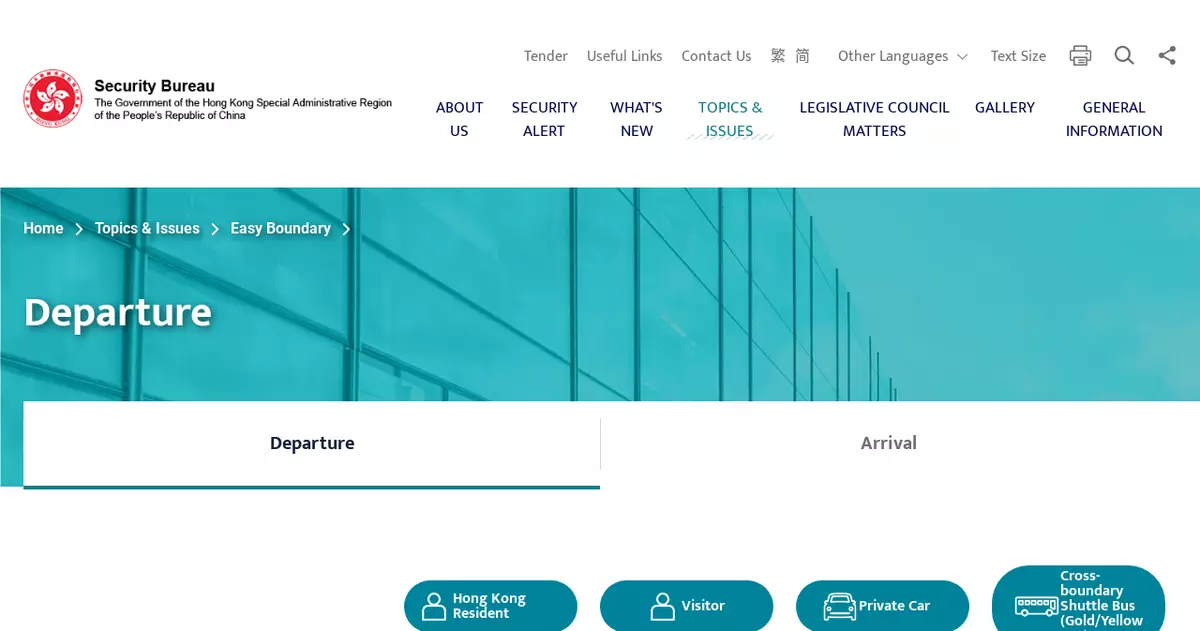
Residents and visitors may visit "Easy Boundary" (www.sb.gov.hk/eng/bwt/status.html?type=outbound), a one-stop information platform on immigration clearance launched by the Security Bureau, to obtain useful information in one go, including the respective average waiting time for passengers and private cars at land BCPs, as well as for the Gold Bus and Yellow Bus to plan their trips and save waiting time.
The Transport Department's Emergency Transport Co-ordination Centre will operate 24 hours to closely monitor the traffic conditions and public transport services of various districts, the BCPs and major stations; implement contingency measures when necessary to meet service demands; and disseminate the latest traffic information through various channels.
"The full support and co-ordination of the leaders and relevant departments of Guangdong Province and Shenzhen Municipality are crucial to the implementation of the special boundary-crossing arrangements to facilitate the two-way flow of people between Hong Kong and the Mainland, reflecting the effective and close co-operation between Hong Kong and Shenzhen," the spokesman said.
The HKSAR Government will closely monitor the situation and take contingency actions promptly where necessary and deploy manpower flexibly to ensure orderly operations of the BCPs. The Government has formulated contingency plans for the peak periods of cross-boundary travel and made preparations for preventive and control measures to cater for different scenarios. Relevant bureaux and departments have formulated the plans below.
First, with the extension of operating hours at certain BCPs on New Year's Eve, the relevant departments have minimised leave for frontline officers for flexible manpower deployment. Additional counters, temporary counters and channels will be in operation to facilitate passenger and vehicular flow.
Second, the Inter-departmental Joint Command Centre set up by the Hong Kong Police Force, the Immigration Department, the Customs and Excise Department and other relevant departments will be activated from December 31, 2025 to January 4, 2026 to monitor the real-time situations at various BCPs and regularly report to the interdepartmental working group on festival arrangements, maintain close liaison with Mainland port authorities through the established port hotlines and real-time notification mechanism, and take timely contingency actions to flexibly deploy manpower at the BCPs to ensure smooth operation of the land control points.
Third, the Security Bureau will activate the Emergency Monitoring and Support Centre from December 31, 2025 to January 4, 2026 to closely monitor public order matters and co-ordinate any necessary actions at various BCPs, and support the working group in facilitating interdepartmental follow-up actions where necessary to respond promptly to various kinds of emergencies.
The interdepartmental working group on festival arrangements is tasked with holistically co-ordinating and steering the preparatory work of various government departments for welcoming visitors to Hong Kong during the New Year's Eve and New Year holidays, as well as strengthening information dissemination to enable the public and visitors to plan their itineraries according to the latest situation.
Source: AI-found images