Skip to Content Facebook Feature Image

Japanese wartime atrocities in China captured through soldier's lens

China

China

China

Japanese wartime atrocities in China captured through soldier's lens

2024-12-13 18:44 Last Updated At:19:07

A collection of rare historical photographs taken by a Japanese soldier has exposed the horrifying war crimes committed by Japan during its invasion of China last century, sparking renewed calls for the Japanese society to confront and reflect on this dark chapter of history.

In recent years, Japanese civic groups have actively disclosed evidence of wartime atrocities related to the invading Japanese troops in China. Among these efforts, the Japan-China Friendship Association has preserved a wealth of photos including harrowing images documenting the Nanjing Massacre, one of the most barbaric episodes of World War II. These photographs are regularly displayed in exhibitions across Japan.

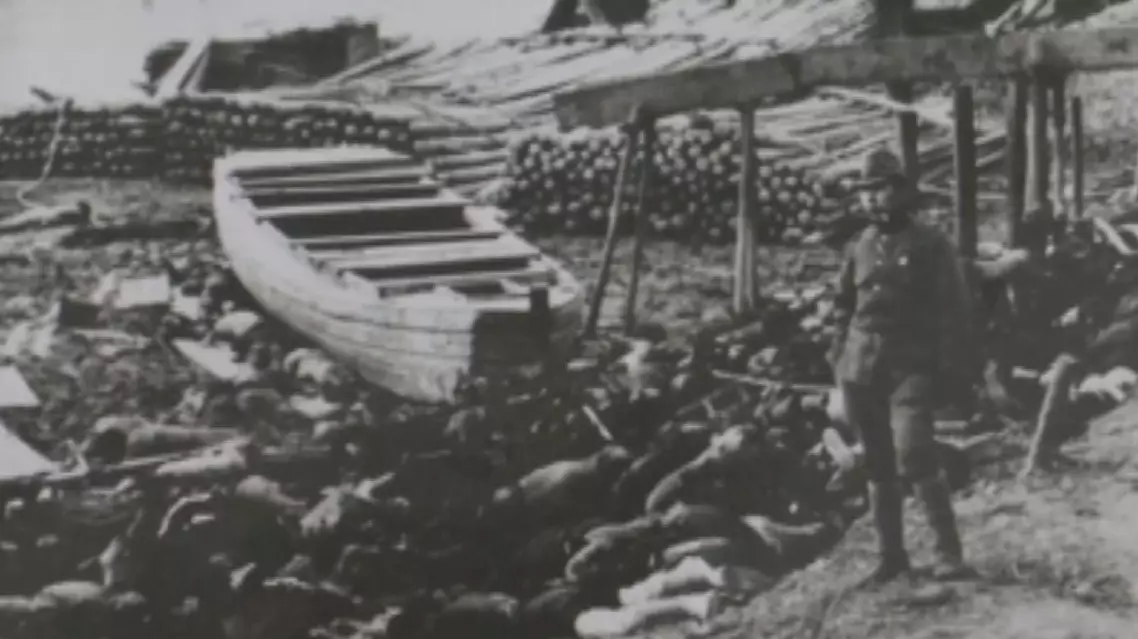
One photograph, taken when Japanese troops captured the then-Chinese capital Nanjing in 1937, stands out for its chilling detail. It shows the bodies of victims - many of them civilians, including women and children - piled on the banks of the Yangtze River following a bloody slaughter.

"After a mass execution, the Japanese troops used gasoline and heavy oil to burn the bodies. The corpses shown in this part of the image were charred black. It is a scene of cruelty and tragedy beyond description," explained Hisashi Inoue, president of the Japan-China Friendship Association.

This photo is just one of many incriminating scenes documented by late Japanese serviceman Moriyasu Murase, who captured over 3,000 images in China between 1937 and 1940. His photographs also include evidence of the Japanese invaders' direct involvement in operating "comfort stations."

"He (Murase) served as a photographer for the Japanese army and took many photographs under orders from his superiors. These photos are particularly valuable because we know who took them. He was a Japanese soldier who had unrestricted access to document scenes that were unfavorable to the Japanese military. These photos hold great historical value," said Inoue.

After Murase passed away, his family donated the photos to the Japan-China Friendship Association. Inoue emphasized that these images serve as a harsh reminder of war atrocities and the importance of preventing their recurrence.

"In Japan, the Nanjing Massacre and the Japanese military's invasion of China remain insufficiently acknowledged by the public. Many young people are unaware of these facts. Furthermore, there's a considerable number of right-wing individuals in Japan who advocate for historical revisionism. These people believe the Japanese military could not have been at fault and even deny the facts presented by China, dismissing them as false accusations. From the perspective of both historical truth and Japan-China friendship, these erroneous views must be corrected and criticized," said Inoue.

The association also expressed concerns over the Japanese government's longstanding attempts to obscure or distort this history, resulting in widespread public ignorance. By gathering and presenting compelling evidence, they hope to encourage deeper reflection, especially among younger generations.

Another exhibition in Iida City featured medical instruments linked to the notorious Unit 731, brought back by former youth soldiers. Yoshitaka Tanaka, vice president of the Japan-China Friendship Association, said it was the first time these instruments and related stories have been publicly shown.

"Now these facts are being displayed and the public is shocked by what they see. Based on this feedback, we must spread historical truths more widely across Japan," he said.

"We must take history seriously and pass it on correctly to future generations. It is also necessary to foster amicable relations with neighboring nations," said Inoue.
Japanese wartime atrocities in China captured through soldier's lens
Japanese wartime atrocities in China captured through soldier's lens

Li Lan, a deputy to the 14th National People's Congress (NPC), said that the infrastructure at the Alashankou port, also known as Alataw Pass, a major railway port in northwest China's Xinjiang Uygur Autonomous Region, should be further upgraded and used intensively and efficiently to better support the high-quality development of foreign trade.

Located on the border with Kazakhstan, the Alashankou port serves as a key transportation corridor linking China with Central Asia and Europe. Freight services passing through Alashankou now cover 128 routes, connecting China with 21 countries. Cargo carried ranges from auto parts and electronic products to daily consumer goods, according to customs data.

Li, director of the port's customs technical center, has witnessed profound changes of the land port amid the country's opening-up drive.

As an important gateway opening up to the west, the Alashankou port has become one of the fastest-growing ports in terms of the foreign trade cargo throughput since the Belt and Road Initiative (BRI) was proposed by China. While performing her duties as an NPC deputy during the past year, Li focused on addressing the pain points facing foreign trade enterprises in their process for customs clearance.

"We have also conducted market research in Central Asia. Initially, we thought that our infrastructure was significantly superior to theirs. However, in recent years, their infrastructure has greatly been modernized and highly efficient. Also, their customs clearance efficiency has improved rapidly. On the other side, I think our infrastructure, including customs clearance capabilities, needs to be enhanced and further improved," said Zheng Jiahong, the person in charge of a local enterprise.

Through field research, Li discovered that a lack of standardized provisions regarding regarding the number of channels at ports of different levels, the configuration of inspection facilities and equipment, the layout of functional areas, operational procedures, and human resource guarantee significantly constrained customs clearance efficiency at the port, thereby adding burdens to logistics companies.

"In international trade, the logistics cycle is a key factor affecting the profits of foreign trade enterprises. It's safe to say that every hour, every minute counts on our cost. Saving time essentially means increasing corporate profits," said Shan Pu, the person in charge of a logistics enterprise in Alashankou City.

Xinjiang boasts 16 of the 101 land ports across China. In Li's research, she found that the primary entities responsible for port construction in various regions are often prefecture-level or even county-level governments, leading to a lack of unified standards for first-class port construction, which makes it more challenging to meet the growing demands of foreign trade development.

In her proposal to this year's NPC session, Li suggests that the National Standards for the Construction of Port Inspection Infrastructure should be revised at a faster pace at the national level, so as to provide scientific guidance for the construction of ports across the country and enable them to adapt to the increasing demands of imports and exports.

"During this year's 'two sessions', while exchanging views with several deputies from the delegation of Xinjiang, I noticed a shared aspiration that everyone is eager for Xinjiang to make greater contributions to the country's overall plan of opening up to the west. Through my thorough and in-depth research, I hope that the relevant ministries and commissions will expedite the formulation of a new edition of the National Standards for the Construction of Port Inspection Infrastructure. This will enable the upgrading of our ports, better equipping them to meet the demands of high-quality development in the country's foreign trade sector in the future," Li said.

The "two sessions" refer to the annual meetings of China's top legislature -- the National People's Congress (NPC), and the top political advisory body -- the National Committee of the Chinese People's Political Consultative Conference (CPPCC).

The 14th NPC opened its fourth session on Thursday in Beijing.

NPC deputy calls for infrastructure upgrades of land ports in Xinjiang

NPC deputy calls for infrastructure upgrades of land ports in Xinjiang

Recommended Articles