Skip to Content Facebook Feature Image

China’s economic conference clearly outlines 2025 goals: experts

China

China

China

China’s economic conference clearly outlines 2025 goals: experts

2024-12-13 20:44 Last Updated At:21:17

China's annual Central Economic Work Conference, which was held in Beijing on Wednesday and Thursday, has specified a number of key tasks for 2025, said various experts after the meeting.

The first task for next year is to boost consumption, improve investment efficiency, and expand domestic demand on all fronts, and a special campaign dedicated to stimulating consumption will be implemented, according to the meeting.

Experts said there will be more resources allocated to boost consumption and ensure people's livelihood.

"After the introduction of consumer goods trade-in programs earlier this year, its effects have gradually manifested. It is evident that the sales growth of household appliances has noticeably increased. We believe that the expansion of the trade-in policy to cover more product categories next year, coupled with an increase in financial support, will stimulate a broader growth in the sales of consumer goods," said Feng Ming, director of macroeconomic think tank research office, Chinese Academy of Social Sciences.

"[The meeting] particularly emphasized on enhancing investment efficiency, with a focus on the alignment of funds and projects. Efforts will be made to improve the supply structure and reduce the operational costs of our economy and society," said Luo Zhiheng, chief economist of Yuekai Securities.

The meeting also pointed out that China should take steps to make scientific and technological innovation drive the development of new quality productivity and build a modernized industrial system.

"Sci-tech innovation holds a strategic core position in the entire modernization process. [The meeting] further stressed the direction of sci-tech innovation is accelerating the development of new quality productive forces and constructing a modern industrial system. This will make our technological innovation more focused and enhance our total factor productivity," said Huang Hanquan, director, Chinese Academy of Macroeconomic Research, National Development and Reform Commission.

Other key tasks include giving full play to the leading role of economic system reform; expanding high-standard opening up and keeping foreign trade and foreign investment stable; mitigating risks in key areas; promoting integrated urban-rural development; boosting regional development vitality; ramping up green transition and improving people's wellbeing.
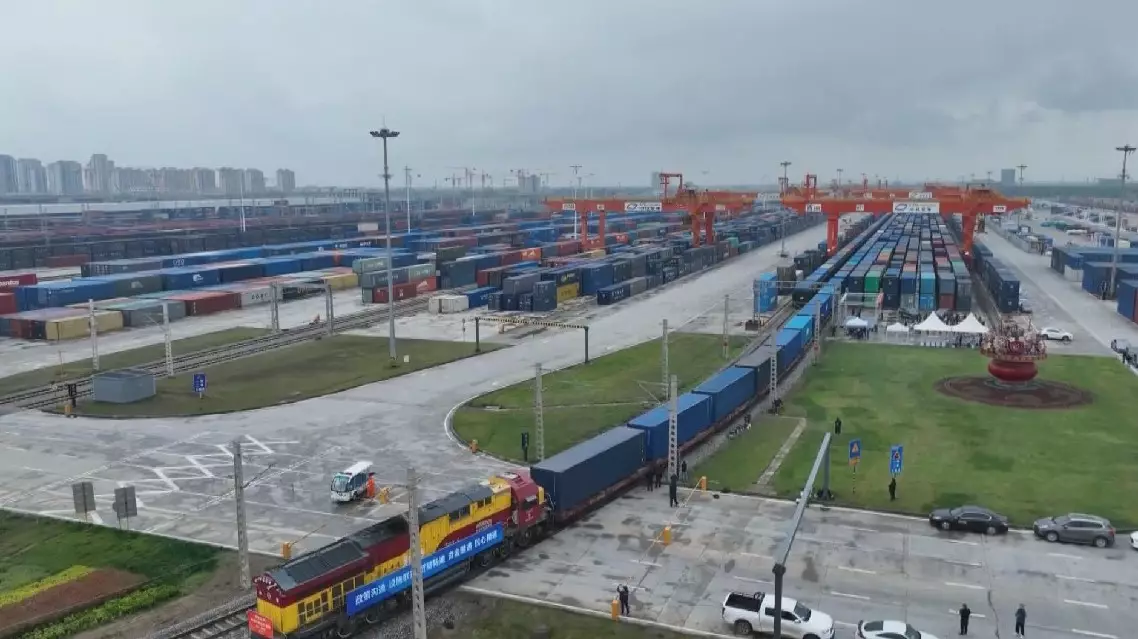
China’s economic conference clearly outlines 2025 goals: experts
China’s economic conference clearly outlines 2025 goals: experts

Iran on Monday publicly rejected a core U.S. demand to cease all uranium enrichment, while projecting a dual-track strategy of guarded diplomatic engagement and reinforced military preparedness.

The moves came as the indirect Iran-US talks in Oman's Muscat last week yielded no breakthrough and regional tensions continued to simmer.

On Monday, Mohammad Eslami, president of the Atomic Energy Organization of Iran, said that while Iran could consider diluting its 60-percent enriched uranium, it would only do so if all international sanctions were first lifted.

Eslami also dismissed past proposals to ship the material abroad for safekeeping.

Iranian President Masoud Pezeshkian and Foreign Minister Seyed Abbas Araghchi echoed this line on Monday, reaffirming Tehran's strategy of engaging in talks while refusing to concede on what Iran views as sovereign rights.

Pezeshkian and Araghchi have described the Muscat talks as a "good start" but warned that diplomacy must be based on "respect, not coercion."

In a televised speech on Monday, Iran's Supreme Leader Ali Khamenei urged Iranians to show unity and "disappoint the enemy" ahead of the 47th anniversary of the 1979 Islamic Revolution, amid rising tensions with the United States.

Meanwhile, Ali Larijani, secretary of Iran's Supreme National Security Council, is set to lead a delegation to visit mediator Oman on Tuesday.

Simultaneously, Iran has signaled a shift toward greater military opacity. Iran's state news agency IRNA said in a report on Sunday that the Defense Ministry has halted all public displays of new weaponry "for security reasons and to safeguard the principle of surprise," a move widely interpreted as preparing for potential conflict.

Positions from the United States and Israel have appeared equally firm. A report on Sunday by Israel's Channel 15 said the United States had privately messaged Iran, seeking Iran's "concessions" in the next round of talks, and expecting "serious and meaningful content."

On Monday, The Jerusalem Post, citing Israeli defense officials, reported that Israel has warned the U.S. it "will strike alone" if Iran crosses its "red lines" on ballistic missiles.

Israeli Prime Minister Benjamin Netanyahu's office said on Sunday that he will meet with U.S. President Donald Trump on Feb 11 in Washington, and will discuss the U.S.-Iran negotiations.

Netanyahu is expected to demand that the U.S. promote the transfer of Iran's enriched uranium out of the country and restrict Iran's ballistic missile capabilities.

Iran rejects zero enrichment, projects dual-track posture amid stalled talks with U.S.

Iran rejects zero enrichment, projects dual-track posture amid stalled talks with U.S.

Recommended Articles