China's home appliance giant Haier stands out as a beacon of innovation, with more and more of its plants recognized as "lighthouse factories" integrating AI technology across product design, production processes and customer service.
In October, World Economic Forum (WEF) unveiled its 12th batch of global lighthouse factories. Haier Jiaozhou Air Conditioner Interconnected Factory, located in Qingdao City of east China's Shandong Province, secured its place as an "end-to-end lighthouse factory" for its seamless integration of big data, advanced algorithms, and generative AI across the entire value chain. This milestone brought Haier to have nine lighthouse factories and one sustainable lighthouse factory in total, cementing its position as a global leader in manufacturing excellence.
The Jiaozhou factory has made significant strides, exporting products to over 130 countries and regions, a feat made possible through the development and implementation of its COSMOPlat platform.
As the world's first platform to incorporate full-process user participation, COSMOPlat epitomizes Haier's shift from traditional production to mass customization. By transforming hardware experiences into tailored scenarios, the platform enables users to transition from passive buyers to active participants and co-creators. This approach, in turn, reorients the company's operations from being product-centric to user-centric.
The Jiaozhou factory exemplifies a fully digitized production process, from order placement to product delivery. Even production scheduling, once reliant on manual Excel sheets, is now automated.
"Every Wednesday and Thursday we finalize production plans for the following week. This involves scheduling 400 to 500 product types, amounting to 200,000–250,000 units. Previously, we relied on manually updating Excel spreadsheets, which often took more than four hours and sometimes extended into the night. Now, we just need to select our orders and click the scheduling button. The system processes everything automatically, allowing us to focus on other tasks instead of constantly monitoring the process," said Wang Cheng, an order manager at the factory.
Beyond automation, the platform offers optimization suggestions based on self-learning algorithms. These algorithms analyze historical production data while integrating projections for upcoming months. By continuously expanding its database after each production cycle, the system enhances the accuracy of its forecasts.
The factory's AI-driven systems extend beyond production into product design, where they have dramatically improved efficiency. The facility currently manufactures over 700 product models and introduces approximately 150 new models annually. Previously, designing new products required extensive trial-and-error iterations involving manual testing. By leveraging predictive models built on accumulated design data and module parameters, engineers can now input basic boundary conditions to generate product specifications instantly. This innovation has reduced the design cycle from 110 days to just some 50 days.
Haier's application of AI also extends into its after-sales service, where the company employs sensors to monitor air conditioner performance in real time. Predictive analytics detect potential faults, enabling service teams to address issues proactively before they escalate. This forward-looking approach minimizes repair frequency and enhances customer satisfaction.
Chen Xinghua, head of Intelligent Factory Solutions at Haier's COSMOPlat Institute of Industrial Intelligence, emphasized the importance of integrating upstream and downstream information flows.
"It's crucial to connect our upstream user data and downstream information. Otherwise, the factory remains a 'black box,' relying on external instructions to determine what to produce. Now, we have the initiative to understand what needs to be done, preparing our capacity and logistics to better serve our users," Chen said.
The success of Haier's Jiaozhou factory offers valuable lessons for manufacturers across industries.
"It can provide comprehensive digital and intelligent upgrades across various industries, including energy and chemicals, traditional home appliances, automobiles, electronics, and apparel, transcending industry boundaries to serve our customers," Chen said.
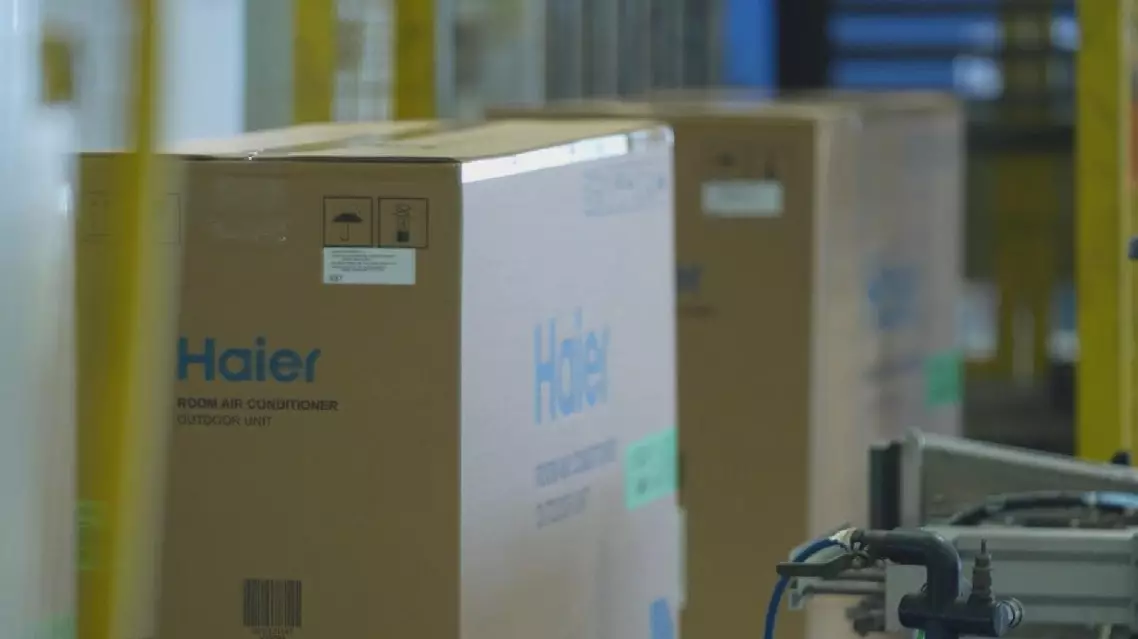
Haier's lighthouse factory redefines intelligent manufacturing, customer-centric innovation