With burgeoning development of Macao, four iconic cross-sea bridges connecting the Macao Peninsula and Taipa island have borne testaments to the region's seismic changes.
The latest episode of China Media Goup (CMG)'s documentary "25 Years of Lotus Bond" highlights how these bridges have significantly contributed to Macao's economic prosperity and improved the quality of life for its residents.
The journey began in 1974 with the Governor Nobre de Carvalho Bridge. This was the first bridge to connect the peninsula and Taipa Island, equipped with dual two-lane roads and ample clearance for large vessels below. Its inauguration marked the end of an era defined by ferry rides, laying a vital transportation foundation for Macao's burgeoning economy.
Zhong Shan, a marathon enthusiast and veteran of the construction industry, relishes the changing scenery as he runs through Macao.
"I start from the peninsula, cross the Governor Nobre de Carvalho Bridge and then take the walking path across from Ocean Garden. After that, I would run south to Coloane and back from there to the building we are right now. That gives me a half marathon. The views from the bridge are so good that I often forget I'm tired," Zhong shared.
As Taipa and Coloane thrived, the original bridge often faced gridlock. In a bid to ease congestion, the Ponte de Amizade, also called the Bridge of Friendship, emerged from the drawing board, completed in 1994 after four years of construction. Spanning more than 4,000 meters, it became another lifeline for the region.
The Sai Van Bridge, completed in 2004, took connectivity to new heights with its innovative double-decker design, further weaving together the fabric of Macao's transportation network.
Fast forward to Sept 29, 2024, excitement rippled through the streets as residents gathered to celebrate the imminent opening of the Macao Bridge. This impressive structure, the first dual eight-lane crossing in the region, promises to seamlessly integrate the transport system in the region.
"Thanks to the care of our motherland, life in Macao has become more desirable, and transit is becoming more accessible," said a local resident.
"As a Macao resident, we deeply appreciate the nation's unwavering support for our economic growth and improved living standards," said another resident.
Two days later, on National Day, the Macao Bridge officially welcomed its first batch of vehicles.
The sight of these four bridges, spanning the waters like a vivid rainbow, stands as a testament to Macao's remarkable journey.
The story of Macao's cross-sea bridges was featured in the third episode of the CMG documentary aired on Sunday. The series premiered on CCTV-1 at 20:00 Friday and will run until Dec 17, with subsequent broadcasts on CCTV-4 and CCTV-13.
The documentary comprises five thematic episodes: Love for the Home and the Nation, A Path of Diversity, The Flavor of Happiness, A City of Integration, and Gateway to the Future. It highlights the successful practices of "one country, two systems" in Macao under the strategic guidance of the central government.
The Chinese government resumed sovereignty over Macao and established the Macao Special Administrative Region (SAR) on December 20, 1999.
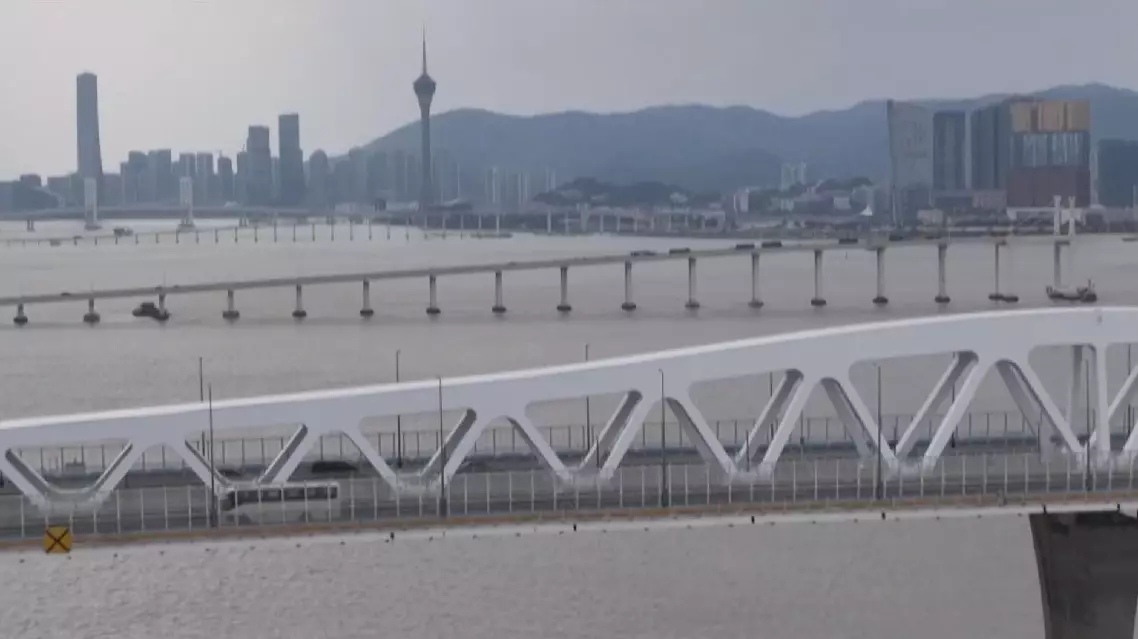
Iconic cross-sea bridges bear testimony to seismic changes in Macao