China's Macao Special Administrative Region (SAR) is establishing itself as a vital bridge connecting China and Portuguese-speaking countries under the support and guidance of the central government, fostering expanding trade relations and cultural exchanges while driving the region's appropriate economic diversification.
This bridge-building role of Macao is exemplified by individuals like Rodrigues Angela Claudia, a fourth-generation businesswoman of mixed Chinese-Portuguese descent. Her family's trading company, F. Rodrigues (Successors) Limited, established in 1916, has long facilitated trade between Portugal and the Chinese mainland.
Now, with increasing collaboration between China and Portuguese-speaking countries, Angela, assistant to the general manager of the company, is navigating a new era of opportunity.
Just two kilometers from her office at Rodrigues Commercial Building stands the striking the China-Portuguese-speaking Countries Commercial and Trade Service Platform Complex.
"This building was established in 2019, followed by the exhibition area, where we are now gradually moving in to attract more visitors, including the Chinese mainland's tourists and business groups. They will learn about these products and potentially bring them back home," Angela said in an interview with China Central Television in the run-up to the 25th anniversary of Macao's return to the motherland on Dec 20, 1999.
The 1,800-square-meter exhibition space within the complex displays a diverse range of products from nine Portuguese-speaking countries, from East Timorese coffee beans and Mozambican cashews to Brazilian chili peppers.
Five years ago, coinciding with the 20th anniversary of Macao's return to China, Chinese President Xi Jinping visited the complex on an inspection tour in Macao.
Angela recalled President Xi's visit with pride, particularly his interest in her company's Portuguese sardines.
"The sales of Portuguese sardines has had over 80 years of history in Macao, so many generations of Macao residents have grown up eating them. It was unexpected that such a small product would receive attention from President Xi," Angela said.
Her mother, Hong San San, deputy general manager of F. Rodrigues (Successors) Limited, added, "We were all very happy. Friends immediately sent us photos [about Xi's visit]. It was truly encouraging."
Former Secretary for Economy and Finance Lionel Leong also remembers the significance of the visit.
"On the morning of December 19, 2019, we were very honored to have President Xi visit the China-Portuguese-speaking Countries Commercial and Trade Service Platform Complex. He was keen to understand Macao's role in the platform and showed great interest in products from Portuguese-speaking countries," he said.
During the visit, President Xi said he was pleased to see that the complex had been equipped with various facilities as planned and the idea of building the platform had become a reality, calling the construction of the service platform an "important step" in giving full play to Macao's strengths to meet the needs of the country.
Leveraging its unique historical roots, Macao has maintained close and extensive connections with Portuguese-speaking countries, which comprises nine countries across four continents.
This strategic positioning of Macao was further reinforced in the outline development plan for the Guangdong-Hong Kong-Macao Greater Bay Area city cluster in south China, issued by the Communist Party of China (CPC) Central Committee and the State Council on Feb 18, 2019.
The outline underscores the goal of fostering Macao's evolution into a crucial commercial and trade cooperation hub between China and Portuguese-speaking countries, positioning this compact city of just over 30 square kilometers as a vital link between vast markets.
"I often say it's a gift from the central authorities. Macao must play a key role in the future development of China's relations with Portuguese-speaking countries, leveraging our precise connections effectively," Leong said.
Angela, a witness and beneficiary of the platform's development, said she aims to leverage resources from Portuguese-speaking countries to create a Macao brand for both domestic and international markets.
"President Xi's inspection of Macao and his emphasis on the platform have given those of us in this industry great hope and confidence," she said.
Xi said promoting appropriately diversified and sustainable economic development of Macao based on its positioning as a global tourism and leisure hub and a service platform for economic and trade cooperation between China and Portuguese-speaking countries is important not only for the people in Macao, but also for the development of the region and even the whole country.
Over the years, Xi has been deeply concerned about Macao's development, even during his overseas visits and diplomatic meetings.
In December 2018, during a state visit to Portugal, Xi emphasized Macao's unique role in enhancing communication and cooperation between China and Portuguese-speaking countries, as well as its significance in implementation of the Belt and Road Initiative.
In April 2019, during talks with Portuguese President Marcelo Rebelo de Sousa in Beijing, he reiterated that Macao has become a bridge for the long-term friendly cooperation between China and Portugal.
如今这座不到70万人口的涌动着中国与葡语国家合作的蓬勃生机。 Today, Macao, with a population of under 700,000, is a vibrant hub for China-Portuguese-speaking countries cooperation, breathing life into shared endeavors.
Local entrepreneurs like Chan Kuok Sang are capitalizing on this, promoting natural fragrances from Portuguese-speaking countries in the Chinese market.
"Portuguese-speaking countries are among the world’s richest in natural aromatic resources. We have focused on promoting natural spices from these countries into the Chinese market in recent years," Chan said.
"I believe the China-Portuguese platform offers a great opportunity for us to bring Mozambican products to the Macao market, with potential future expansions into the Chinese mainland," said Mozambique businessman Pereira.
"Besides economic and trade relations, the development of cultural and educational connections through the Macao platform is a distinctive aspect of our positioning," said Leonel Alberto Alves, president of Lusophone Arbitration and Mediation Association.
"Leveraging Macao's strengths to support the nation's needs and continuing to build Macao as a platform for [cooperation] between China and Portuguese-speaking countries is a long-term mission of the Special Administrative Region government," said Lei Wai Nong, secretary for economy and finance of the Macao SAR government.
Under President Xi's guidance and support, Macao continues to integrate itself into the country's overall development, seizing new opportunities through its participation in the Belt and Road Initiative and the Greater Bay Area construction.
The Greater Bay Area consists of the Hong Kong Special Administrative Region (HKSAR), the Macao SAR, as well as nine cities in Guangdong Province -- Guangzhou, Shenzhen, Zhuhai, Foshan, Huizhou, Dongguan, Zhongshan, Jiangmen and Zhaoqing.
China aims to build the bay area into a role model of high-quality development, an international first-class bay area and a world-class city cluster, as a key development strategy in the country's reform and opening up.
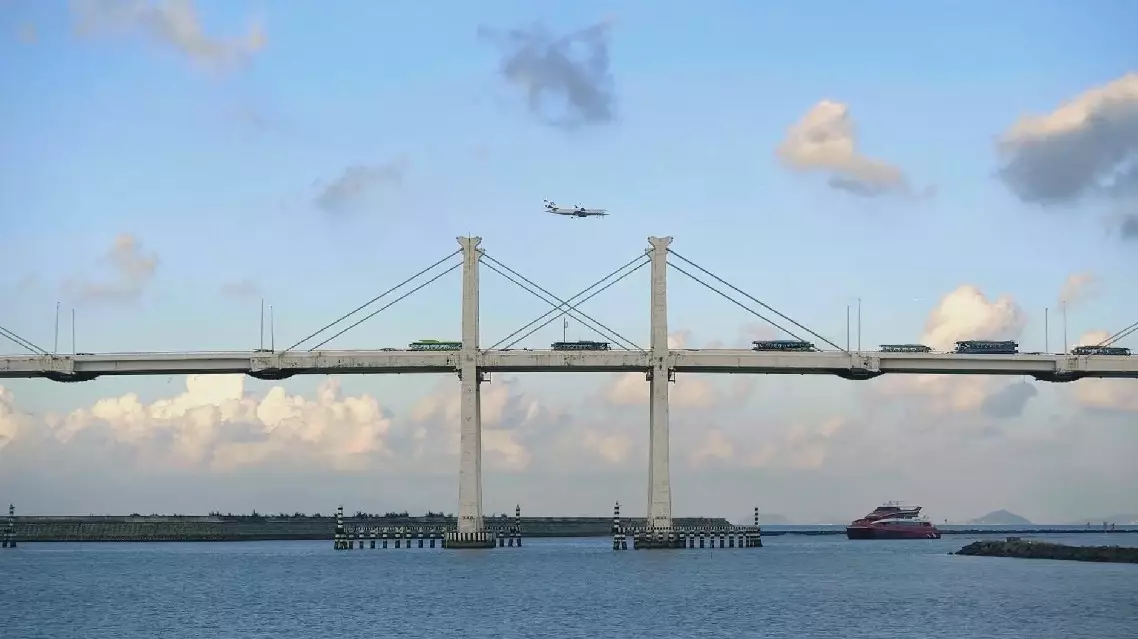
Macao emerges as key bridge facilitating cooperation between China, Portuguese-speaking countries