China Media Group (CMG) on Monday unveiled its selection of top 10 news stories for China's archaeological findings in 2024.
The top 10 domestic archaeology news for 2024 are as follows.
1. Fifty-six Chinese cultural relics were returned from Italy.
On Nov 8, President Xi Jinping witnessed the return of 56 lost Chinese cultural relics from Italy, part of over 2,100 items returned to China.
2. The highest-level tomb from ancient Chu state dating back to over 2,200 years was discovered in east China's Anhui Province.
The Wuwangdun tomb excavated in Huainan City of Anhui has been confirmed as the largest and highest-level tomb from ancient Chu state and the most structurally complex of its kind.
Covering a total area of some 1.5 million square meters, the millennia-old mausoleum includes a main tomb (Tomb No. 1), a rectangular chariot and horse pit, accompanying tombs, and sacrificial pits.
Key findings included the largest ancient bamboo mat ever found in China, bronze wares, over 100 wooden figurines and many well-preserved seeds.
3. Mengxihe site in southwest China's Sichuan Province reveals a comprehensive picture of early human society through stone tools and remains dating back to the Palaeolithic Age.
The Mengxihe Site located in Sichuan's Ziyang City dates back to between 50,000 to 70,000 years ago, and preserves a number of organic matter remains including animal fossils, ebony and plant seeds, which are of great significance to the study of ancient humans' collecting behaviors.
4. A tomb from the Three Kingdoms (Wei, Shu and Wu) period, linked to Eastern Wu minister Zhang Zhao, was uncovered in Nanjing, shedding light on aristocratic burial rituals and highlighting Nanjing's historic role as Eastern Wu's capital.
5. Archaeologists made more discoveries at one of the largest tombs in the Qinghai-Xizang Plateau in northwest China.
This newly researched tomb complex belongs to Reshui graveyard site which was built during the Tuyuhun-Tubo period of the early Tang Dynasty (618-907) in Dulan County, Haixi Mongolian Tibetan Autonomous Prefecture, northwest China's Qinghai Province, according to the archaeological team.
6. Large-scale building foundations dating back approximately 2,500 years were discovered in Shaoxing City, east China's Zhejiang Province.
This discovery marks the first confirmation of such structures from the Warring States Period (475-221 BC) within the city, providing crucial clues in the search for the capital of the ancient Yue State.
7. A 1.1-million-year-old site in the Nihewan Basin shows advanced tool-making techniques, highlighting early human innovation.
An international research team, led by the Institute of Vertebrate Paleontology and Paleoanthropology (IVPP) of the Chinese Academy of Sciences, carried out systematic study on the characteristics of stone tool technology at the Cenjiawan site in Nihewan basin, northern China, revealing the earliest prepared core technology in Eurasia.
8. Fossils dating back 300,000 years found at the Hualongdong site east China's Anhui Province offer insights into early human evolution in East Asia. Discovered in late 1988, the Hualongdong site has yielded remarkable finds during continuous excavations since 2013. Approximately 20 individual ancient human fossils, including a relatively complete skull, over 400 stone artifacts, numerous bone fragments with evidence of artificial cutting and chopping, and more than 80 vertebrate fossils have been unearthed at this site.
9. The discovery of a relics site dating back about 3,700 years marks a major breakthrough in archaeological research on the Xia Dynasty (2070 BC-1600 BC), China's earliest known dynasty.
The Baliqiao archaeological site, located in Fangcheng County in the city of Nanyang, central China's Henan Province, shows enormous similarity to the Erlitou ruins, a previously excavated ground-breaking site that was identified by archaeologists as one of the capital cities during the Xia Dynasty.
10. The unearthing of nearly 4,000 artifacts from an excavation of 1,240 tombs in Xi'an, capital of northwest China's Shaanxi province, sheds light on burial customs during the Tang Dynasty (618-907).
Among the finds in Xi'an Jiali Village is the family tomb of the Tang Dynasty imperial consort, concubine Dong. It offers invaluable insights into the reign of the Emperor Xuanzong (685-762) and the political and social dynamics of the era.
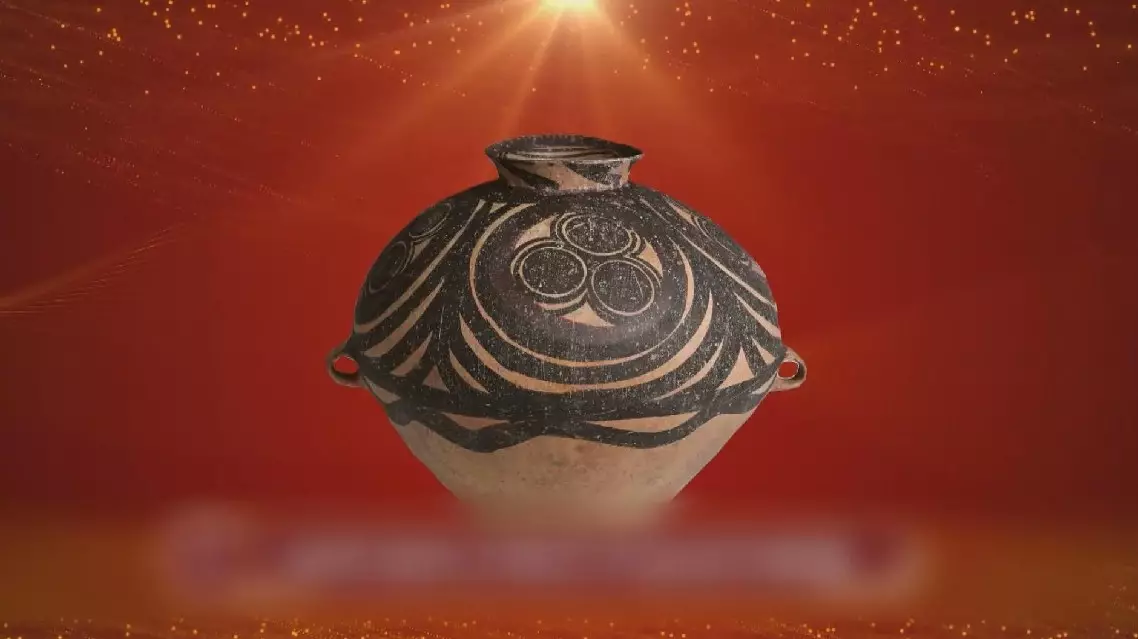
China Media Group picks top 10 domestic archaeology news for 2024