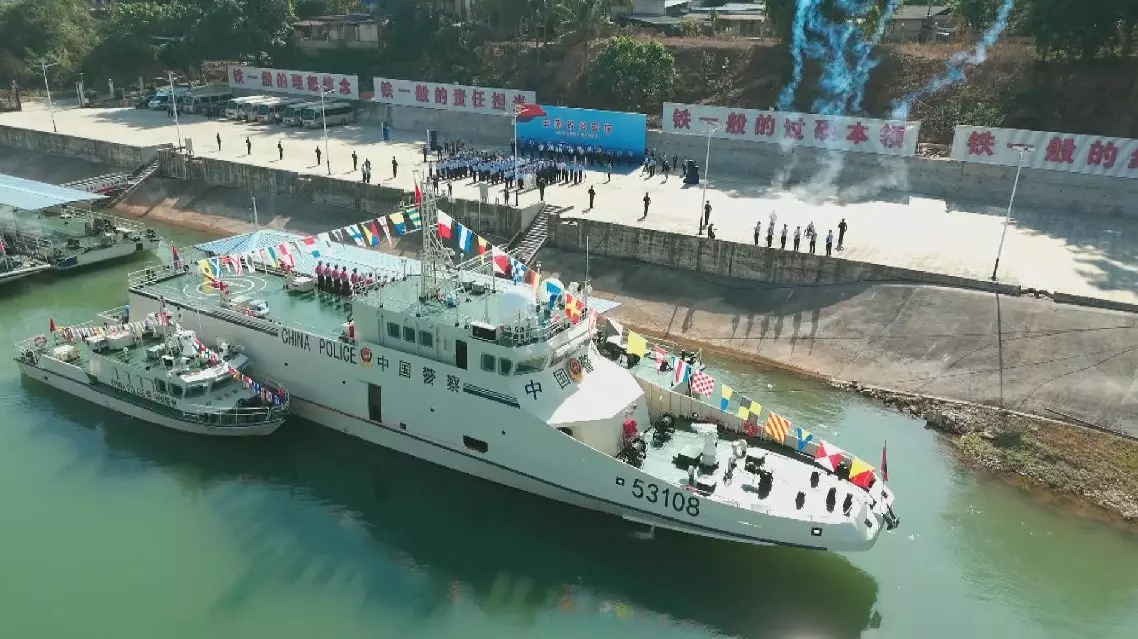
Two new Chinese law enforcement vessels were officially commissioned on Monday to support joint patrols and law enforcement missions by China, Laos, Myanmar and Thailand on the Mekong River.
The two vessels are respectively the new command vessel No. 53108 and the high-speed patrol law enforcement vessel No. 53117. Their performance and functions have been enhanced and expanded to meet the requirements of joint Mekong River patrols and law enforcement missions for the new era.
More than 200 representatives from law enforcement departments and guests from all walks of life from China, Laos, Myanmar and Thailand participated in the handover ceremony.
The vessel No. 53108 will participate in the 148th joint patrol on the Mekong River.
The Mekong River, also known as the Lancang River in China, is an important waterway for cross-border transportation. Since December 2011, the four countries have been conducting joint river patrols.
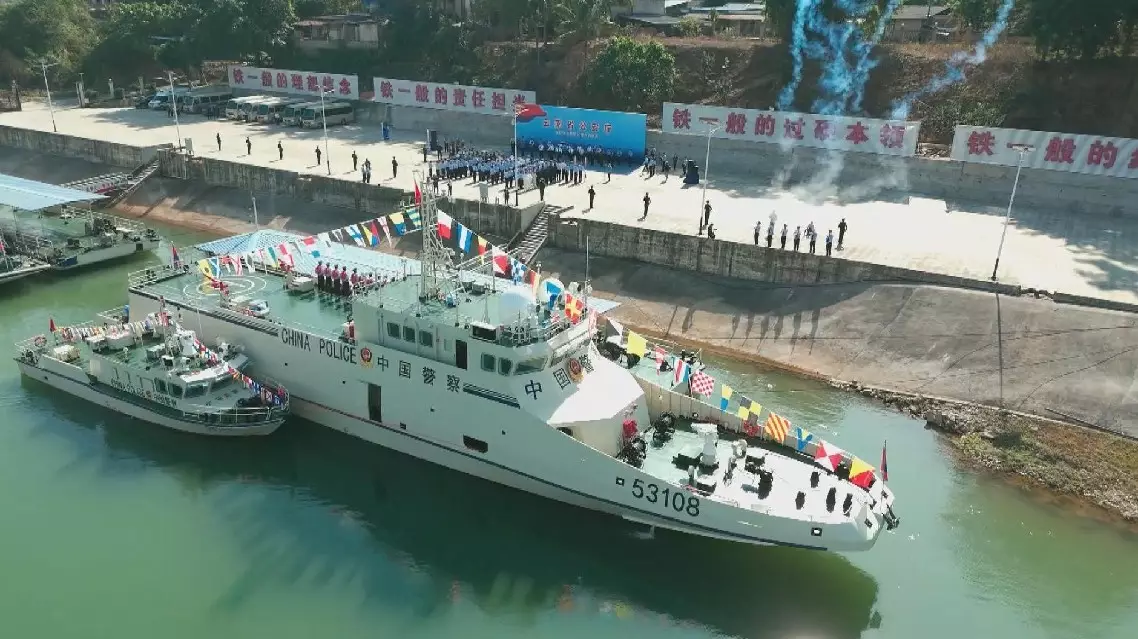
New Chinese vessels commissioned for Mekong River joint patrol
International observers have commended China's steady development trajectory as a source of confidence and stability for the global economy, with experts from Russia and Mexico highlighting the strategic direction set out in the country's 15th Five-Year Plan (2026-2030).
Chinese lawmakers on Thursday approved the outline of the 15th Five-Year Plan at the closing meeting of the fourth session of the 14th National People's Congress, wrapping up this year's "two sessions", the country's annual political gatherings widely watched around the world.
Experts and officials shared their perspectives on China's policy direction, particularly its focus on technological innovation and systematic development.
"The entire population has benefited from China's economic achievements and successes. At present, preparations for the 15th Five-Year Plan are particularly noteworthy precisely because the country's leadership is striving to reach a new level in addressing social challenges. This five-year period will be extremely difficult in terms of the foreign policy environment. Global turbulence is increasing, and problems and challenges that may come from abroad must be compensated for by internal development. China has successfully done this so far, and is now doing it even more systematically and with greater precision," said Dmitry Novikov, first deputy chairman of the Committee on International Affairs of Russia's State Duma, on Tuesday.
Mexican economist Enrique Dussel, professor of economics at the National Autonomous University of Mexico, said China's remarkable progress in high-tech sectors was a result of the continuity and focus of its innovation policies.
"This is very present in the 'two sessions'. There is a coherent bet regarding high tech. So China does not copy and paste existing technologies, but is increasingly specializing in new disruptive technologies and innovations, from artificial intelligence to electric automobiles, autonomous transportation, nanotechnology and new technologies in which China is becoming the leader," he said.
"China has become the leader in a group of key sectors in global value chains. And very importantly, China today is pushing in these new high tech sectors through policies, such as new productive forces. So everything shows, we expect that China will continue with this path in the next Five-Year Plan," he said.
As global uncertainties mount, observers noted that China's systematic approach to development and its emphasis on shared progress offer valuable lessons and opportunities for cooperation, particularly for countries in the Global South seeking sustainable development pathways.
Int'l observers view China's 15th Five-Year Plan as source of global confidence