China debuted its first polysilicon futures on the Guangzhou Futures Exchange on Thursday.
The total volume of trading reached 32.855 billion yuan (about 4.5 billion U.S. dollars) on Thursday morning.
Polysilicon options contracts will be added on Friday.
China is the world's largest producer, consumer and importer of polysilicon.
Polysilicon is a key material for the photovoltaic industry.
Price fluctuation for polysilicon reached 280 percent in China in 2023.
The Guangzhou Futures Exchange is offering seven polysilicon futures contracts.
The benchmark listing price for the futures was 38,600 yuan per metric ton.
At 09:00 upon opening, the main polysilicon futures contract surged by as much as 13.99 percent, hitting the upper limit at 44,000 yuan per metric ton.
The momentum then weakened, with the increase narrowing to around 7 percent, and prices stabilizing at approximately 41,000 yuan per metric ton.
"The polysilicon futures are able to provide long-term price signals and risk management tool for relevant enterprises, help enterprises with reasonable planning of production capacity layout and arrangements of production and operation, guide the industry in optimizing resource allocation, resisting risks of price fluctuations, and stabilizing production and operation, and enhance the resilience and security of industrial and supply chains," said Chen Ruigang, an official of Guangzhou Futures Exchange.
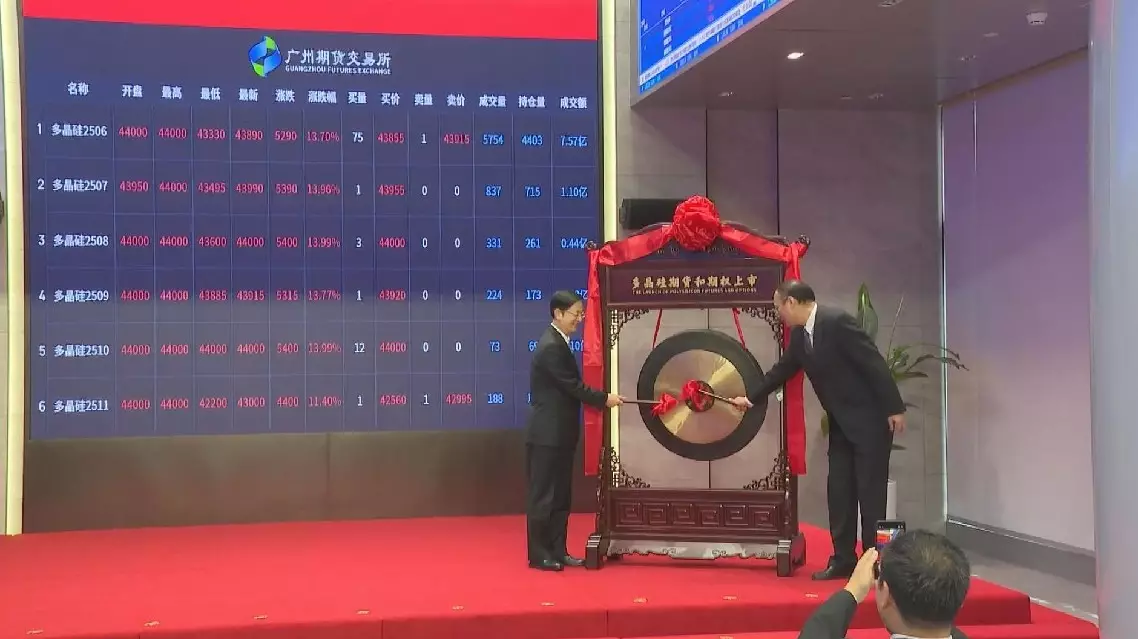
China's first polysilicon futures debut
Pakistani warplanes struck several locations across Afghanistan on Thursday night and Friday, killing at least six people, including a woman and a child, and wounding more than a dozen others, local officials said.
The strikes hit a fuel depot near the country's Kandahar Airport, areas in the capital Kabul, and the eastern Nangarhar Province.
A Pakistani security source said the strikes targeted hideouts belonging to the Pakistani Taliban, also known as Tehrik-e-Taliban Pakistan (TTP).
In Kabul's 21st police district, one of the areas hit, a market was left in ruins. Several cars were destroyed, and windows of buildings in the market and nearby areas were shattered. A crater caused by the Pakistani airstrikes was also visible.
"This is my car. I had parked it here, and it was the only way I could bring food to my family's table. It was my sole source of income and my only means of employment. Now my car is in this condition, and I have no other way to provide for my family," said Mohamad Ghulam, a taxi driver.
The airstrikes destroyed a house, killing four members of a single family. More than a dozen other households in the area reported their homes either fully or partially destroyed.
One of the victims was 22-year-old Hedayatullah, who had just been married. He was killed alongside his pregnant wife, as well as his brother and sister.
"Hedayatullah got married nine months ago. His brother was 18 years old. He himself was 22 years old, he also had a 12-year-old sister, and his wife was about 19 years old and was pregnant," said Ghulam Sakhi, a relative of the victims.
"This neighbor of ours was a family of five. Their mother was not present at the moment of the bombardment, but the rest of them lost their lives. It was Hedayatuallah's family. From my own family, two of my daughters, my sister-in-law, my brother, and two nieces got injured," said Mohamad Homayoun, a survivor.
In the past weeks, scores of people from both sides have been killed or injured in the conflict between Afghanistan and neighboring Pakistan, according to officials from the two countries.
The United Nations mission in Afghanistan has called for an immediate halt to cross-border clashes, warning that the escalating violence is driving a surge in civilian casualties and deepening a humanitarian crisis.

At least 6 killed, more than a dozen wounded in Pakistani airstrikes on Afghanistan: officials