Latest official customs data showed the total import and export value of the nine provinces and autonomous regions along the Yellow River reached 1.09 trillion yuan (about 158 billion U.S. dollars) in the first two months of 2026, rising 15.4 percent year on year.
The figure, a new record for the period, highlights the Yellow River Basin's foreign trade performance, characterized by steady expansion and leading other inland regions.
Specifically, trade growth within the Yellow River basin varied significantly. Six provincial-level regions along the river recorded growth, with Shaanxi, Inner Mongolia, Henan, and Ningxia leading the way -- posting year-on-year increases of 69 percent, 38.6 percent, 28.2 percent, and 23.9 percent, respectively.
Looking at export categories, the "new three" (electric vehicles, lithium-ion batteries and photovoltaic cells), along with other high-tech and agricultural products saw notable growth. Mechanical and electrical products, in particular, surged 17.3 percent, accounting for 61 percent of total exports.
Take the marine economy in east China's Shandong Province as an example: its mechanical and electrical products, especially high-value marine engineering equipment with long supply chains, have shown impressive export momentum. These products have held the world's largest market share for several consecutive years, injecting strong momentum into China's foreign trade growth.
"We have successfully overcome key technical challenges, including the welding of ultra-high-strength steels, and integrated air-cooled generators above 1,000 kW and air-conditioning systems into offshore platforms. This fills a technological gap in related domestic fields," said Xie Wanpeng, a deputy general manager at Qingdao Haixi Heavy-Duty Machinery Co., Ltd., a subsidiary of China State Shipbuilding Corporation (CSSC)'s Wuhan Marine Machinery Plant Co., Ltd.
The shipbuilding and offshore engineering equipment industry, integrating high-end manufacturing, new materials, and smart systems, requires a resilient and increasingly sophisticated industrial chain for support.
At the Haixi Bay Shipbuilding and Marine Engineering Industrial Base in Qingdao, east China's Shandong Province, where the company is located, over 50 shipbuilding, offshore engineering equipment manufacturing, and supporting enterprises have clustered. This has formed a powerful industrial ecosystem featuring leading players driving innovation, research and development-led growth, and full-chain collaboration.
"About 30 percent of the materials for our ongoing projects are supplied by the local industrial cluster. This shortens procurement radius and significantly reduces logistics costs. Currently, we have over 100 platforms and port machinery equipment under construction, with delivery dates scheduled through 2027," said Zhou Zhenfeng, a project manager of offshore platform division at Qingdao Haixi Heavy-Duty Machinery Co., Ltd.
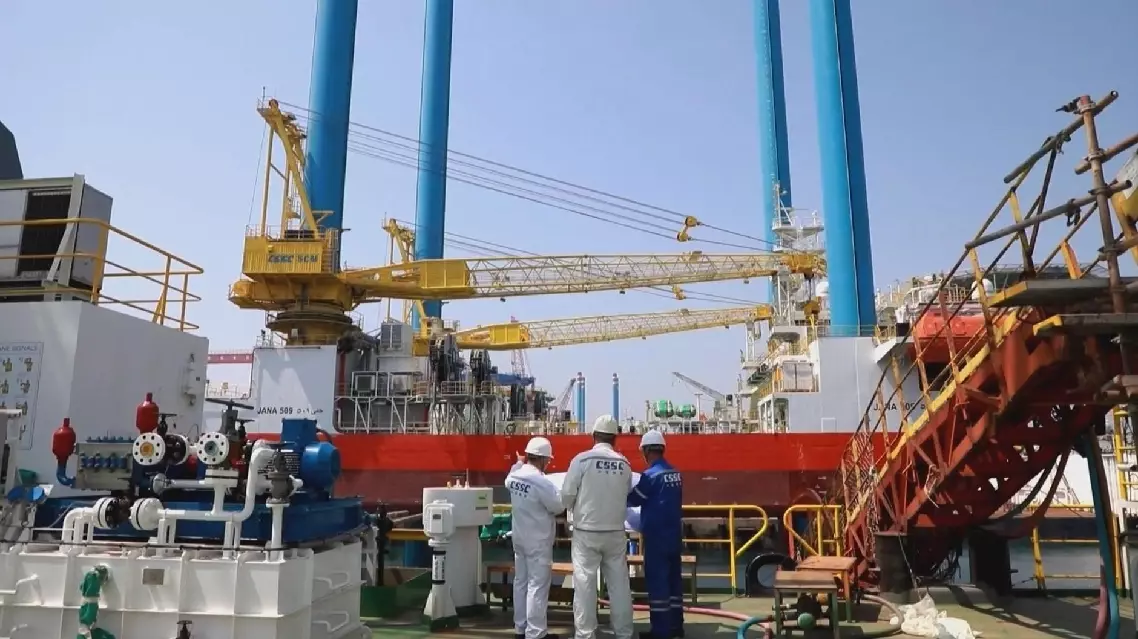
Foreign trade in Yellow River Basin hits 1.09 tln Yuan in Jan-Feb
U.S. President Donald Trump on Friday threatened to increase tariffs on cars and trucks imported from the European Union (EU) to 25 percent next week.
Trump said on Truth Social that he is "pleased" to announce that, based on the fact the EU is not complying with U.S.-EU trade deal, next week he will be "increasing tariffs charged to the European Union for cars and trucks coming into the United States," adding the tariff will be increased to 25 percent.
"It is fully understood and agreed that, if they produce cars and trucks in U.S.A. plants, there will be NO TARIFF," he stressed.
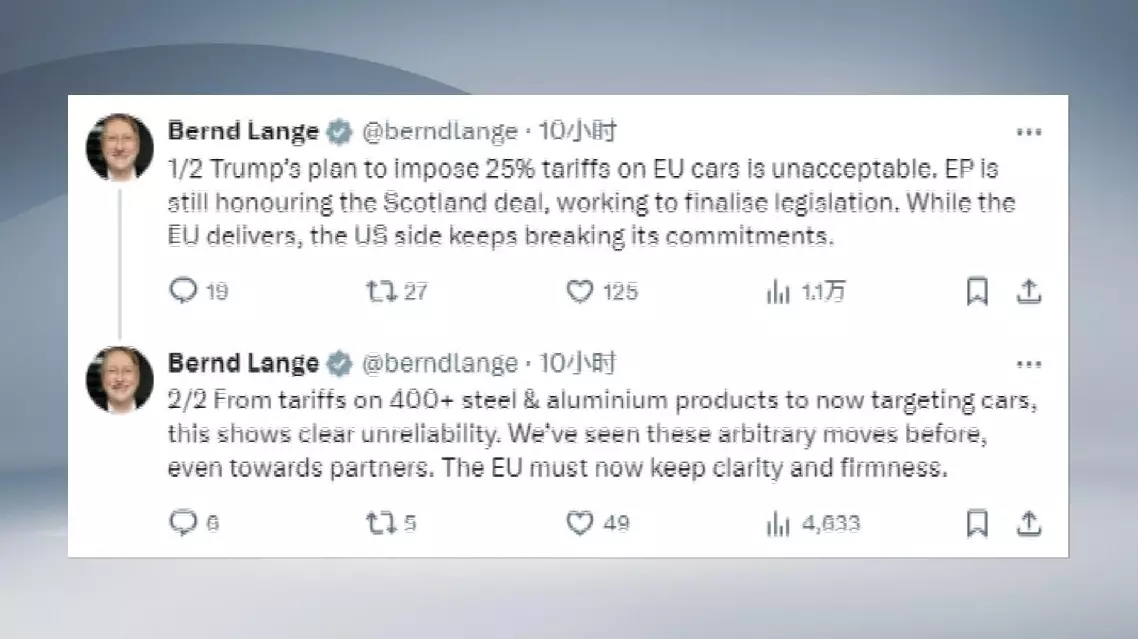
Bernd Lange, chair of the European Parliament's (EP) Committee on International Trade, on the same day strongly condemned the U.S. plan to slap the auto tariff, declaring the move "unacceptable" in a post on X.
Lange said the EU and the EP are honoring the trade agreement reached with the United States in Scotland last year, and are working on legislation to implement it.
"We are currently drafting the legislation; we have a parliamentary position and aim to finalize this in June," Lange said.
Lange said the United States has repeatedly breached the agreement, including imposing tariffs on more than 400 products containing steel and aluminium. Those products are now subject to an average tariff of 26 percent, he said.
He noted that Trump's latest move demonstrates just how "unreliable" the U.S. side is.
A European Commission spokesperson said Friday that the EU will "keep options open" to protect its interests if the United States takes measures inconsistent with the joint statement between the two sides signed last year on reciprocal, fair and balanced trade.
The EU remains fully committed to a predictable, mutually beneficial transatlantic relationship, the spokesperson said, adding that should the United States take measures inconsistent with the Joint Statement, "we will keep our options open to protect EU interests."
The EU is implementing its Joint Statement commitments in line with standard legislative practice, keeping the U.S. administration fully informed throughout, the spokesperson said, adding that the EU maintains close contact with its U.S. counterparts while also seeking clarity on U.S. commitments under the deal.
The U.S.-EU trade deal was reached last year, under which the EU would suspend tariffs on all U.S. industrial products and introduce tariff-rate quotas for a wide range of U.S. agri-food products entering the EU market. In return, the United States would apply a 15-percent import tariff on most EU goods.
The U.S. Supreme Court ruled in February that the Trump administration's tariff policies under the International Emergency Economic Powers Act were unconstitutional. But the Trump administration has since introduced a new set of import taxes based on other laws, seeking to impose a new tariff regime.
According to EU statistical agency Eurostat, the value of EU-U.S. trade in goods and services reached 1.7 trillion euros (about 2 trillion U.S. dollars) in 2024, equivalent to roughly 4.6 billion euros per day.
Trump threatens to raise tariffs on auto imports from EU to 25 pct