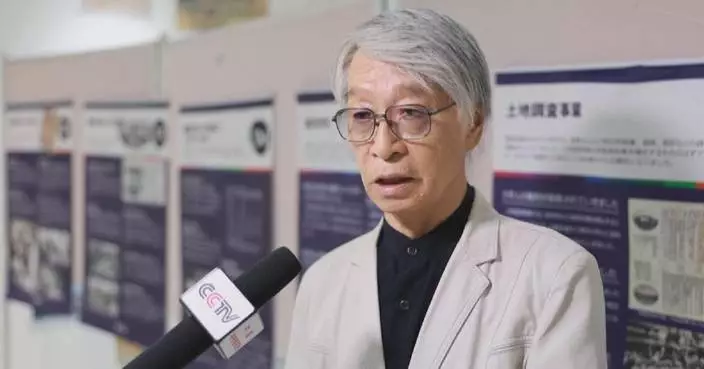
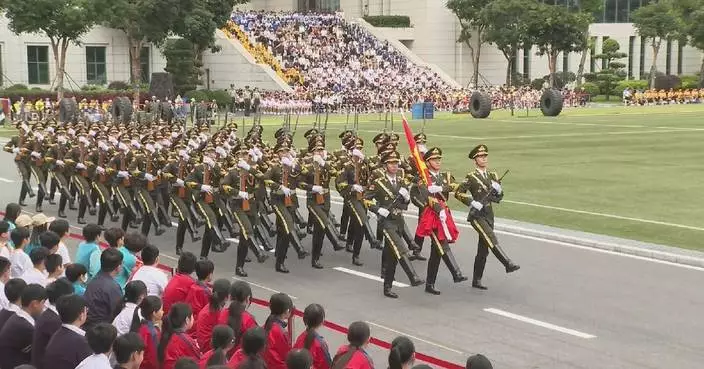
A group of Japanese peace activists gathered outside the Prime Minister's Office in Tokyo on Friday to protest the government's push for constitutional revision and the lifting of a ban on lethal weapons exports.
The Japanese government officially revised the "Three Principles on Transfer of Defense Equipment and Technology" and related implementation guidelines on April 21, allowing overseas sales of weapons, including those with lethal capabilities.
Kyodo News, a Japanese news agency, said the changes mark a significant shift in the country's defense policy, noting that it has long touted itself as a "peace-loving nation" under its war-renouncing Constitution since its defeat in World War II.
The protesters accused the Takaichi administration of lifting the export ban without sufficient debate or deliberation in the National Diet.
"Without full discussions in the National Diet, the government just arbitrarily decided on arms exports and made various excuses for it. Also, regarding the incident of intrusion into the Chinese embassy, the government has not issued an apology. Japan should be on friendly terms with neighboring countries, yet it engages in actions that incite confrontation. [Constitutional revision] is truly disturbing. Especially nowadays, the Liberal Democratic Party and Prime Minister Takaichi are pushing for arms exports in order to build a nation capable of waging war. This is absolutely unacceptable," one female protester said.
"As a matter of fact, it [lifting the ban on lethal weapons exports] was arbitrarily decided by the cabinet without any consideration of people's opinions. Revising the pacifist constitution will undoubtedly harm Japan's national interests. I sincerely hope that the Takaichi administration will stop this practice," a male protester said.
"Article 9 of Japan's constitution has gradually, to some extent, been distorted by various faits accomplis. While Japan is nominally a 'peaceful country,' this is not the case in reality," another female protester said.

Protesters rally in Tokyo against arms exports, constitutional revision
China's zero-tariff policy is widely seen as a major opportunity for African countries, supporting their efforts to improve livelihoods, advance trade upgrading and promote regional stability, African officials and economic stakeholders said.
On Friday, China officially expanded its zero-tariff policy to cover all 53 African nations with which it maintains diplomatic relations. The move aims to create new pathways for African exports and industrialization at a time when global trade faces mounting pressures from protectionism.
The policy builds upon earlier measures: since Dec 1, 2024, China has already eliminated tariffs on 100 percent of tariff lines for 33 least developed countries in Africa. The latest expansion now includes economies that are relatively more developed, such as Kenya, Egypt and Nigeria, opening doors for a broader range of African products to enter the Chinese market duty-free.
Omar Toure, president of the Economic Community of West African States (Ecowas) Commission, noted that economic growth and poverty reduction can contribute to greater stability and peace in the region.
"For us, this is a major opportunity for our countries because China is a massive market and having access to such a massive market for our produce and products is a major opportunity that we must all seize. It will have impact on overall development of our countries through enhanced productivity because as you know, poverty is a key driver of insecurity in our region. The zero tariff policy is likely to advance our development, to support our development, as well as help us entrench peace and security in our region and on the continent," he said.
Beyond expanding market access, the initiative is expected to strengthen Africa's industrialization and help upgrade regional industries, spurring ambitions to pursue global economic involvement.
"It will enhance trading relations between China and the rest of its partners. I think to a large extent, also within Africa itself, it's going to act as a great catalyst for improving trade, for enhancing the economic relations and also for industrialization," said Bianca Ojukwu, Minister of State for Foreign Affairs of Nigeria.
"China is a very big market, and if you supply to China, it means you will enhance the value of trade or the volume of your exports. And that in itself is monumental. In the sense that, apart from just the value of the export, you get more and more people getting higher incomes and also being able to upgrade their production facilities. So it's really going to benefit Africa in a way that Africa can also begin to participate in a global trade," said David Chewe, Fund Manager of Zambia Export Development Fund.
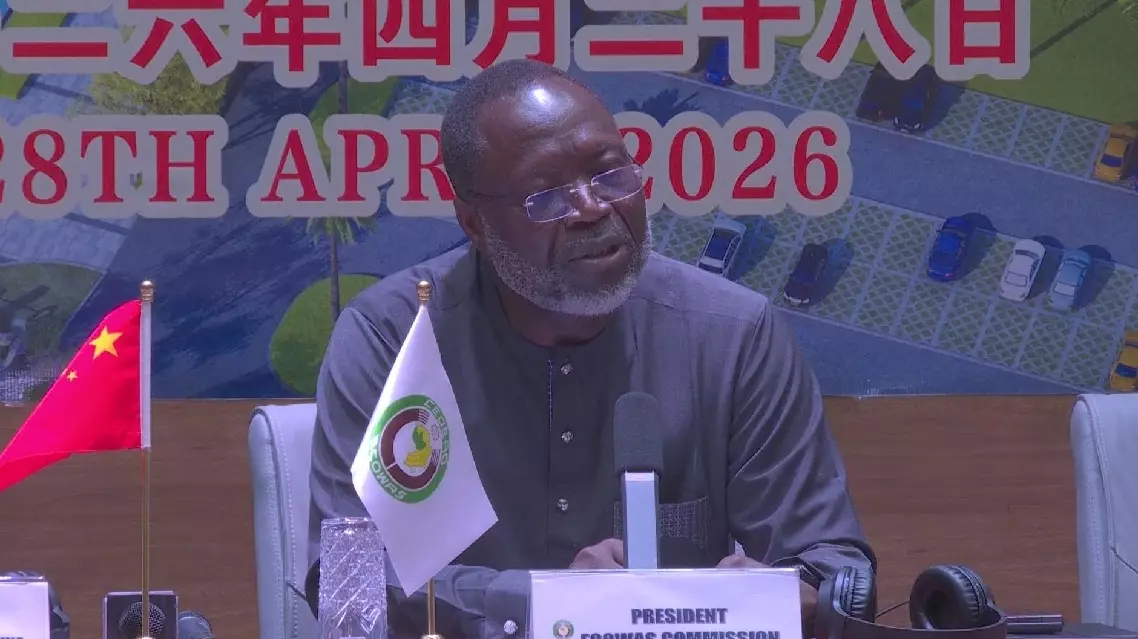
China‘s zero-tariff policy on Africa applauded as catalyst for boosting bilateral trade, peace