China announced significant breakthroughs in its ongoing archaeological projects on Thursday, unveiling new discoveries at ancient sites dating back to the earliest dynasties of Chinese civilization.
The announcement was made by the National Cultural Heritage Administration in Beijing.
At the 3,700-year-old Erlitou site in central China's Henan Province, archaeologists have, for the first time, uncovered the complete layout of a crossroads area with four partitioned wall sections, further shedding light on the multi-grid layout and architectural system of the ancient capital's palace area.
Discovered in 1959, the Erlitou ruins have been identified by archaeologists as one of the capital cities during the Xia Dynasty (2070-1600 B.C.), China's earliest known dynasty.
Known as "the earliest China," Erlitou holds significant reference value for studying the origin of Chinese civilization, the rise of kingdoms, the planning of ancient capitals, and other key issues related to the development of Chinese civilization. Its central area currently spans approximately three million square meters.
Meanwhile, at Yinxu, or the Yin Ruins in Anyang, researchers have mapped an intricate network of main roads and ditches north of the Huan River, which once formed the urban framework of the Shang (Yin) Dynasty (1600–1046 B.C.) capital.
"Previously, our work at Yinxu focused on the southern bank of the Huan River, where numerous oracle bones were discovered. However, the northern bank, particularly the area east of the Xibeigang royal tombs, was largely unexplored. Now, we have uncovered a network of roads: three running vertical to the other three, with some large roads stretching over 1.6 kilometers, completely transforming our understanding of the layout of Yinxu," said Wang Wei, a member of the Department of the Chinese Academy of Social Sciences.
The Zhongcun cemetery in north China's Shanxi Province, dating to the transition between the Xia and Shang periods, has provided valuable insights into high-status burials. To date, archaeologists have excavated five high-status tombs from the late Xia and early Shang periods at Zhongcun. As the largest and most significant burial site from the Xia-Shang transition period in the eastern Loess Plateau, it reflects unique local burial customs while also demonstrating influences from Erlitou culture, providing evidence of cultural convergence.
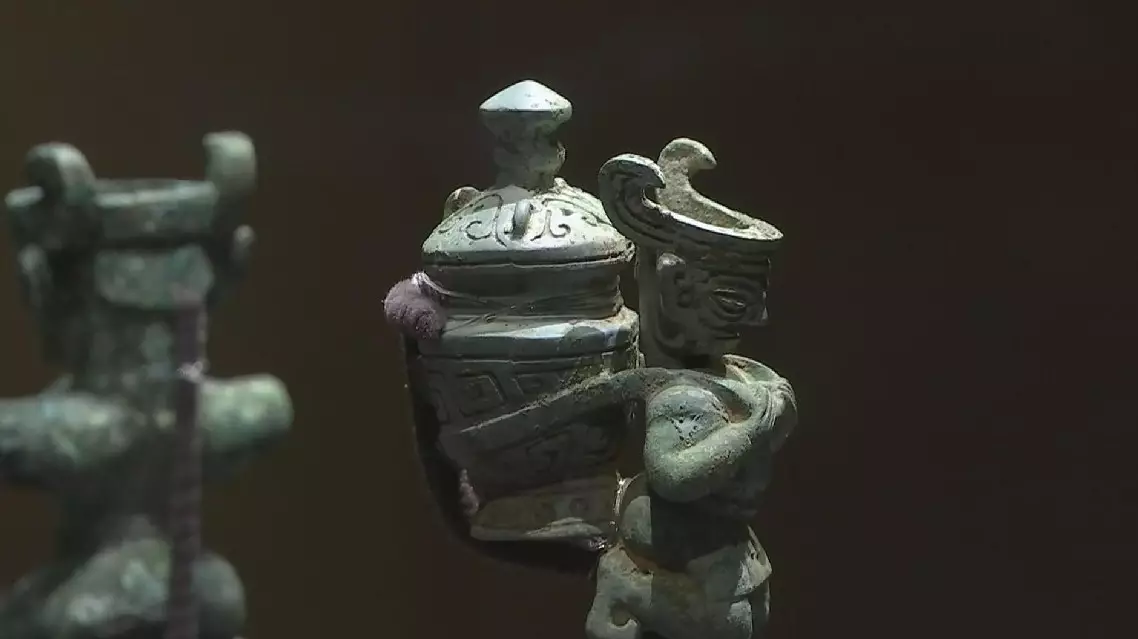
At the Sanxingdui Ruins in southwest China's Sichuan Province, new findings include jade and stone workshops, building foundations, and large water networks, offering deeper insights into the site's layout and functional zoning.
Artifacts unearthed at Sanxingdui highlight the deep connections between Sanxingdui culture and regions such as the Central Plains, northwest China, and the middle reaches of the Yangtze River, emphasizing the interconnected and multi-regional nature of early Chinese civilization.
Spanning 12 square kilometers, the Sanxingdui Ruins are believed to be remnants of the Shu Kingdom, dating back 4,500 to 3,000 years.
Discovered in the late 1920s in Guanghan City, the site is considered one of the world's most significant archaeological discoveries of the 20th century.
China unveils key archaeological findings, shedding new light on earliest dynasties