Chinese research icebreaker Xuelong 2, or Snow Dragon 2, has sailed more than 10,000 nautical miles since it departed for China's 41st Antarctic expedition on November 1, completing one third of the planned voyage.
The 41st Antarctic expedition set sail from Guangzhou, the provincial capital of Guangdong in south China on Nov. 1, and the whole mission will take nearly seven months.
The expedition team is composed of more than 460 people and three ships, including research icebreakers Xuelong and Xuelong 2, and cargo vessel Yongsheng.
Xuelong and Xuelong 2 arrived at China's Zhongshan Station in Antarctica on Nov. 28 and unloaded there.
Xuelong 2 left the Zhongshan Station for the Qinling Station on Dec 11 and met with cargo vessel Yongsheng on Dec 21.
"Since we officially departed from Guangzhou on Nov 1, we have sailed through the South China Sea, the Sulu Sea near the Philippines, the Lombok Strait before we sailed on the Indian Ocean. After crossing the westerlies, we arrived at the Zhongshan Station and completed the first stage of the mission. Then we sailed eastward along the Antarctic continent and have now arrived at the Ross Sea where the Qinling Station is located," said Xiao Zhimin, captain of Xuelong 2.
Xuelong 2 and Yongsheng arrived at the Qinling Station on Dec. 25.
The Zhongshan Station, set up on Feb. 26, 1989, is located in the Larsemann Hills in East Antarctica with a total area of 378 hectares.
As the second Chinese scientific research base in Antarctica, the Zhongshan Station serves as a key hub for inland expeditions and supports research in meteorological observation, oceanography, geology, and other fields.
The Qinling Station is China's fifth research station in the continent. It started operation on Feb. 7, 2024.
Apart from investigating the impact of climate change on the Antarctic ecosystem and conducting international research and logistics cooperation, the 41st Antarctic expedition will build the supporting infrastructure for the Qinling Station.
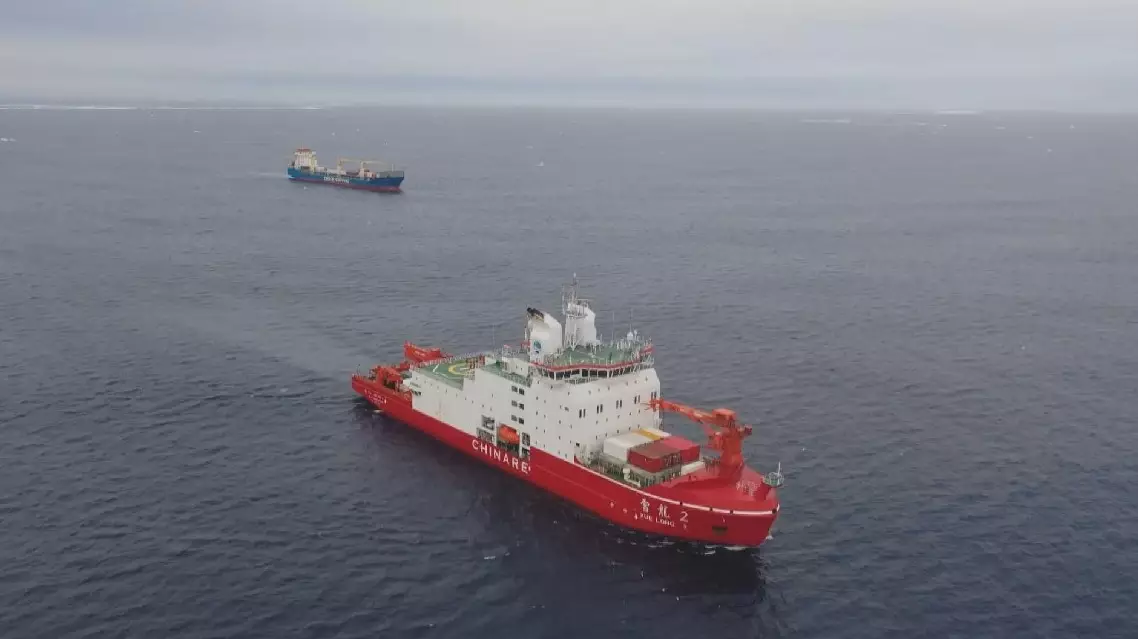
Xuelong 2 sails 10,000 nautical miles on current Antarctic expedition