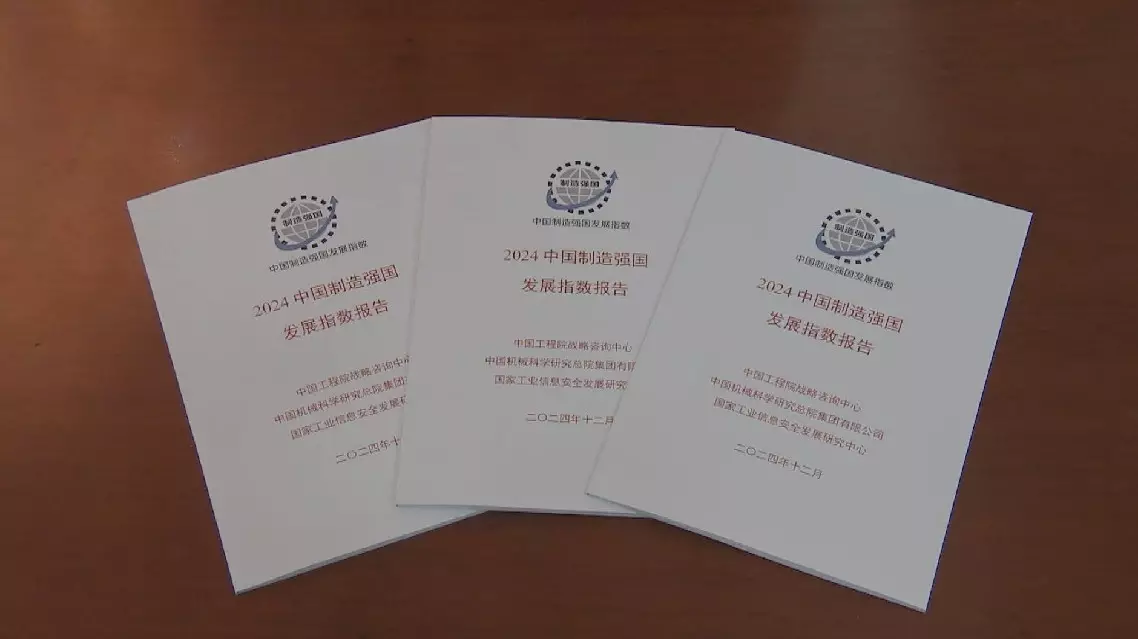
China ranked fourth in the world in manufacturing development in 2023, according to the 2024 China Manufacturing Power Development Index Report released on Monday.
The report, presented by the Chinese Academy of Engineering, the National Manufacturing Strategy Advisory Committee and other relevant departments, provides an in-depth analysis of the development of the manufacturing industries in major countries worldwide, with a focus on trends and major new features in China.
According to the report, China's manufacturing development power index showed an overall positive trend, with its global competitiveness on the rise and notable achievements in areas such as quality improvement, efficiency enhancement, and green, low-carbon development.
The Manufacturing Power Development Index is made up of five sub-indices: scale development, quality efficiency, structural optimization, innovation development, and sustainable development. These metrics comprehensively reflect the strength of a country's manufacturing industry.
According to the report, in 2023, China ranked fourth in the world in terms of the manufacturing development index. While the growth rate of China's manufacturing sector slowed, its overall scale continued to expand.
China represented the second-highest increase in the world in terms of the quality efficiency index, particularly in three key indicators that reflect the efficiency and effectiveness of manufacturing - manufacturing value-added rate, labor productivity in manufacturing, and sales profit margin. For the first time in years, all three of these core metrics saw simultaneous improvement.
The report highlighted that China claimed the largest year-on-year improvement in the sustainability sub-index, marking a major highlight in China's manufacturing sector in 2023.
"Among the five indicators, the three indexes of quality efficiency, innovation development, and sustainable development all showed steady increase or growth in a particular manner. This actually indicates that our high-quality development strategy had achieved initial results, marking a shift from focusing on scale to emphasizing quality and efficiency. Our technological innovation also exerted effects, and our transformation paced up. Our focus on high-quality manufacturing was more and more solid," said Wang Decheng, a member of the National Manufacturing Strategy Advisory Committee.
The report also noted some declines in certain sub-indices of China's manufacturing power index, and experts pointed out that the industry faces various challenges. Nevertheless, they emphasized that the overall favorable conditions outweigh the negative factors, the trend of economic recovery remains strong, and the long-term outlook for China's manufacturing sector continues to be positive.
According to the latest data, in the first three quarters of 2024, China's manufacturing value-added grew by 5.2 percent year on year, exceeding the GDP growth rate by 0.4 percentage points. In November 2024, this growth rate further went up to 6.0 percent, showing an overall improvement over 2023.
China ranks 4th in manufacturing development index: report