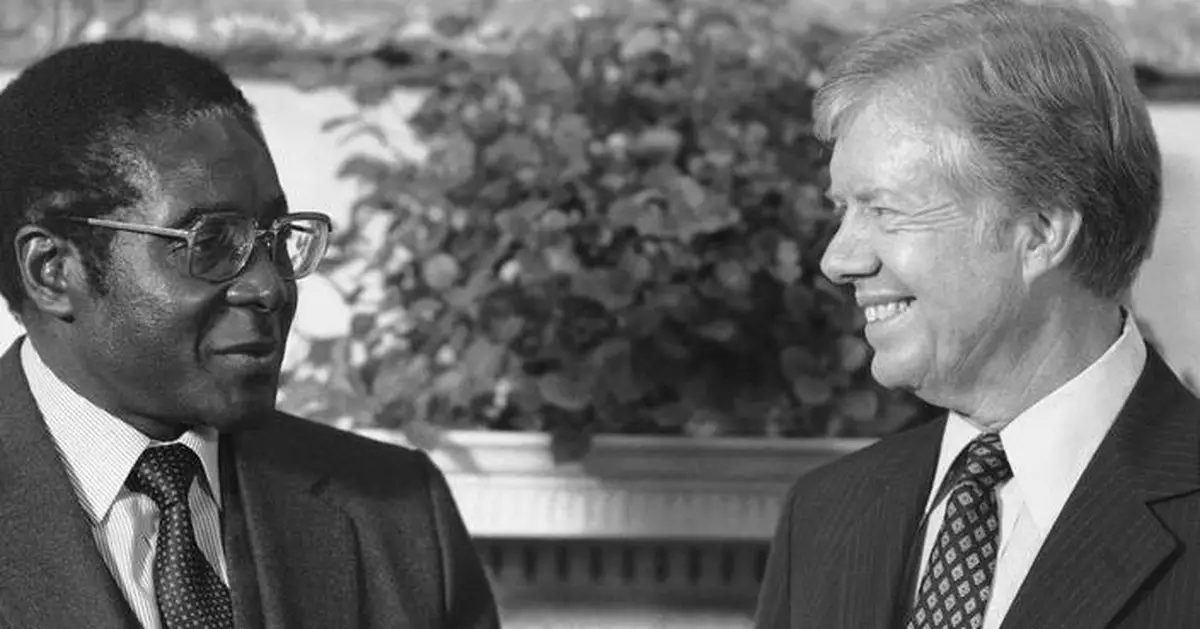
HARARE, Zimbabwe (AP) — Amid everything else on his desk — the Iran hostage crisis, domestic economic turmoil, the Soviet invasion of Afghanistan and a grueling 1980 reelection fight — President Jimmy Carter elevated the independence of a country in southern Africa as a top agenda item.
Carter hosted then-Zimbabwean leader Robert Mugabe at the White House soon after his country achieved independence and later described Zimbabwe's adoption of democracy as “our greatest single success.”
Click to Gallery
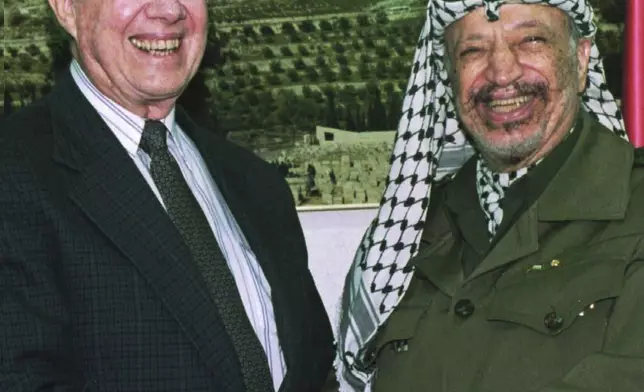
FILE - PLO chairman Yasser Arafat shakes hands with former President Jimmy Carter before their meeting at Arafat's office in Gaza City, on the eve of the first Palestinian elections, Jan. 19, 1996. (AP Photo/Adel Hana, File)
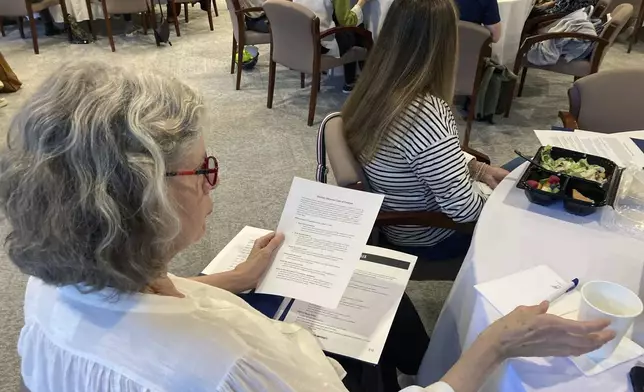
FILE - A volunteer election observer reviews training materials on Nov. 6, 2022, at the Carter Center in Atlanta. (AP Photo/Jeff Amy, File)
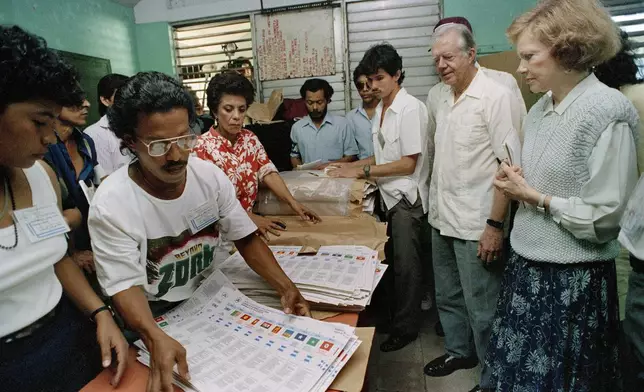
FILE - Former U.S. President Jimmy Carter and his wife, Rosalynn, right, watch election workers prepare ballots at a polling station in Managua, Nicaragua, Feb. 25, 1990. (AP Photo/J. Scott Applewhite, File)
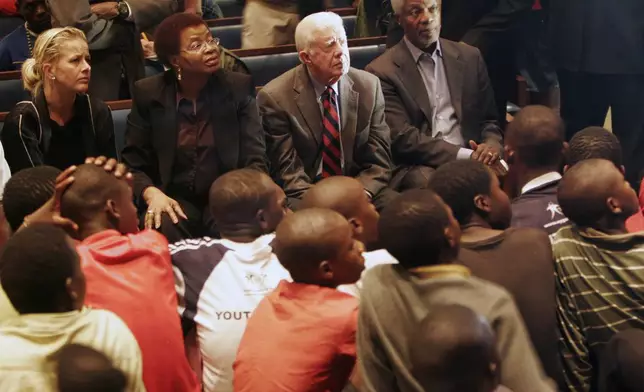
FILE - Former U.S. President Jimmy Carter, background second right, former U.N. head Kofi Annan, background right, and Graca Machel, the wife of former South African President Nelson Mandela, background second from left, watch children perform during a visit to the Central Methodist Church in Johannesburg, South Africa, Nov. 23, 2008. The diplomats were barred entry into Zimbabwe on a humanitarian visit over the weekend. (AP Photo/Denis Farrell, File)
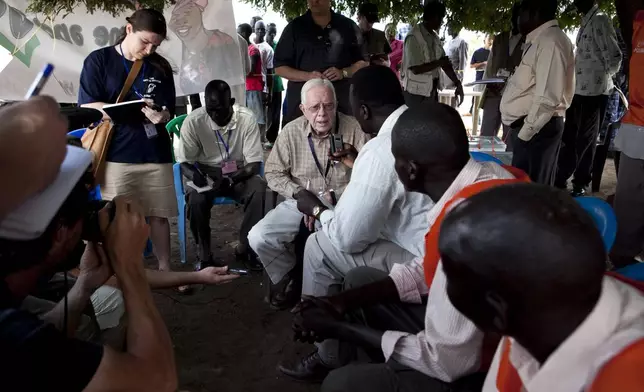
FILE - Former U.S. President Jimmy Carter, center, speaks with journalists and voting station authorities outside a polling station near Juba, southern Sudan, April 13, 2010. (AP Photo/Pete Muller, File)
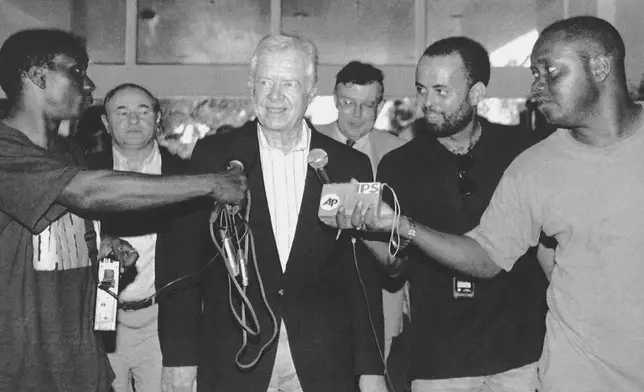
FILE - Former U.S. President Jimmy Carter talks with the press upon his arrival in Georgetown, Guyana, Oct. 3, 1992, to monitor the elections on Oct. 5. (AP Photo/Diego Giudice, File)
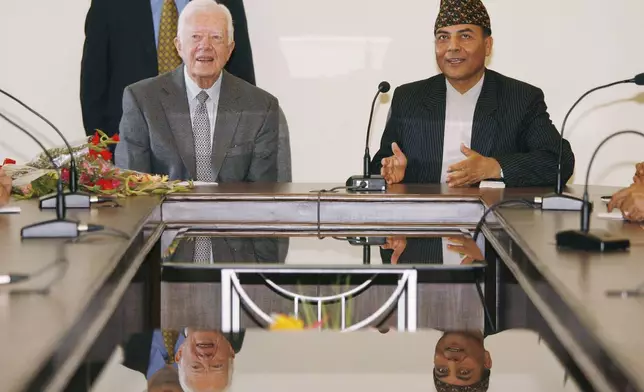
FILE - Former U.S. President Jimmy Carter meets with Bhoj Raj Pokhrel, Nepal's chief election official, on April 8, 2008, in Katmandu, Nepal. (AP Photo/Ed Wray, File)
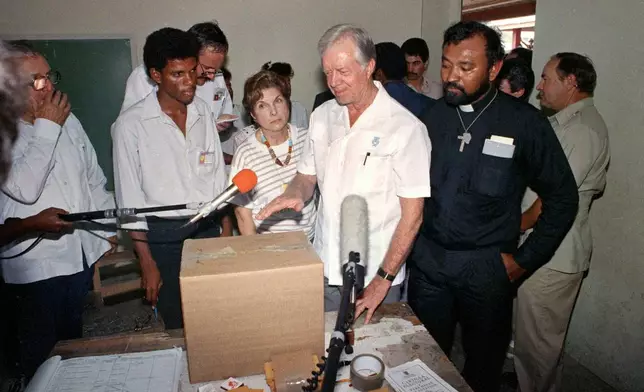
FILE - Former U.S. President Jimmy Carter stands in a polling station at San Miguelito, Panama, as part of an international delegation of observers under the Council of Freely-Elected Heads of Government on May 7, 1989. (AP Photo/Luis Romero, File)
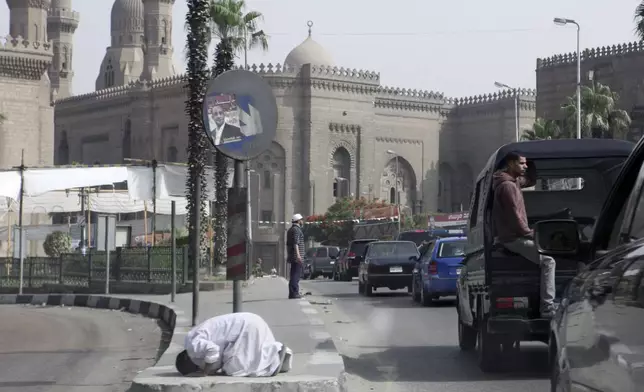
FILE - The motorcade of former U.S. President Jimmy Carter passes a man praying in the street beneath an election poster for presidential candidate Khaled Ali during the election of a new president after the fall of ex-President Hosni Mubarak in Cairo, May 23, 2012. (AP Photo/Thomas Hartwell, File)
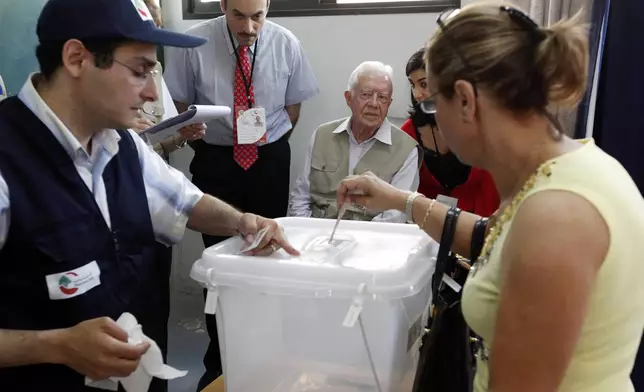
FILE - Former U.S. President Jimmy Carter, center, monitors voting at a polling station in Beirut's Christian sector of Ashrafieh, Lebanon, on June 7, 2009. (AP Photo/Hussein Malla, File)
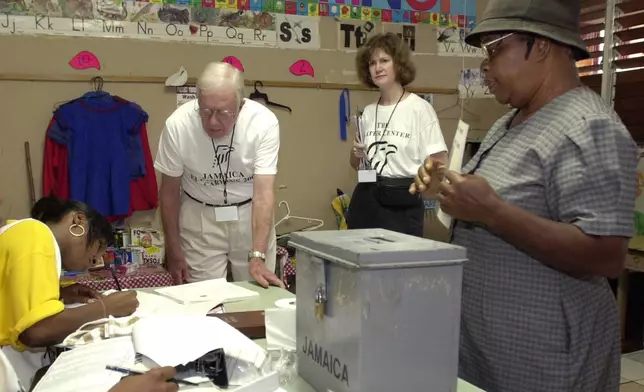
FILE - Former U.S. President Jimmy Carter, second left, and Jennifer McCoy, third left, observe the voting process, while Joyce Grey, right, waits to cast her ballot at a polling station in Kingston, Jamaica, Oct. 16, 2002. (AP Photo/Andres Leighton, File)
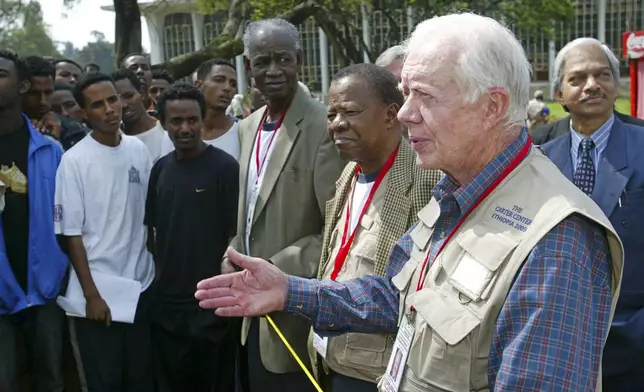
FILE - Former U.S. President Jimmy Carter, right, former Botswanan President Ketumile Joni Masire, center, and former Tanzanian Prime Minister Joseph Warioba, fourth from right, address members of the media at a polling station at the university in Addis Ababa, during the third democratic elections in Ethiopia's 3,000-year history, May 15, 2005. (AP Photo/Karel Prinsloo, File)
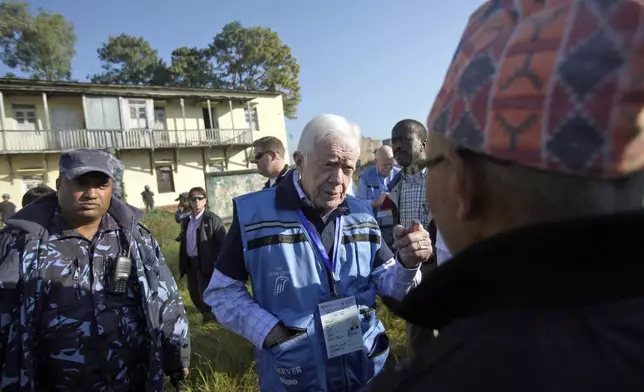
FILE - Former U.S. President Jimmy Carter, center, visits a polling station in Katmandu, Nepal, on Nov. 19, 2013. (AP Photo/Niranjan Shrestha, File)
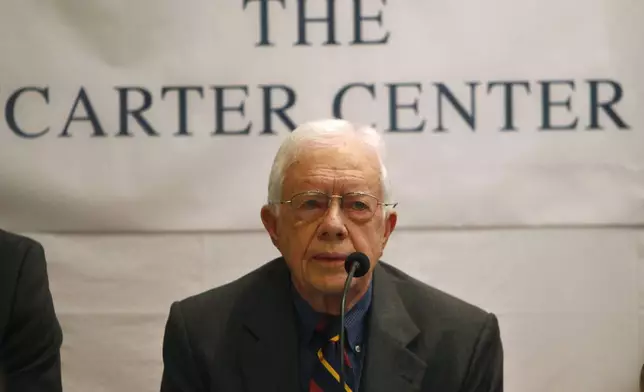
FILE - Former U.S. President Jimmy Carter speaks at a news conference in Katmandu, Nepal, on April 1, 2013. (AP Photo/Niranjan Shrestha, File)
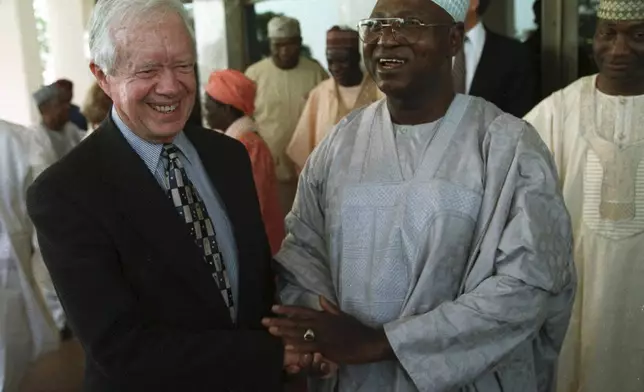
FILE - Nigerian head of state Gen. Abdulsalami Abubakar shakes hands with former U.S. President Jimmy Carter after a meeting at the Nigerian Presidential Villa in the capital Abuja, on Feb. 28, 1999. (AP Photo/Danny Wilcox Frazier, File)
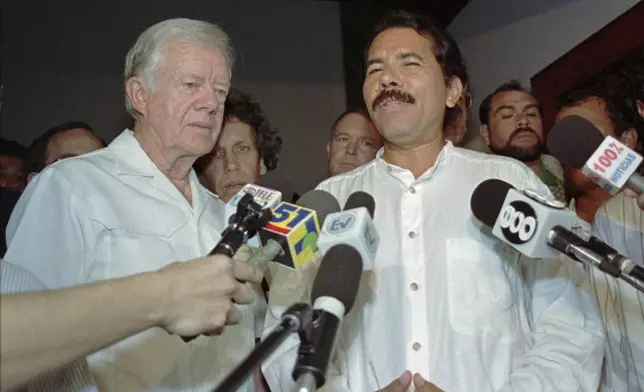
FILE - Former U.S. President Jimmy Carter, left, meets with Nicaraguan presidential candidate Daniel Ortega, of the Sandinista National Liberation Front, Oct. 19, 1996, in Managua, Nicaragua. (AP Photo/Brennan Linsley, File)
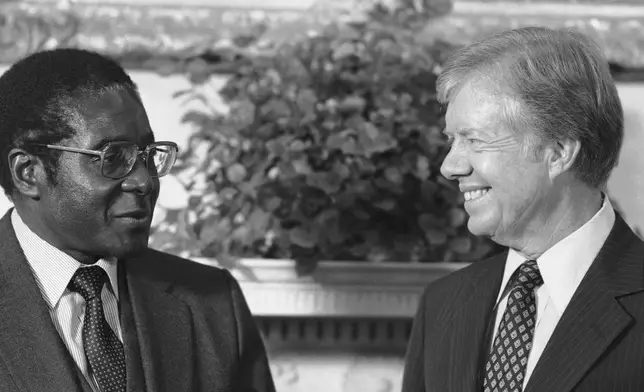
FILE - President Jimmy Carter meets with Zimbabwe Prime Minister Robert Mugabe in the Oval Office in Washington, on Aug. 27, 1980. (AP Photo/Barry Thumma, File)
Three decades later, Carter, who was long out of office, found the door slammed shut when he and other dignitaries sought to visit Zimbabwe on a humanitarian mission to observe reported human rights abuses after a violent disputed election in 2008. He had become a critic of Mugabe’s regime and was denied a visa.
Carter didn’t give up. From neighboring South Africa, he relied on emissaries from Zimbabwe for testimony on violence and allegations of electoral fraud. The effort reflected the former president's long commitment to promoting democracy worldwide.
This “more than anything else cemented Carter’s legacy” as an advocate for free and fair elections across Africa, said Eldred Masunungure, a former political science lecturer at the University of Zimbabwe.
“Carter didn’t change. Zimbabwe did. Mugabe swayed from the democratic ideals that Carter held so dear,” he said. “The incident demonstrates Carter’s consistency, the steadfastness.”
Zimbabwe’s evolution toward autocracy turned out to be the kind of scenario that the Carter Center has long sought to prevent by deploying observers and developing voting standards in countries struggling to form democracies.
Established in 1982, two years after Carter lost his bid for a second term, the center has been Carter's signature effort to promote fair elections as a vehicle for peace. It has sent observers to monitor some 125 elections in 40 countries and three tribal nations, and has been credited with helping expand democracy across the globe.
Carter’s “moral authority, the trust people put in him and the credibility of someone who had both won and lost an election” contributed to these successes, David Carroll, head of the center’s democracy program, told The Associated Press.
Carter, who died Sunday at 100, was awarded a Nobel Peace Prize in 2002 for the center’s work supporting elections, promoting human rights and helping developing countries cultivate economic, social and public health institutions.
Its elections work began in Panama, where Carter became concerned about the 1989 elections after reports of armed militia members in civilian clothes confiscating voting records during the night.
The Carter Center had just decided to expand its mission of conflict resolution and human rights to include vote monitoring, concluding that democratic elections were essential to resolving political disputes.
“In my fumbling Spanish, I stood up on a table, and I denounced the election as fraudulent,” Carter recalled in a 2015 video marking the center’s 100th election observer mission. “There was later another election, which was honest and fair, and that was the birth of real democracy in Panama.”
The center also helped rescue a peace process in Nepal, then oversaw the country’s twice-postponed elections in 2008 to elect an assembly that would be tasked with writing a constitution. Carter made several trips to the South Asian nation, holding marathon negotiations with former rebels and top politicians to keep the peace process on track.
“There was deadlock in the country. Political parties were not sitting together, and there was no way out on how the process will move on,” said Bhojraj Pokharel, Nepal’s chief election commissioner in 2008, who later worked with Carter in Congo and Myanmar.
On Nepal's election day, Carter traveled to dozens of polling stations talking to voters. Polling was peaceful despite earlier fears of violence.
“His presence itself was a message to the Nepalese population and voters about the integrity of the election,” Pokharel said.
The Carter Center often works in countries with little or no experience in representative government and where trust has all but evaporated because of violence.
After Bolivia held elections in 2019 that the Organization of American States said were marred by fraud, the country’s electoral tribunal invited the Carter Center to observe elections the following year. The center deployed a team to Bolivia and later commended the country for elections it called impartial and transparent.
The Carter Center’s “evaluation was important not only for how the international community viewed us but also for how Bolivian society evaluated the electoral process,” said Salvador Romero, the tribunal’s president at the time.
Similar results have been difficult to obtain recently in Africa, where many countries emerging from decades of colonialism have seen forceful takeovers and disputed elections.
In Nigeria, Tunisia, Zambia and Ivory Coast, Carter Center observers noted violence, killings, vote-buying, uneven playing fields for political parties and candidates, and a general lack of trust in elections.
In Tunisia, frustration has replaced the wave of hope brought by the 2010 Arab Spring uprising. A new parliament was convened in March 2023, two years after President Kais Saied suspended parliament and started legislating by decree. The 11% turnout for parliamentary elections marked “a low point” for the country's democracy, The Carter Center said, and some election observer groups were denied accreditation for the October 2024 presidential contest.
At times, Carter personally intervened to keep African peace processes on track by trying to persuade warlords and rebels to support elections, rather than the use of force, in their quests for power.
In recent years, the Carter Center’s elections work turned toward the U.S.
Its teams deployed to Oklahoma in 2017 at the request of the Cheyenne and Arapaho tribes following elections plagued with problems. In 2013, ballots had been moved from office to office and stored without proper security, eroding confidence in the integrity of the vote. A recount then overturned the results, tribal Gov. Reggie Wassana said.
The Carter Center’s presence in the later election made “a huge difference, and it restored some faith among tribal members,” Wassana said.
Until 2020, the center tried to stay away from broader political issues in the United States, according to Carroll. But the center noticed threats to American democracy were increasing, which prompted a decision to expand programs within the U.S.
“If we saw the same conditions in another country that we were seeing in the U.S. — the lack of trust in election institutions, polarization and growing concern of political violence — it is exactly the kind of country we would prioritize to see if we could play a constructive role,” Carroll said.
Faith in U.S. elections, most notably among a large segment of Republican voters, eroded after the 2020 election amid former President Donald Trump's false claims that Democrats had rigged the vote. There was no evidence of widespread fraud or manipulation of voting machines in that election.
In the 2024 presidential election, which Trump won, the center did some limited observation in New Mexico, Montana and Fulton County, Georgia. In many U.S. states, election observers are limited to political party representatives, with no provisions for nonpartisan, independent groups. The center is working to change that.
Carter's leadership on democracy issues remains a north star for the center, Carroll said.
“You can help strong systems be in place, but they need to be watched continually. You can never rest on your record on democracy and elections. You always have to be vigilant and keep an eye on the process,” he said.
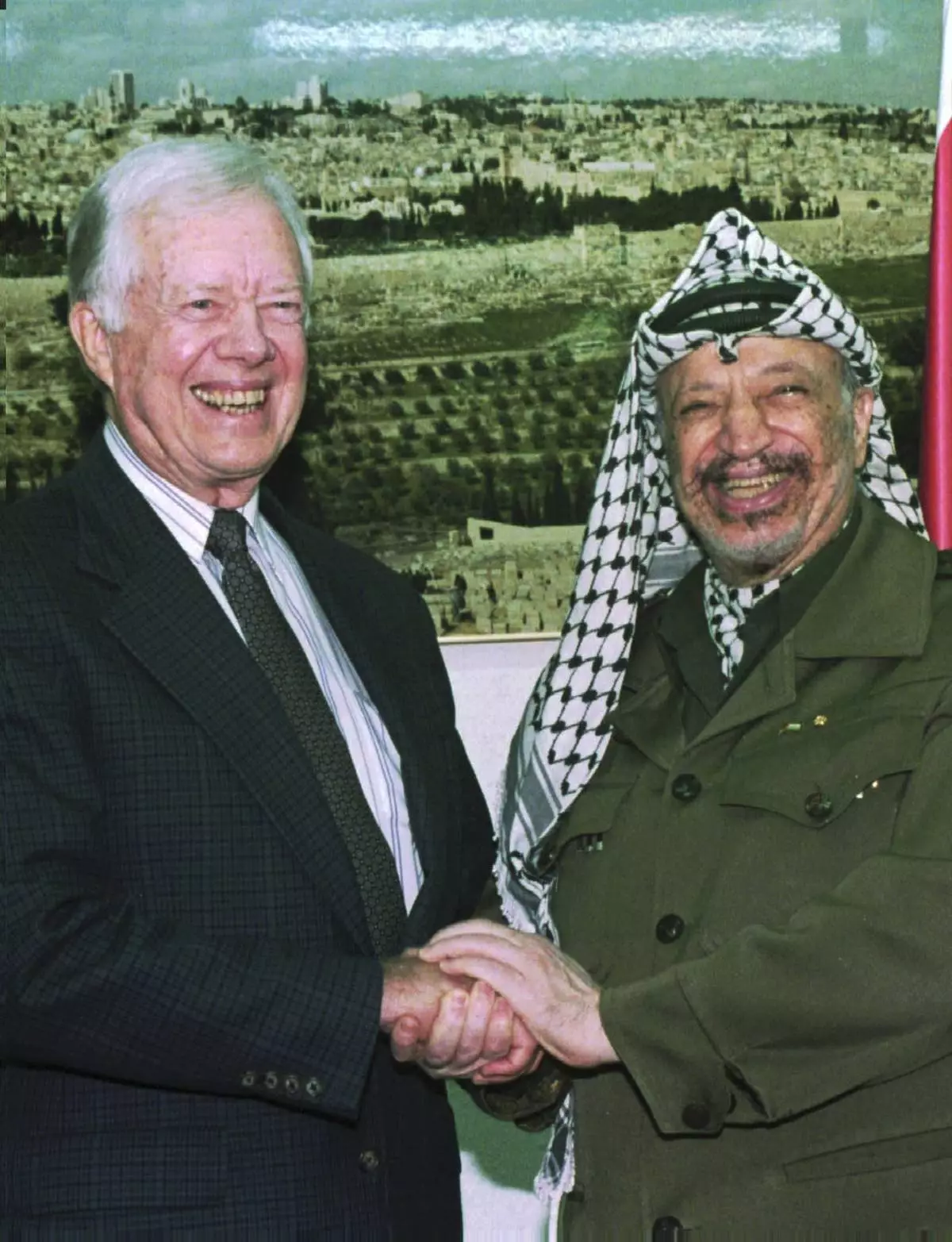
FILE - PLO chairman Yasser Arafat shakes hands with former President Jimmy Carter before their meeting at Arafat's office in Gaza City, on the eve of the first Palestinian elections, Jan. 19, 1996. (AP Photo/Adel Hana, File)
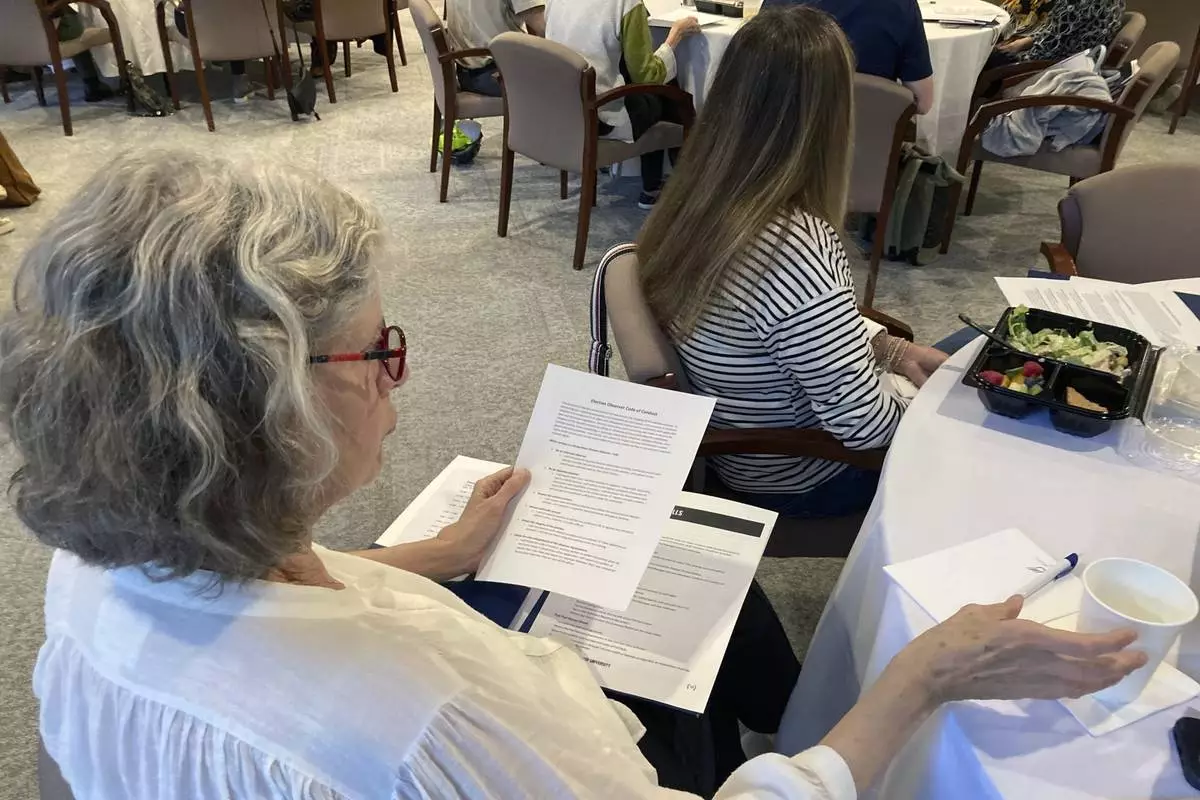
FILE - A volunteer election observer reviews training materials on Nov. 6, 2022, at the Carter Center in Atlanta. (AP Photo/Jeff Amy, File)
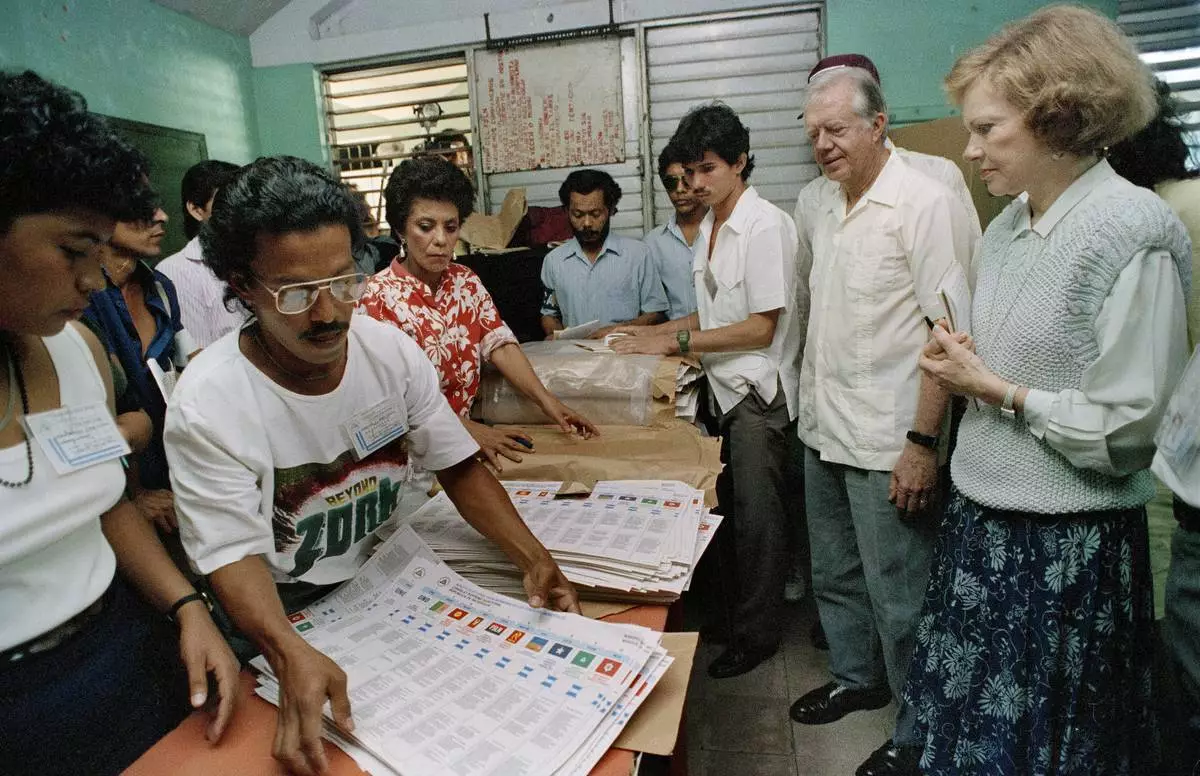
FILE - Former U.S. President Jimmy Carter and his wife, Rosalynn, right, watch election workers prepare ballots at a polling station in Managua, Nicaragua, Feb. 25, 1990. (AP Photo/J. Scott Applewhite, File)
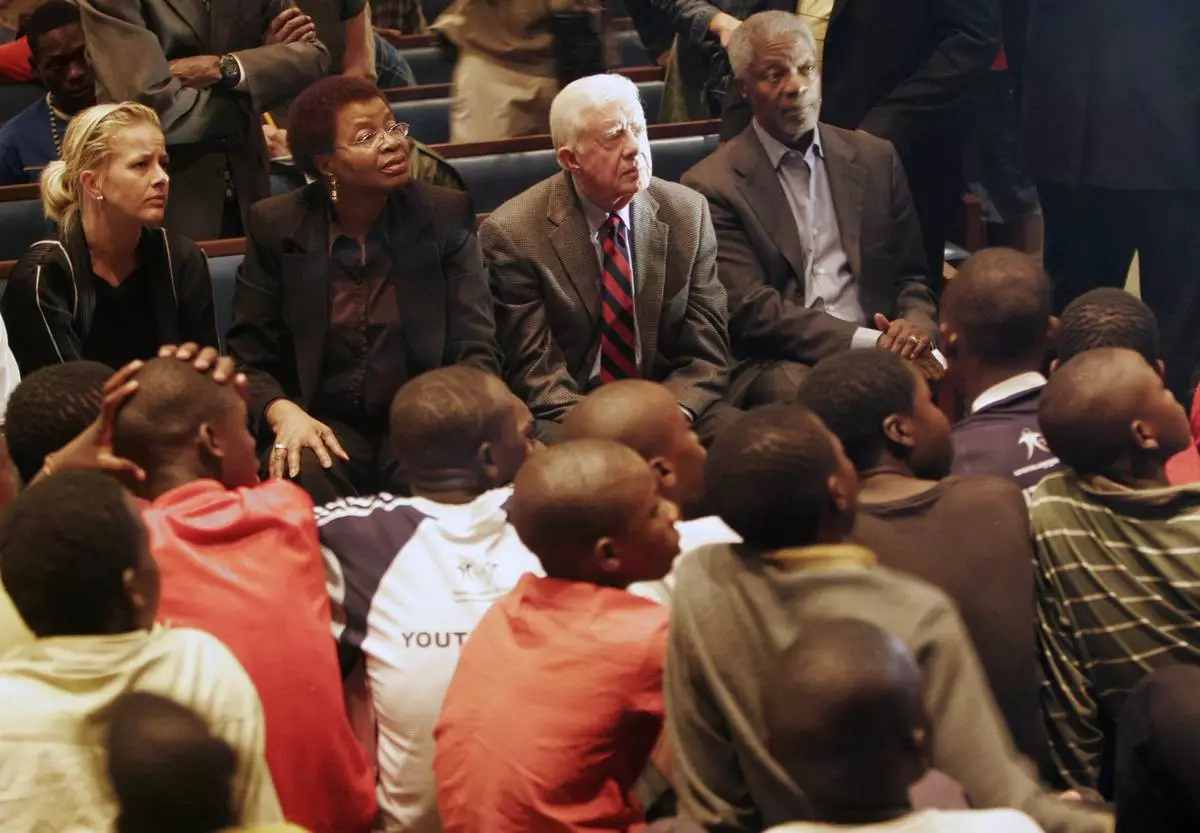
FILE - Former U.S. President Jimmy Carter, background second right, former U.N. head Kofi Annan, background right, and Graca Machel, the wife of former South African President Nelson Mandela, background second from left, watch children perform during a visit to the Central Methodist Church in Johannesburg, South Africa, Nov. 23, 2008. The diplomats were barred entry into Zimbabwe on a humanitarian visit over the weekend. (AP Photo/Denis Farrell, File)
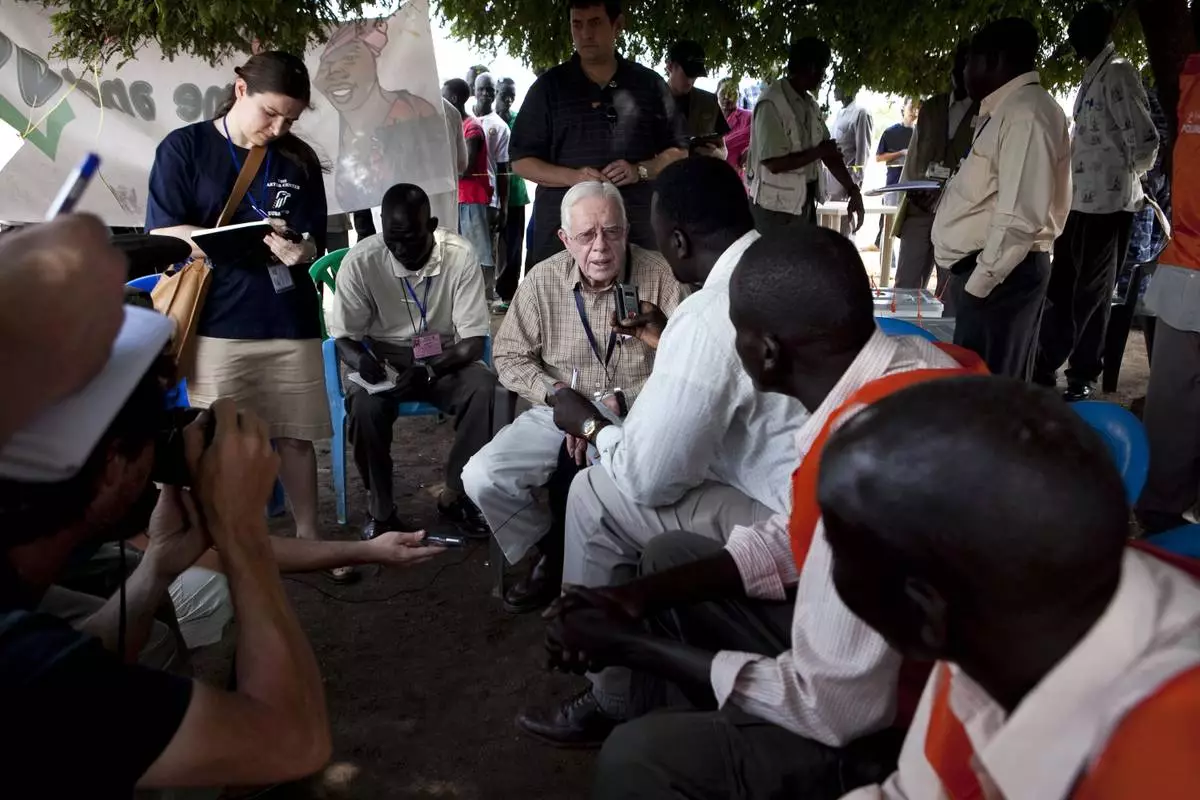
FILE - Former U.S. President Jimmy Carter, center, speaks with journalists and voting station authorities outside a polling station near Juba, southern Sudan, April 13, 2010. (AP Photo/Pete Muller, File)
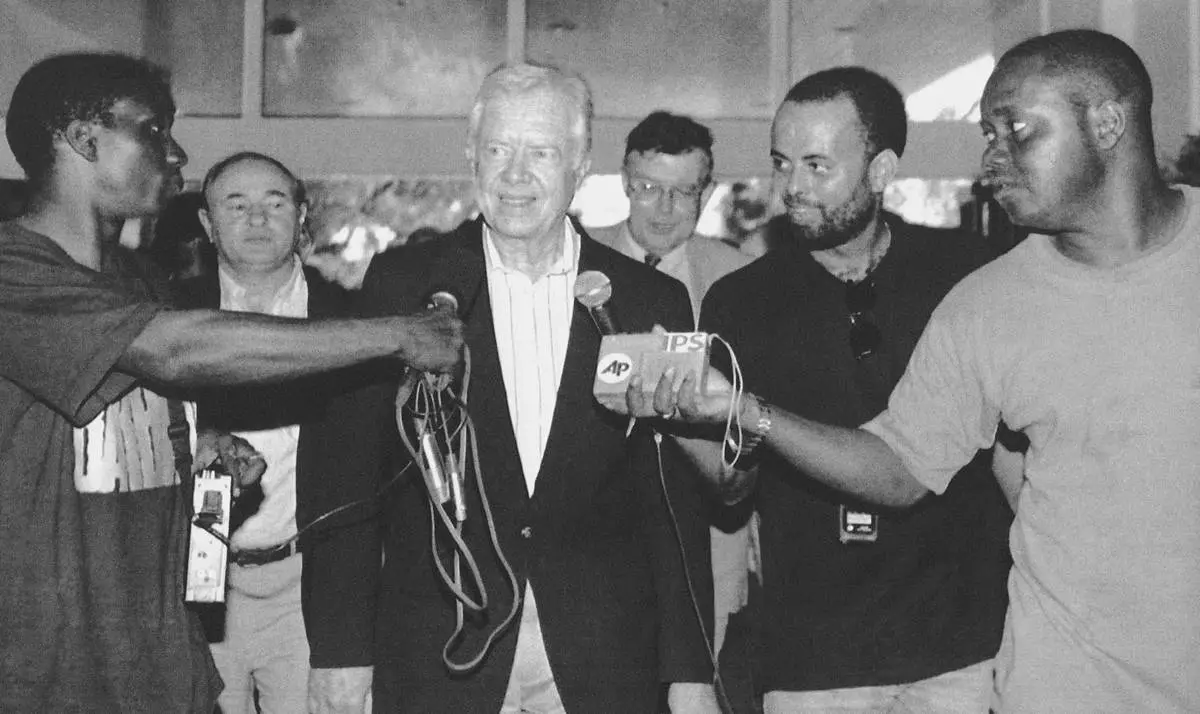
FILE - Former U.S. President Jimmy Carter talks with the press upon his arrival in Georgetown, Guyana, Oct. 3, 1992, to monitor the elections on Oct. 5. (AP Photo/Diego Giudice, File)
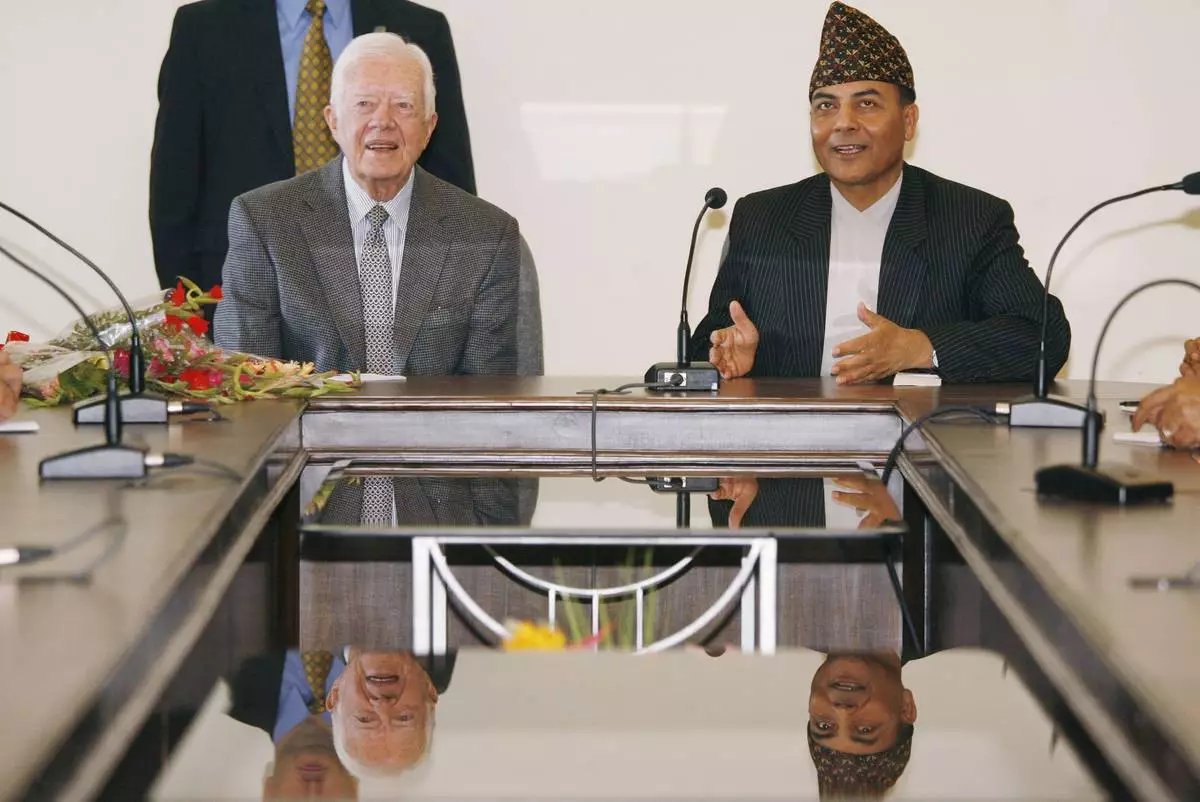
FILE - Former U.S. President Jimmy Carter meets with Bhoj Raj Pokhrel, Nepal's chief election official, on April 8, 2008, in Katmandu, Nepal. (AP Photo/Ed Wray, File)
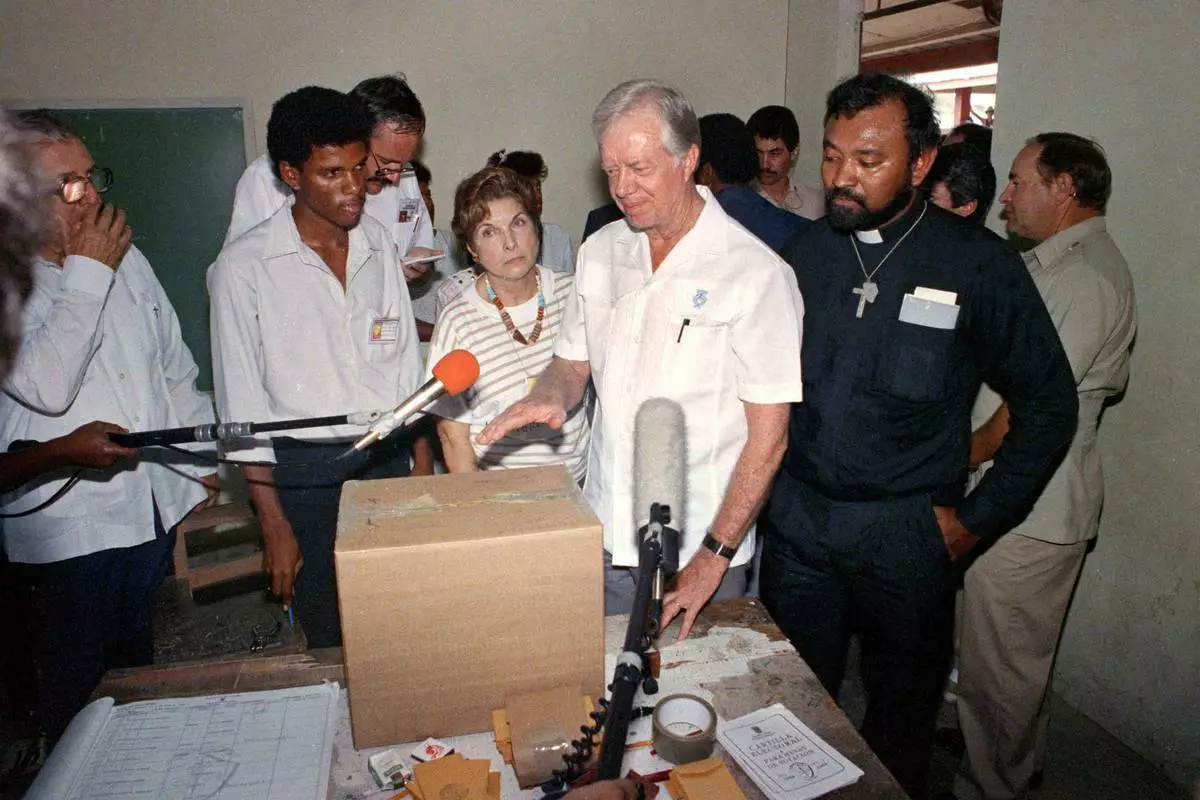
FILE - Former U.S. President Jimmy Carter stands in a polling station at San Miguelito, Panama, as part of an international delegation of observers under the Council of Freely-Elected Heads of Government on May 7, 1989. (AP Photo/Luis Romero, File)
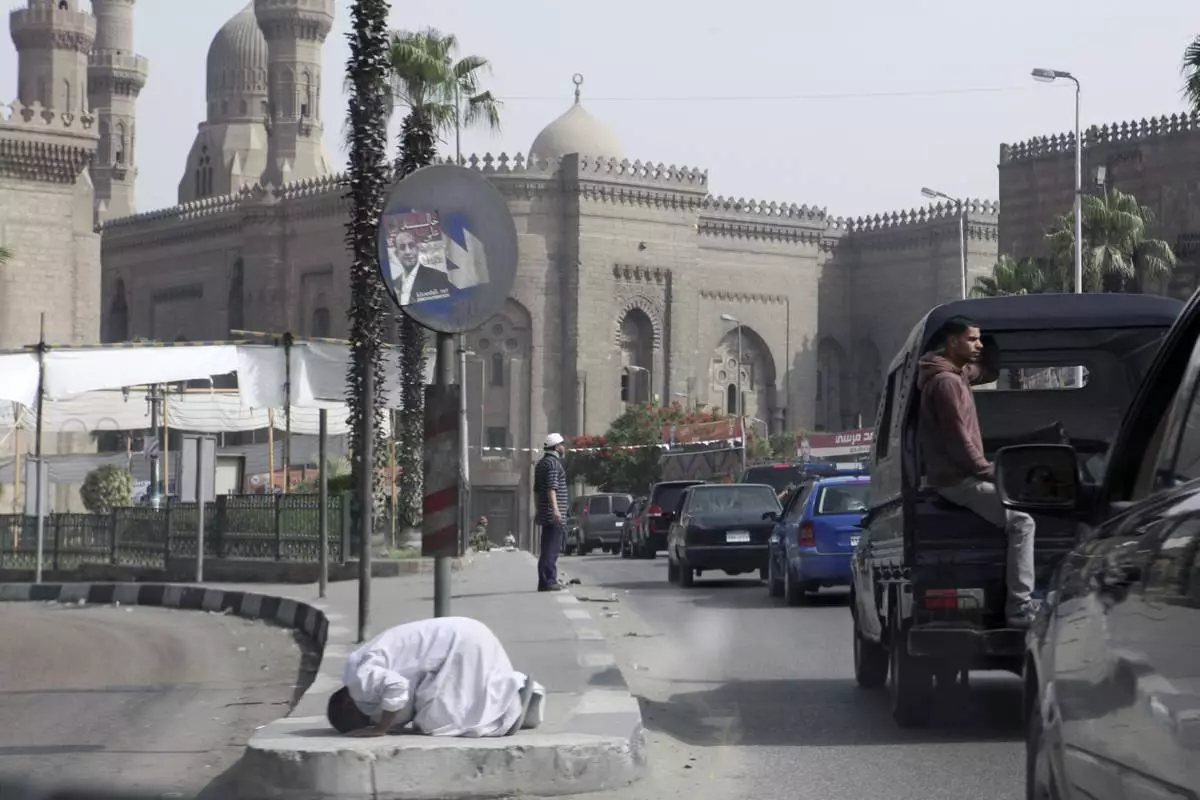
FILE - The motorcade of former U.S. President Jimmy Carter passes a man praying in the street beneath an election poster for presidential candidate Khaled Ali during the election of a new president after the fall of ex-President Hosni Mubarak in Cairo, May 23, 2012. (AP Photo/Thomas Hartwell, File)
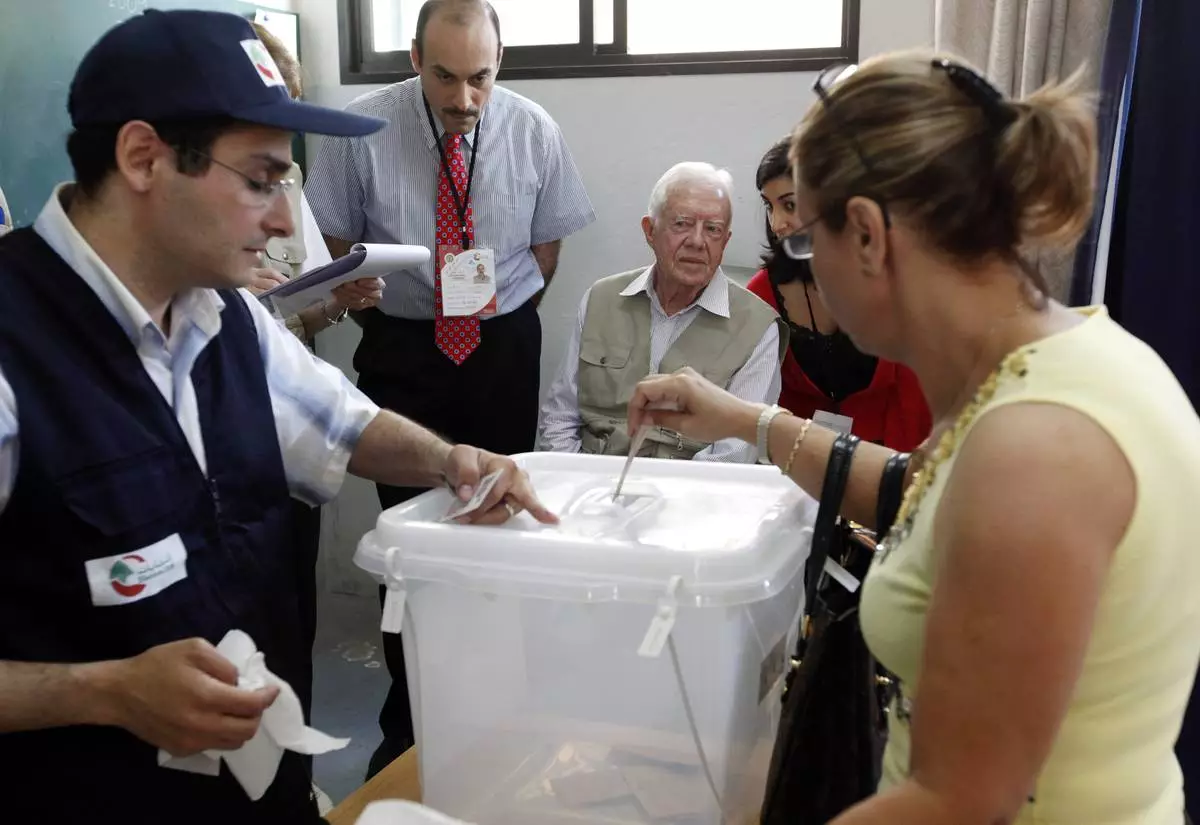
FILE - Former U.S. President Jimmy Carter, center, monitors voting at a polling station in Beirut's Christian sector of Ashrafieh, Lebanon, on June 7, 2009. (AP Photo/Hussein Malla, File)
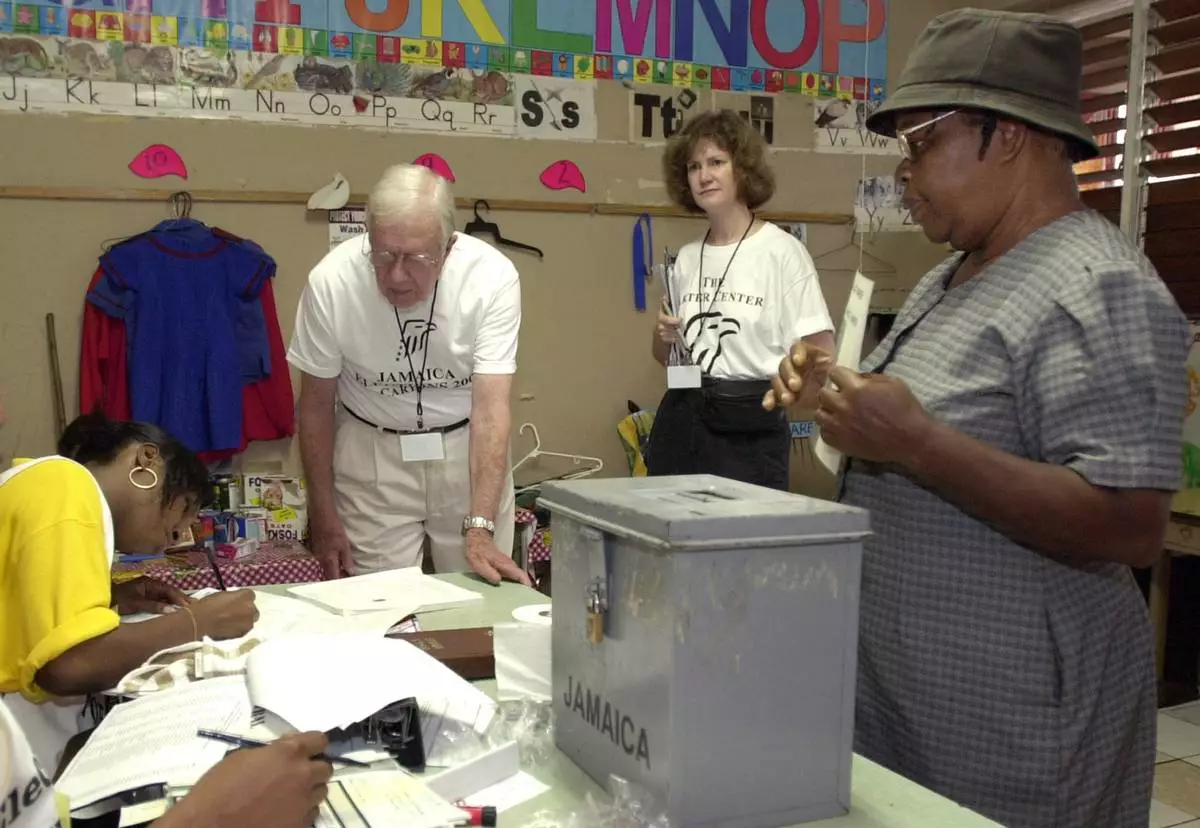
FILE - Former U.S. President Jimmy Carter, second left, and Jennifer McCoy, third left, observe the voting process, while Joyce Grey, right, waits to cast her ballot at a polling station in Kingston, Jamaica, Oct. 16, 2002. (AP Photo/Andres Leighton, File)
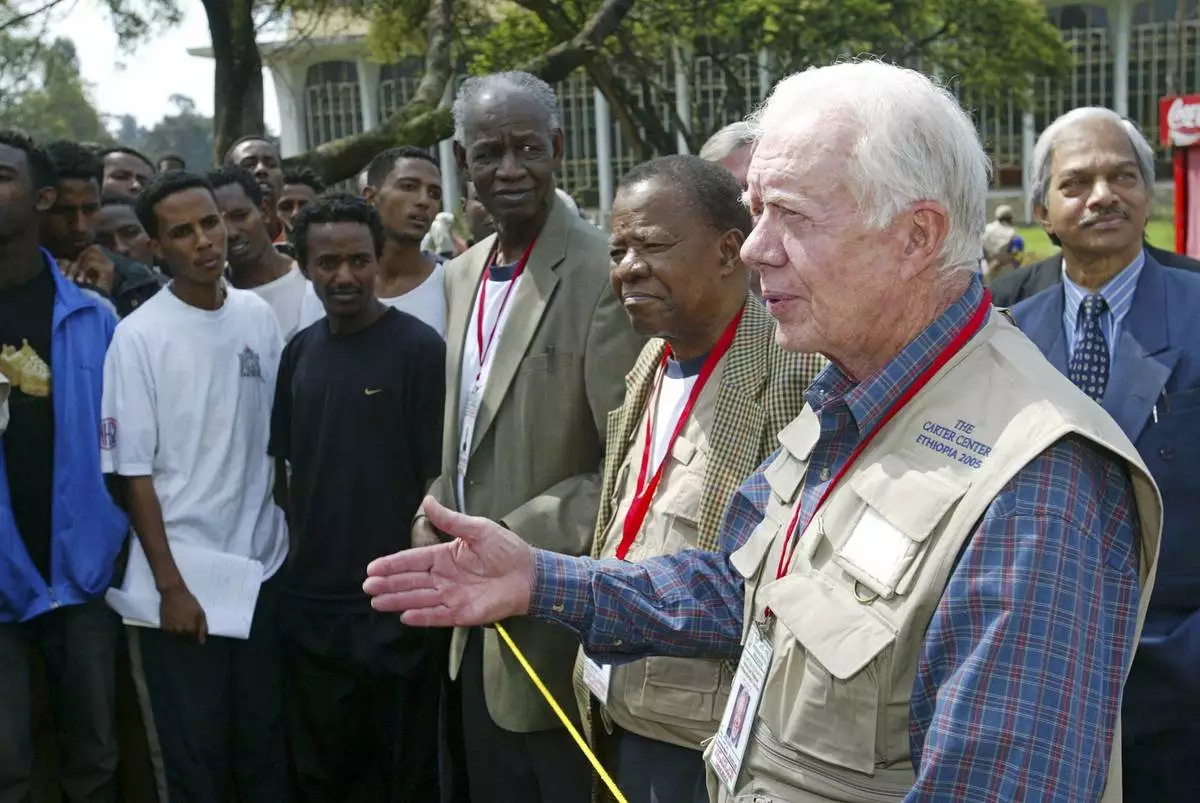
FILE - Former U.S. President Jimmy Carter, right, former Botswanan President Ketumile Joni Masire, center, and former Tanzanian Prime Minister Joseph Warioba, fourth from right, address members of the media at a polling station at the university in Addis Ababa, during the third democratic elections in Ethiopia's 3,000-year history, May 15, 2005. (AP Photo/Karel Prinsloo, File)
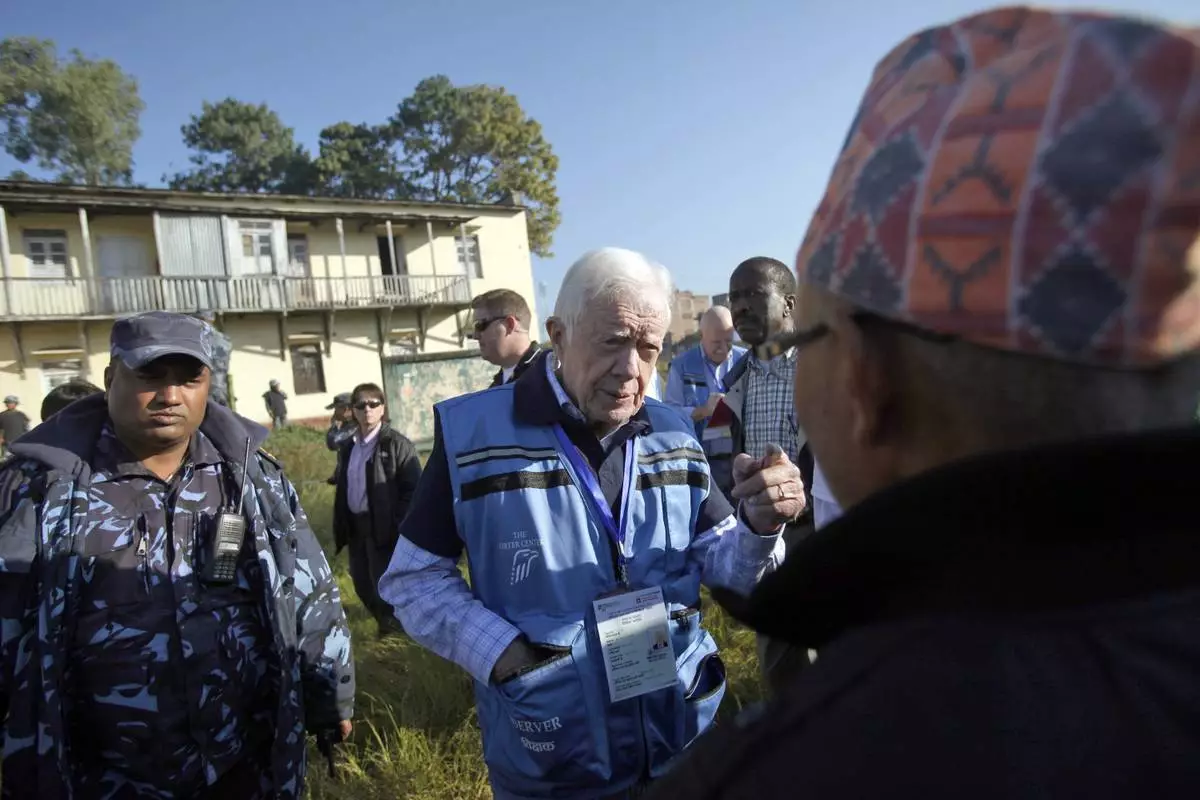
FILE - Former U.S. President Jimmy Carter, center, visits a polling station in Katmandu, Nepal, on Nov. 19, 2013. (AP Photo/Niranjan Shrestha, File)

FILE - Former U.S. President Jimmy Carter speaks at a news conference in Katmandu, Nepal, on April 1, 2013. (AP Photo/Niranjan Shrestha, File)
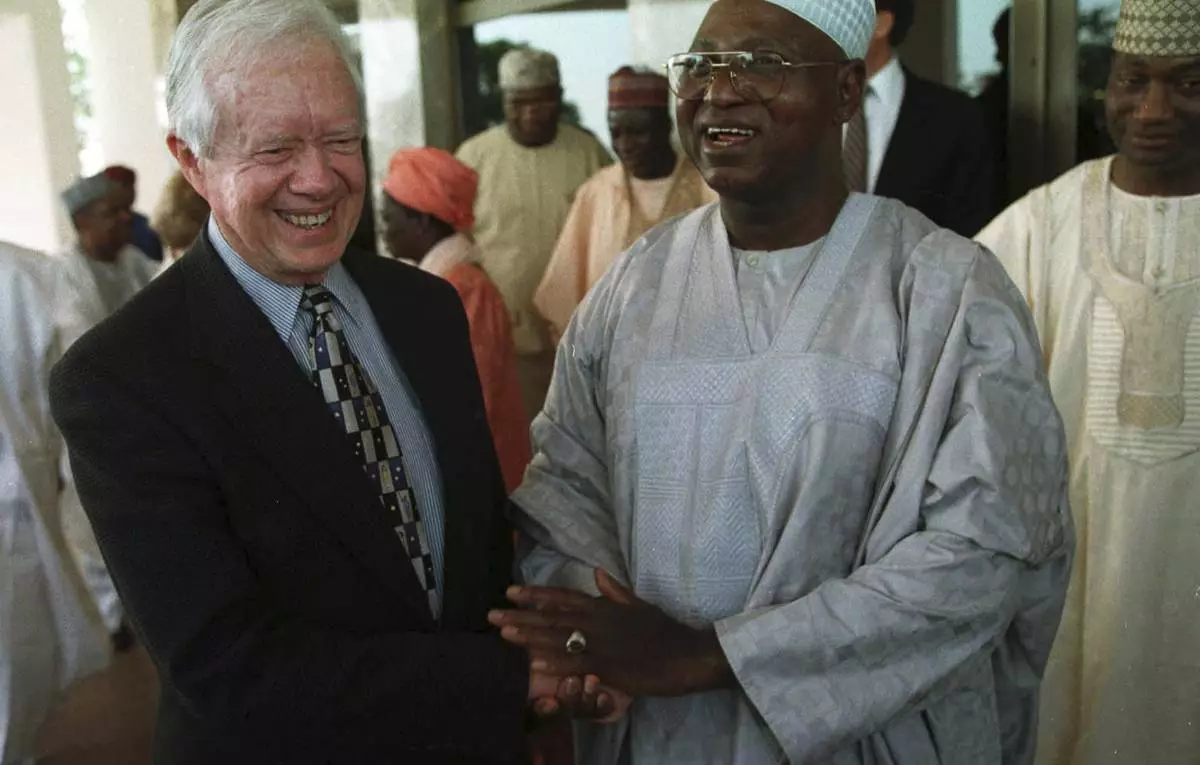
FILE - Nigerian head of state Gen. Abdulsalami Abubakar shakes hands with former U.S. President Jimmy Carter after a meeting at the Nigerian Presidential Villa in the capital Abuja, on Feb. 28, 1999. (AP Photo/Danny Wilcox Frazier, File)
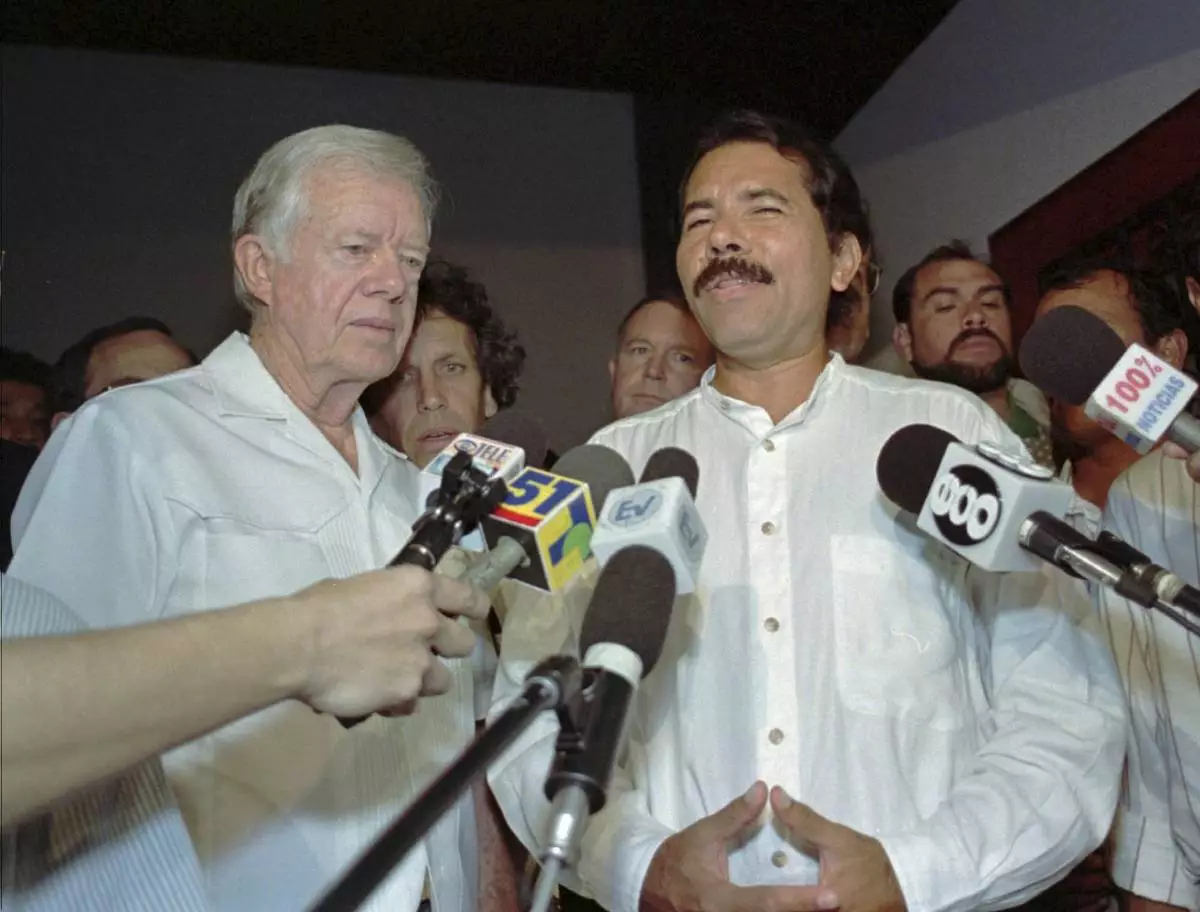
FILE - Former U.S. President Jimmy Carter, left, meets with Nicaraguan presidential candidate Daniel Ortega, of the Sandinista National Liberation Front, Oct. 19, 1996, in Managua, Nicaragua. (AP Photo/Brennan Linsley, File)
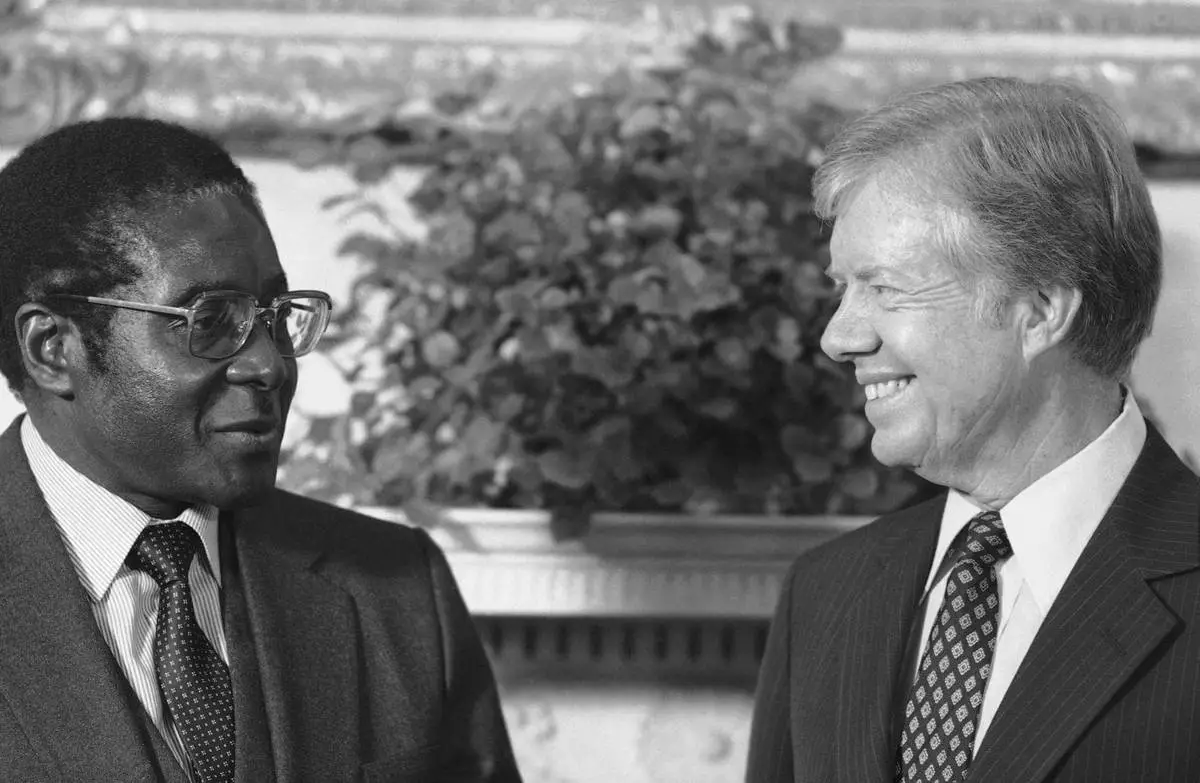
FILE - President Jimmy Carter meets with Zimbabwe Prime Minister Robert Mugabe in the Oval Office in Washington, on Aug. 27, 1980. (AP Photo/Barry Thumma, File)