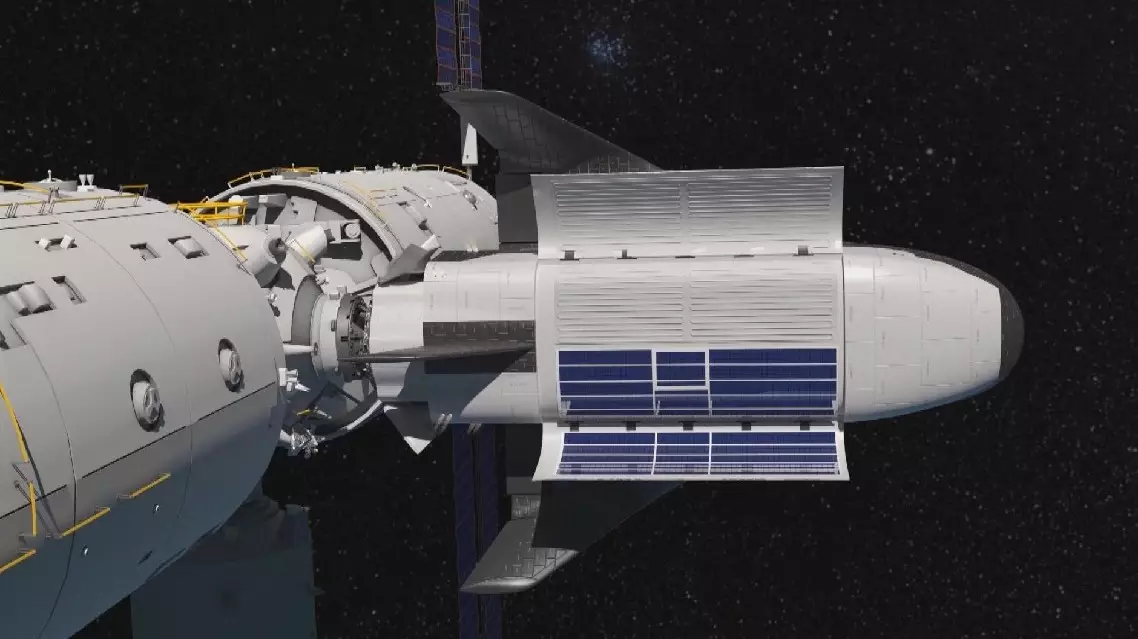
The Haolong space cargo shuttle, a Chinese independently developed reusable winged space cargo vehicle, is expected to further reduce the cost of delivering fresh food to China's space station, according to its chief designer.
Leveraging cutting-edge aviation technologies, the Haolong is designed to be launched by a carrier rocket, dock with the space station, and, after separation, perform de-orbit braking and re-entry maneuvers, culminating in a horizontal landing on an airport runway. It also demonstrates exceptional flight performance in both atmospheric and space environments.
Compared to the Tianzhou cargo spacecraft series, the Haolong offers lower-cost short-cycle in-orbit cargo transportation missions.
"The Haolong space cargo shuttle will normally carry around two tons of payload each time, which will exactly meet the space station's need for the replenishment of supplies for about three months. So, it will be able to provide several replenishments to the space station each year. Such a way of delivery especially fits the replenishment of fresh vegetables and fruits, as well as other supplies that can't be stored for too long. Additionally, the Haolong space cargo shuttle's cold chain system is able to keep these foods fresh," said Fang Yuanpeng, chief designer of the Haolong space cargo shuttle.
The China Manned Space Agency (CMSA) announced the winners of its solicitation for overall schemes targeting a low-cost cargo transportation system -- a vital component of the space station's operations -- on Oct. 29. The Haolong space cargo shuttle, developed by the Chengdu Aircraft Design and Research Institute under the Aviation Industry Corporation of China (AVIC), was one of two schemes selected for contracts in the flight verification phase.
"After docking with the orbiting space station, the Haolong will operate as part of a combined system. We can select the return window as well as the landing site for the space cargo shuttle, allowing it to return to the same site where it was launched. However, this is not the most challenging aspect of developing the craft; it is relatively easy to accomplish," said Fang.
China has released its first report detailing the progress achieved in scientific research and applications related to the country's space station over the past two years.
The CMSA, which compiled the report to 'mark the two-year anniversary of the space station's full establishment,' announced that the report will now be published annually to reflect the progress of ongoing space missions.
The report, released on Monday, highlights key areas such as space life and human research, microgravity physical sciences, and the development of new space technologies and applications.
As of Dec. 1, a total of 181 scientific and application projects have been conducted in orbit. Nearly two tonnes of scientific materials have been delivered, and close to 100 types of experimental samples have been returned, generating over 300 terabytes of scientific data, the CMSA noted.
Haolong space cargo shuttle to cut costs for fresh food deliveries to space station: chief designer
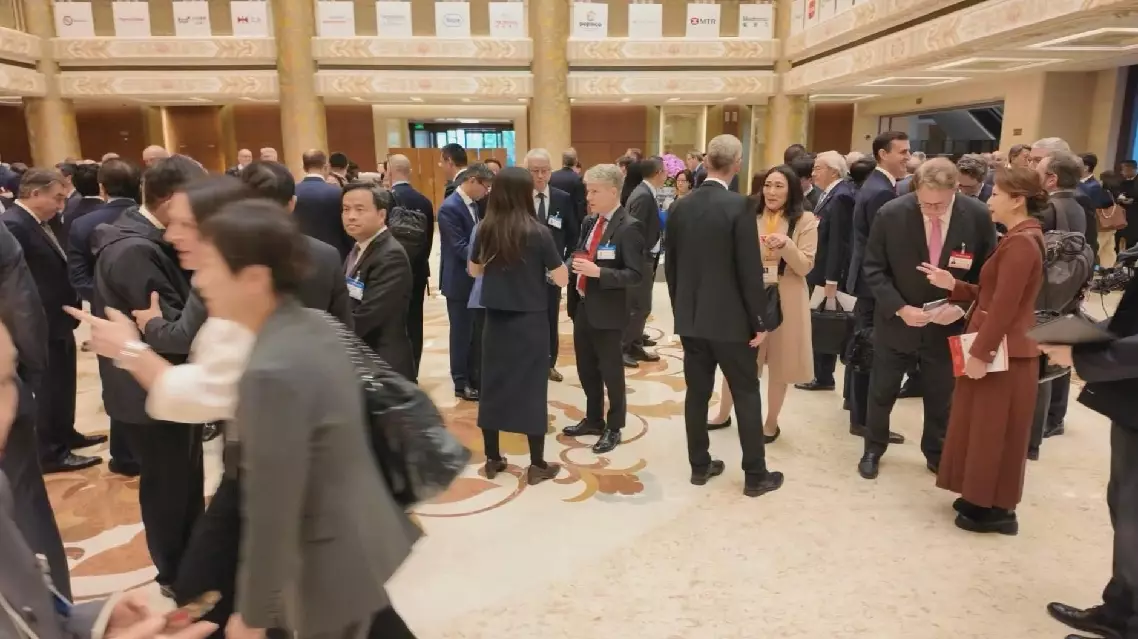
Global business leaders gathering in Beijing for the China Development Forum 2026 said that they remain optimistic about China's role as a key driver of growth and are committed to deepening their presence in the Chinese market.
Themed "China in its 15th Five-Year Plan period: advancing high-quality development and creating new opportunities together", the two-day forum, which kicked off on Sunday, highlighted China as a key engine of global development as the country begins its 15th Five-Year Plan (2026-2030).
Patrick Pouyanne, chairman and CEO of TotalEnergies, a French energy giant, acknowledged the growing barriers in global energy cooperation, but stressed that both China and Europe share a common path toward green energy.
"We have observed more barriers, in fact, we see a lot of, I would say, non-cooperative attitude, I am still convinced, in particular, in the field of energy. But in fact, both China and Europe have exactly the same strategy, which is going to more green energy, which is a way to combine security with supply and China is leading the way," he said.
Philippe Delorme, president and CEO of KONE Corporation, a global leader in the elevator and escalator industry, said that Finnish Prime Minister Petteri Orpo's visit to China from January 25 to 28 has reinforced trust, mirroring the strong relationships KONE has built with its Chinese partners.
"Prime Minister Orpo went to China to reinforce the trust that has been built over time, which is actually very parallel to the trust that KONE has been building with the China-based ecosystem and its customers," he said.
Judy Marks, CEO and president of American elevator maker Otis emphasized the company's strong commitment to China, highlighting the access and enthusiasm she experiences on every visit.
"Well, every time I come to China, my agenda is packed, and I want it that way. I want to see our colleagues, I want to see our business partners, I want to see government officials. And guess what, in China, every time we have that access. It's always an exciting time in China. We're investing and we're here to stay," she said.
Rogier Janssens, president of Merck China, talked about his professional journey of returning to China, drawn by the country's rapid pace of development and the opportunities he sees unfolding.
"I am not new to China. I'm also not new to Merck. I ran the healthcare business for Merck between '17 and '22 out of Beijing. It's interesting. Actually, at some point in time, I was thinking about after 35 years of working in the pharmaceutical industry, I thought maybe I needed to slow down a little bit and take it easy. Maybe I'd take a job at the headquarters or something like that. But in reality, I thought no. There needs to be a bit more excitement and I'm super excited about what I'm seeing and hearing. I mean the speed of China, the way things are development so rapidly here," he said.
Since its inception in 2000, the China Development Forum has become one of the country's major platforms for dialog among Chinese government officials, global business leaders, international organizations, and scholars.
Global business leaders express confidence in China's market