In 2024, Chinese President Xi Jinping attended three major home-ground diplomatic events, made four important overseas visits and participated in over 100 bilateral and multilateral meetings, writing a remarkable new chapter in head-of-state diplomacy over the past year, which has steered the trend of the times toward peace, development and win-win cooperation.
With the global vision, broad-mindedness and sense of common good for humanity befitting the leader of a major political party and a major country, President Xi has had in-depth strategic communications with other global leaders and dignitaries to broaden converging interests for all and promote greater unity and cooperation of the international community.
The year 2024 marks the 45th anniversary of the establishment of diplomatic relations between China and the United States. On March 27, Xi met with representatives of the U.S. business, strategic and academic communities at the Great Hall of the People in Beijing. He noted that the China-U.S. relationship is one of the most important bilateral relationships in the world.
Xi paid state visits to France, Serbia and Hungary from May 5 to 10 to enhance bilateral relations with the three countries and boost mutually beneficial cooperation between China and each of the three countries.
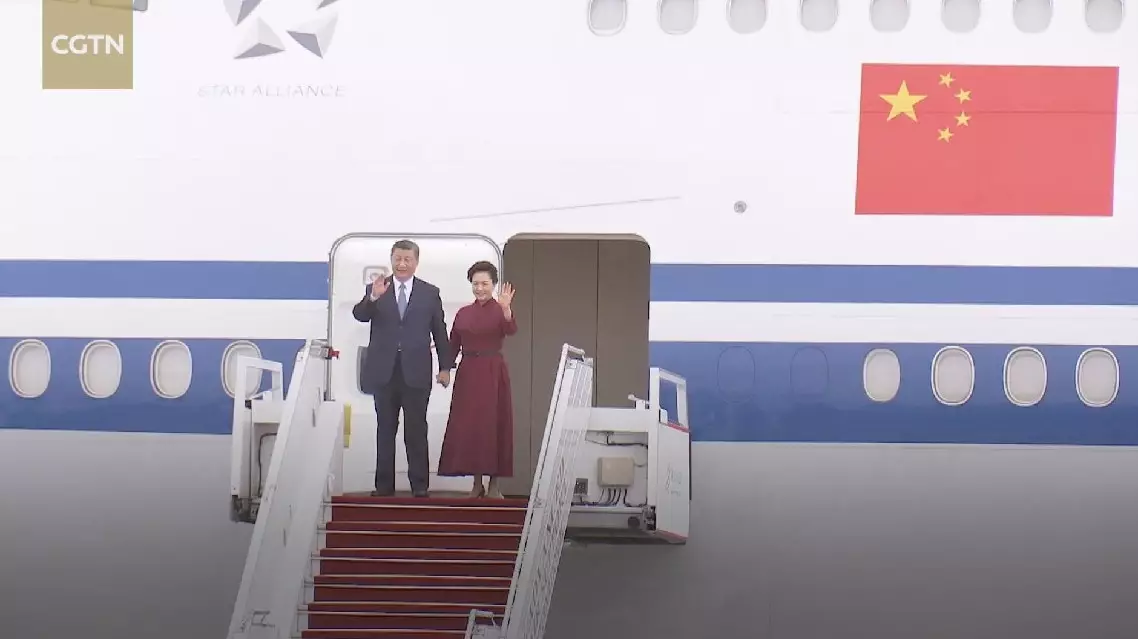
On May 5, Xi arrived at Paris Orly Airport in Paris and began his state visit to France at the invitation of French President Emmanuel Macron.
This is Xi's third state visit to France, which coincided with the 60th anniversary of the establishment of diplomatic relationship between the two countries.
"Mr. President, I would like to thank you again for your third visit to France, and your visit is of great importance, especially at such a sensitive time in global affairs," Macron said at a press conference together with Xi after their talks on May 6.
On May 8, tens of thousands of Serbian people welcomed Xi upon his arrival in Belgrade.
"Serbian people's love and admiration for you comes from the bottom of their hearts," said Serbian President Aleksandar Vucic.
On the evening of May 8, Xi arrived in Budapest to pay a state visit to Hungary. Upon the arrival at the airport, he was warmly welcomed by Hungarian Prime Minister Victor Orban and his wife Aniko Levai.
"We firmly believe that Europe needs extensive and in-depth cooperation with China," Orban said.
On May 30, Xi attended the opening ceremony of the 10th Ministerial Conference of the China-Arab States Cooperation Forum in Beijing and delivered a keynote speech.
"The Middle East is a land bestowed with broad prospects for development. War should not continue indefinitely. Justice should not be absent forever," Xi said.
On June 28, Xi delivered an important speech at the conference marking the 70th anniversary of the Five Principles of Peaceful Coexistence. The five principles refer to mutual respect for territorial integrity and sovereignty, non-aggression, non-interference in each other's internal affairs, equality and mutual benefit, and peaceful co-existence.
"Promoting development and progress for humanity has always been a big topic on the minds of all nations," Xi said.
Xi made historic state visits to Kazakhstan and Tajikistan from July 2 to 6.
The visits showcased China's good neighborhood diplomacy and peaceful coexistence with Central Asian countries, bolstering diplomatic and economic relations between China and Central Asian nations.
On July 2, Xi arrived in Kazakhstan's capital Astana.
On July 4, he attended the 24th meeting of the Council of Heads of State of the Shanghai Cooperation Organization (SCO) at the Independence Palace in Astana.
On the evening of July 4, Xi arrived in Dushanbe for a state visit to Tajikistan at the invitation of Tajik President Emomali Rahmon.
On Sept 2-6, Xi, along with 51 African heads of state and government, two presidential representatives, the chairperson of the African Union Commission, and the secretary-general of the United Nations, gathered at the Great Hall of the People in Beijing. In just five days, Xi held nearly 50 bilateral meetings with African leaders.
"The China-Africa relationship is now at its best point in history. With future growth in mind, I propose that bilateral relations between China and all African countries which have diplomatic ties with China be elevated to the level of strategic relations," Xi said.
On Oct 22-24, Xi attended the 16th BRICS Summit in Kazan, Russia, at the invitation of Russian President Vladimir Putin.
"The more tumultuous our times become, the more we must stand firm at the forefront, exhibiting tenacity, demonstrating the audacity to pioneer and displaying the wisdom to adapt. We should work together to open a new horizon in the high-quality development of greater BRICS cooperation," Xi said.
On Nov 14, Xi arrived in Lima to attend the 31st APEC Economic Leaders' Meeting and pay a state visit to Peru at the invitation of Peruvian President Dina Boluarte. The two heads of state attended the inauguration ceremony of the Chancay Port, which was built with Chinese aid, via video link.
"President Xi, your visit is a symbol of our bonds of friendship and cooperation, as well as our strong commitment to working together for prosperity and development," said Boluarte.
On Nov 16, Xi met with U.S. President Joe Biden in Lima.
"China's commitment to the goal of developing a stable, healthy and sustainable China-U.S. relationship remains unchanged," Xi told Biden.
On Nov 19, Xi arrived in Brasilia to start a state visit to Brazil. One day later, Xi held talks with his Brazilian counterpart Luiz Inacio Lula da Silva at the Alvorada Palace, the official residence of the Brazilian president.
The two presidents announced the elevation of China-Brazil relationship to that of a China-Brazil community with a shared future for a more just world and a more sustainable planet.
Key takeaways from President Xi Jinping's 2024 diplomatic moments