The "2025 New Year Concert -- Sailing in the Greater Bay Area" produced by China Media Group (CMG) was aired at 21:15 on New Year's Day.
Co-hosted by the CMG, the People's Government of south China's Guangdong Province, and the governments of the neighboring Hong Kong and Macao Special Administrative Regions, the New Year Concert this year came to Guangdong's Zhongshan City and fully showcased the vigorous and upward spirit of the Guangdong-Hong Kong-Macao Greater Bay Area.
Arranged in the format of "9+2" to represent the 11 cities and regions in the Greater Bay Area, the concert invited singers and actors from the Chinese mainland, Hong Kong, Macao and Taiwan regions to present the diverse traditional cultural treasures of the Greater Bay Area and showcase its technology, art, traditions and trends.
The concert also adhered to the creative concept of "integration" to show a series of fusion-inspired tracks that were embedded with touching stories about a shared homeland.
The concert began with a violin performance and a track featuring a blend of traditional music originated from Guangdong and "Radetzky March" by Austrian composer Johann Strauss in a bid to usher in a new year of sailing into the future for the Greater Bay Area.
The concert also embraced a variety of other performances, including the Cantonese opera and a child choir formed of children from the three regions of Guangdong, Hong Kong, and Macao.
The event was aired via China Central Television (CCTV), the Chinese-language channels of the CMG, and radio channels such as Radio The Greater Bay.
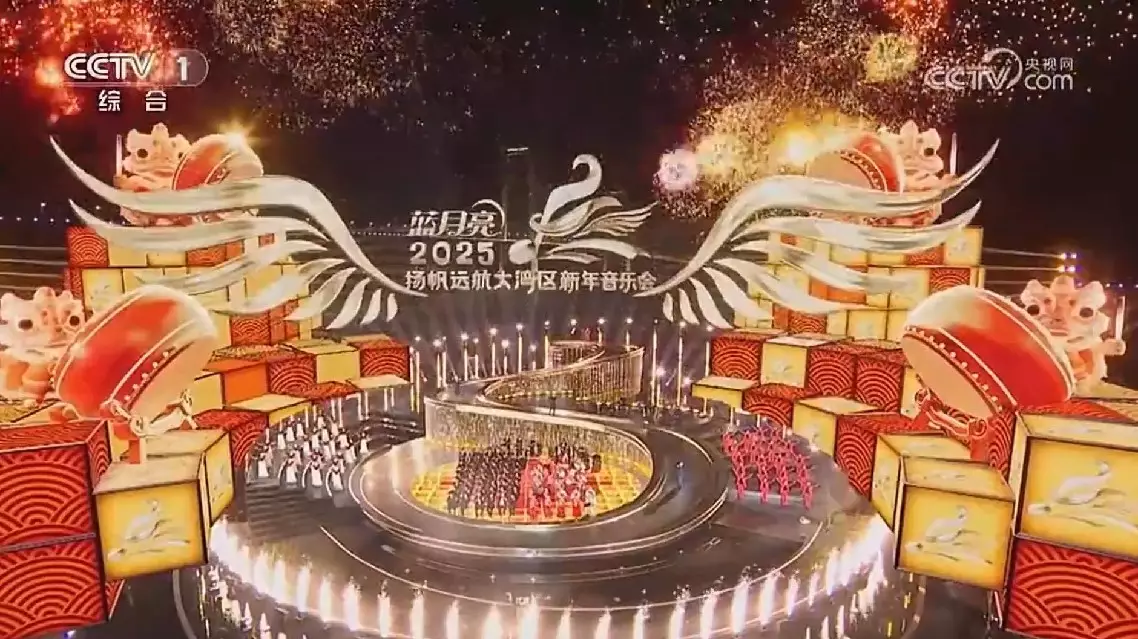
China Media Group stages Greater Bay Area New Year concert
China's two major power grid operators -- the State Grid Corporation of China (State Grid) and China Southern Power Grid (CSG) -- reported a surge in investment in the first quarter of 2026, underscoring efforts to strengthen infrastructure construction and support high-quality socioeconomic development in China.
The State Grid said it completed fixed-asset investment worth 129 billion yuan (about 18.77 billion U.S. dollars) in the first three months of this year, up 37 percent the corresponding period of the previous year. The spending has driven more than 250 billion yuan (36 billion U.S. dollars) of investment across the wider industrial chain.
Key projects such as the Panxi ultra-high-voltage (UHV) alternating current (AC) line and the Anhui-Hubei back-to-back direct current (DC) project have seen ground broken for their construction, while several west-to-east power transmission projects have been upgraded.
Investment in connecting renewable energy generation to the grid was reported to have exceeded 10 billion yuan (1.45 billion U.S. dollars) from January to March, a year-on-year rise of more than 50 percent.
The CSG also reported robust growth in investment in the three-month period, with fixed-asset investment reaching 38.45 billion yuan (5.58 billion U.S. dollars), up about 50 percent from a year earlier.
Among its achievements, the company completed and commissioned 80 key projects, including the 220 kV cross-sea power grid interconnection project, which was officially put into operation on March 20. The project ended years of grid isolation on the Weizhou Island in south China by linking it to the main power system of the Guangxi Zhuang Autonomous Region.
The construction of 17 other major energy projects, including one linking the power grid of the Xizang Autonomous Region in southwest China with that of Guangdong Province in south China, is advancing rapidly. These projects are expected to bolster regional industries, the maritime economy, digital collaboration and the transition to green energy.
"By accelerating major project construction, investment during the 15th Five-Year Plan period (2026-2030) is expected to approach 1 trillion yuan (145 billion U.S. dollars), driving a further 2 trillion yuan (290 billion U.S. dollars) of investment across upstream and downstream industries," said Dong Yanle, deputy general manager of the Engineering Construction Department under the China Southern Power Grid.
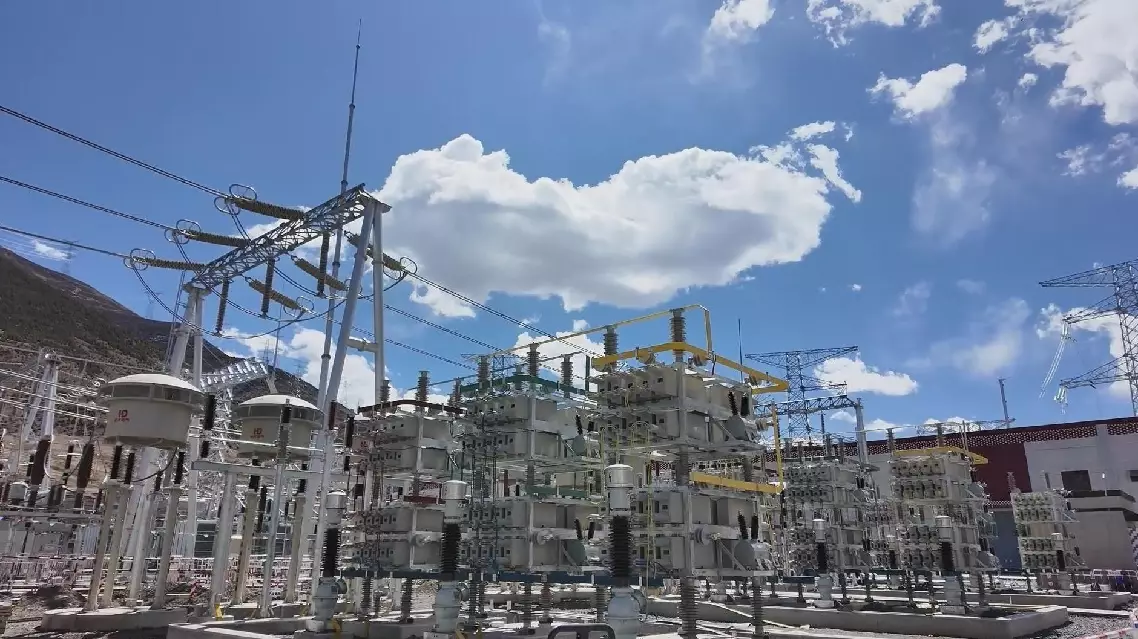
China ramps up power grid investment in January-March to boost growth