Skip to Content Facebook Feature Image

China's visa-free policies boost cultural tourism, with Kung Fu leading the way for global visitors

China

China

China

China's visa-free policies boost cultural tourism, with Kung Fu leading the way for global visitors

2025-01-02 03:06 Last Updated At:11:27

China's expanded visa-free policies have sparked interest among international travelers for traditional Chinese culture and fueled a surge in local cultural tourism.

In the first 11 months of 2024, China welcomed 29.218 million foreign visitors, with 17.446 million entering visa-free, up 123.3 percent year-on-year.

This surge is leading to a growing demand for immersive cultural experiences. China, home to 1,557 nationally recognized intangible cultural heritage items, offers them opportunities to explore these traditions.

In Quanzhou City, east China's Fujian Province, string puppet show has been a popular attraction for international visitors.

"The plate spinners and the puppet that balances the jug on their head, the lion dance and the ribbon dance also. I like seeing these things," said an American visitor.

"I think it's very interesting. I've never seen a doll like this before. And I think it's a very imaginative way. See what the culture sort of outfits were like. I really like it," said an Indonesian student participating in a doll clothes-making workshop

A survey by the China Tourism Academy revealed that over 60 percent of respondents cited experiencing Chinese culture as their primary reason for visiting. World Heritage sites, the four ancient capitals, and intangible cultural heritage items like paper cutting, flower headband, and shadow puppetry are proving to be major draws for international tourists.

Shaolin Kung Fu, one of the most famous traditional martial arts in China, is a globally recognized symbol of Chinese culture. The Shaolin Temple in Quanzhou has seen an influx of international visitors eager to witness and learn this martial art.

"Because martial arts transcend borders. It's a body language understood worldwide," said Li Gang, head coach of Quanzhou Shaolin Temple Warrior Monks Troupe.

Eros, an Italian living in the city for nearly a decade, is a devoted Shaolin Kung Fu enthusiast. He attends performances every month and shared photos on social media to share the moment with his family and friends.

Thanks to the visa-free policy implemented for Italians by the end of 2023, Eros's mother and friends were finally able to visit him and experience Chinese culture.

"If you watch the show, you can just feel the power, the energy. I needed to send my passport for my visa to Chinese consulate. So, you need to plan in this one month before. You don't need to follow this rule now. And you can easily come to visit China," he shared.

China's visa-free policies boost cultural tourism, with Kung Fu leading the way for global visitors


China's visa-free policies boost cultural tourism, with Kung Fu leading the way for global visitors
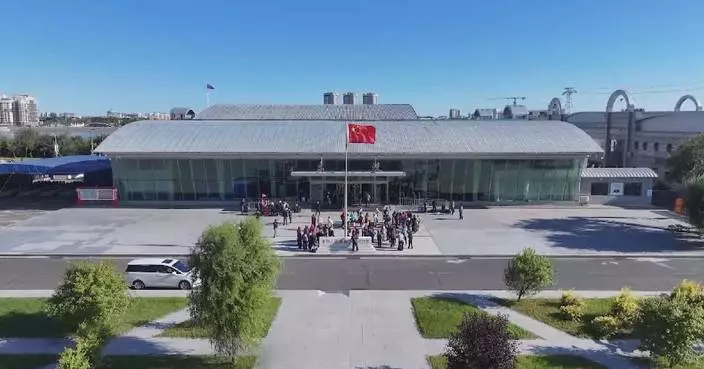
China's BeiDou space-time industry boomed in 2025 with a total output value of 1.3323 trillion yuan (about 186.5 billion U.S. dollars), according to a white paper on its development released on Monday.

The white paper on China's BeiDou Space-time Industry Development in 2026 released by the Global Navigation Satellite System (GNSS) and Location Based Services (LBS) Association of China (GLAC) said that the satellite navigation industry, serving as the foundation of the BeiDou space-time sector, achieved a total output value of 629 billion yuan in 2025, a year-on-year increase of 9.24 percent, demonstrating strong resilience and significant growth potential.

The BeiDou time-space industry is a comprehensive industrial system centered on the BeiDou Navigation Satellite System. It deeply integrates various technological approaches, including remote sensing, geographic information systems, mobile communications, and indoor positioning.

"The most distinctive hallmark of the BeiDou time-space industry in 2025 is its leap from satellite navigation to time-space services, demonstrating a development momentum featuring convergence of technologies, scenario-based applications, and diversified ecosystem. The industry's iterative upgrading continued to pace up, and its core competitiveness improved constantly," said Zhang Huifeng, president of the GLAC.

China has established a complete and autonomous BeiDou time-space industrial and supply chain, spanning from chips, modules, antennas, terminals to system integration and application services, with continuously improving levels of self-reliance and control.

Notably, cumulative shipments of BeiDou-compatible chips and modules have reached the scale of hundreds of millions, effectively safeguarding the secure and robust development of the industrial and supply chain.

The latest data showed that the domestic sales of BeiDou terminal products exceeded 410 million sets in 2025. Additionally, the total social stock of various terminal products equipped with BeiDou functionality has surpassed 2.2 billion sets.

"The digital transformation and intelligent upgrade across industries are comprehensively accelerating. This has led to a surge in demand for high-precision, high-reliability, real-time intelligent time-space information, products, and services, providing vast market opportunities for the development of the BeiDou time-space industry. The industrial value chain is shifting from product delivery to data operation with time-space data becoming a core factor of production, demonstrating immense developmental potential of the industry," Zhang said.

BeiDou industry output value exceeds 1.33 trln yuan in 2025

BeiDou industry output value exceeds 1.33 trln yuan in 2025

Recommended Articles