Chinese startup NeuroXess has reached two significant milestones in brain-computer interface (BCI) technology, highlighting its potential to revolutionize both mobility and communication for patients.
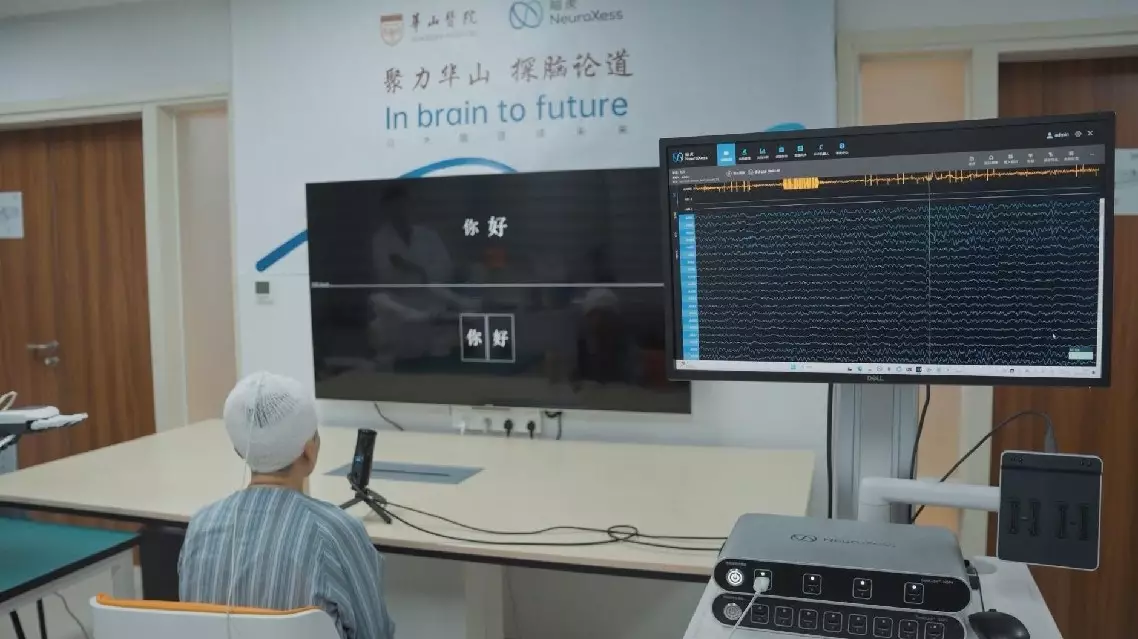
The Shanghai-based company's high-throughput flexible BCI device successfully decoded the precise movements of one patient with brain injuries in real time and facilitated real-time Chinese speech decoding for another.
The trials, conducted at Huashan Hospital, affiliated with Fudan University, involved a 21-year-old female patient with epilepsy. She had a lesion in the motor area of her brain, which required the implantation of the advanced BCI device.
Within just 48 hours of surgery, the patient was able to play table tennis and engage in computer games entirely through thought control, without any physical movement.
After two weeks of training, she was able to navigate common smartphone applications like WeChat, the messaging and social media app, and Taobao, the e-commerce platform, as well as operate smart home devices and a wheelchair using only her mind.
Yang Qinrong, head of software and algorithms at NeuroXess, explained the science behind the technology.
"Each brainwave signal corresponds to a discharge from brain cells, and tens of thousands of such discharges combine to form distinct wave patterns. Through complex big data algorithms, we can process such signals to capture and interpret the characteristics of human thought," Yang said.
The BCI technology works by collecting brain signals, converting them into data, and forming corresponding commands. This process requires both precision and rapid response times. Data from the trials show that the synthetic motion delay for the patients was under 60 milliseconds -- close to the reaction speed of a normal person.
For language functions, the decoding delay for a single Chinese character was less than 100 milliseconds, about one-third of the normal speaking speed.
"The Chinese language system includes over 400 commonly used syllables and four tones, along with a large character library. This places higher demands on both our hardware and software. By increasing the number of electrodes from just a few to several hundred, we can effectively tackle this challenge," said Tao Hu, founder of NeuroXess.
The trials have been successful, with more than 40 intraoperative tests and 4 postoperative trials completed so far, all showing positive recovery outcomes.
NeuroXess is now planning to conduct long-term carrier trials and hopes to apply the technology within the next three years, making the technology accessible for broader use.
This breakthrough is set to pave the way for further advancements in BCI applications, offering new therapeutic possibilities for patients with speech or motor function disabilities caused by conditions like ALS, high-level paraplegia, and stroke.
Chinese startup achieves breakthrough in brain-computer interface technology
Honor's humanoid robot, Lightning, which swept the 2026 Beijing E-Town Humanoid Robot Half-Marathon on Sunday, is a natural extension of years of accumulation in consumer electronics technology, said its developers.
A leading smart device provider in China, Honor independently developed the model, which dominated the podium at the event as it was used by all three teams whose autonomous navigating robots ran the fastest times.
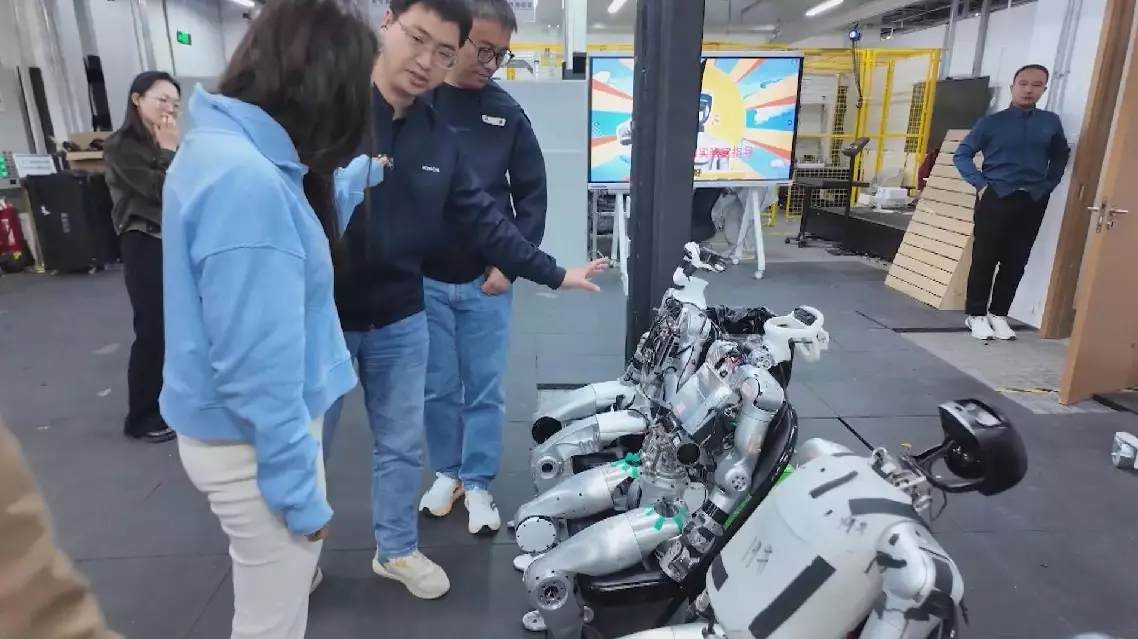
At the Honor factory in Pingshan District in Shenzhen City, south China's Guangdong Province, where robotics engineers developed Lightning. They said the robot's body design incorporates a simulation system that, through artificial intelligence algorithms, can iterate nearly 30,000 design schemes of varying sizes over three months. Complete and mature systems are also in place for battery, communication, and reliability verification.
"We built a simulation lab from scratch. For the robots, we digitize the entire design and put it into a computer. We have our own material library, which can meet the force, thermal, and chemical property demands for each component, under different environments and speeds. We've accumulated about 1000 kinds of materials. For example, if there's a risk with the robot's neck, we just need to change the material code from 001 to 002. Now, through our simulations, we only need one day to perform parallel calculations on 10 different designs, before creating a mold and verifying it in the lab," said Li Zheng, a senior engineer at Honor.
An autonomous robot capable of completing a half-marathon involves a complete industry chain, with core components including high-precision sensors, LiDAR, motors, operating systems, and control algorithms. The development of robotic marathoners have driven an increasing number of component enterprises to get involved.
Manifold, a tech firm established by newly-graduated PhDs, has developed a 3D spatial memory module, which can model an environment in real time and transform it into images that robots can understand. They said several robots running the half-marathon this year adopted their solution.
"Our device can operate within a one-kilometer tunnel with an error margin of only tens of centimeters. For robots, especially in the absence of GPS, this allows them to accurately determine their location. The underlying technology is a multi-sensor fusion technology that we developed in-house," said Qin Youming, CEO and founder of Manifold.
The Beijing Humanoid Robotics Innovation Center set up a training camp for the marathon event. Many university students came a month ahead of the event to develop and debug their technologies and algorithms based on open-source robot bodies, databases, and training platforms.
"These high-quality databases and highly open-source control algorithms are actually very helpful to us. We no longer need to build the house from the ground up, but can skip the most basic part," said Sun Jingyu, a student from Shandong University.
"Through this racing event, I believe we can make our robots more reliable and stable, while also supporting high-dynamic, high-load movements. This is crucial for robots' future application in both industrial, commercial and domestic scenarios," said Guo Yijie, head of the innovative humanoid department and the Marathon project of Beijing Humanoid Robot Innovation Center.
Engineers share development story behind Beijing humanoid half-marathon champion model