The global manufacturing Purchasing Managers' Index (PMI) for December 2024 rose for the second consecutive month, signaling a continued but fragile economic recovery worldwide.
The index, released by the China Federation of Logistics and Purchasing (CFLP) on Monday, stood at 49.5 percent, up 0.2 percentage points from the previous month. The figure marked the second consecutive month of slight increases and set a new high for the second half of 2024, indicating a steady yet modest upward trend in global manufacturing.
Asia's PMI reached 51.1 percent in December, staying above 51 percent for three months in a row, and continuing to anchor the global economic recovery.
For Africa, its PMI rose by 1 percentage point from previous month to 50.2 percent in December, ending two consecutive months of sub-50 readings.
In the Americas, the PMI registered its second consecutive month of increases in December but remained in contraction territory.
Europe's PMI declined by 0.2 percentage points from the previous month to 46.8 percent, reflecting ongoing challenges in the region's manufacturing sector.
On a broader scale, the global manufacturing PMI averaged 49.3 percent for 2024 as a whole. While this suggested better overall manufacturing growth compared to 2023, the PMI's continued sub-50 reading highlighted the lack of strong momentum in global manufacturing activities.

Global manufacturing PMI continues upward trend, but signaling weak economic recovery

Global manufacturing PMI continues upward trend, but signaling weak economic recovery
Iranian Foreign Minister Seyed Abbas Araghchi said on Monday that the situation in Iran is "under total control" following violence linked to protests that spiked over the weekend.
Addressing foreign diplomats in Tehran, the foreign minister noted that armed terrorist groups had infiltrated the protests, attempting to divert them from their legitimate course. He claimed that evidence has been gathered showing Iranian security forces being shot at, with the aim of causing further casualties. He accused the United States and Israel of exploiting the unrest to interfere in Iran's internal affairs.
Araghchi further stated that the government is closely monitoring developments on the streets, emphasizing that "the situation has come under control." He also affirmed that internet services, curtailed during the unrest, would be restored after coordination with security agencies.
The government has engaged in dialogue with merchants and protest representatives and initiated reforms to address grievances related to price hikes and currency depreciation. Iran has taken a series of actions and measures to respond to the demands of peaceful demonstrators, the foreign minister said.
Earlier on Sunday, Araghchi said that clear evidence links recent riots and vandalism of public facilities in Iran to the Israeli intelligence agency Mossad. This came after former U.S. Secretary of State Mike Pompeo mentioned Mossad agents operating on Iran's streets in a social media post. The Iranian foreign minister asserted that police are being attacked by "terrorists" acting under the direction of Israeli operatives, whom Pompeo publicly acknowledged.
The protests initially erupted over a sharp depreciation of the rial and sweeping subsidy reforms. Iranian authorities have blamed the unrest on foreign-linked agents and U.S. sanctions.
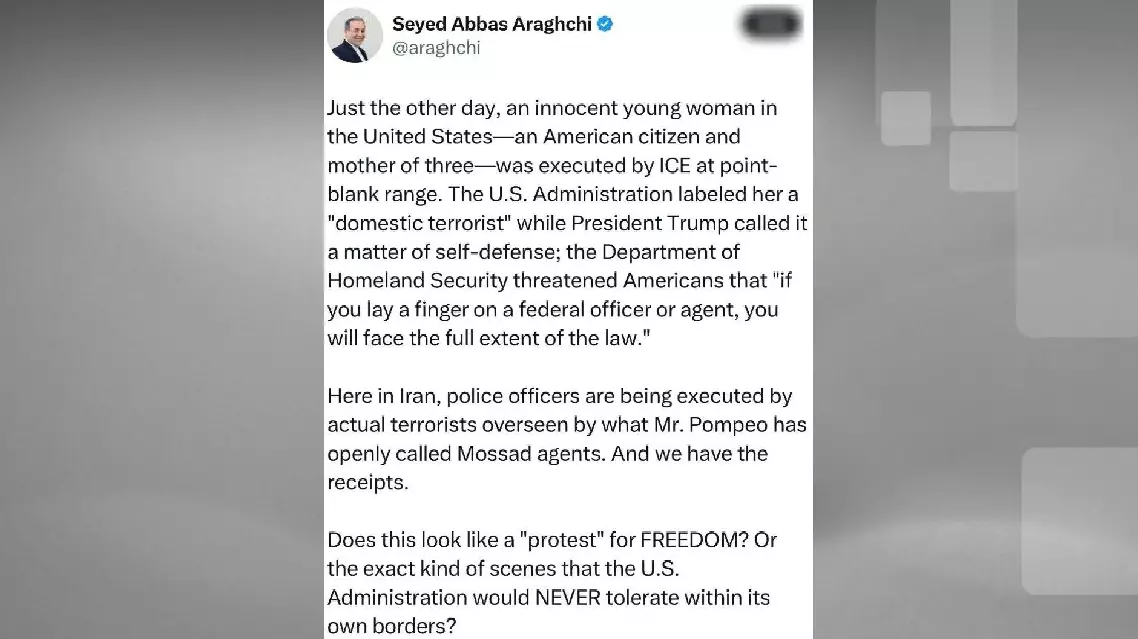
Iranian foreign minister says situation "fully under control," accuses Israeli intelligence of stoking unrest