The transformation of Qingdao Port into a fully automated container terminal, driven by digitalization and intelligentization, is bringing about cumulative acceleration and expansion of Qingdao City's economy amid China's modernization drive, according to experts.
At the heart of the terminal's operations is A-TOS, a cutting-edge management system developed by the port's information technology department in Shandong Province, eastern China, which seamlessly integrates and controls all aspects of terminal operations, including scheduling, distribution, and equipment management.
The average loading and unloading rate of the terminal's automated bridge is 36.2 containers per hour.
"It's the first fully automated container terminal in Asia, and the most efficient automated terminal in the world. Qingdao Port now has a Europe route, a route to the Americas, and a route to Japan and South Korea," said Chen Qiang, IT manager at the terminal.
"Qingdao Port, by serving Northeast Asia, the Shanghai Cooperation Organization countries and the surrounding region, has developed into a highly market-oriented and internationalized shipping and trade hub," said Zhang Yansheng, Chief Research Fellow with the China Center for International Economic Exchanges.
"The ongoing development of Qingdao and its orientation towards the marine economy is going to be a feature of modernization, to link traders with finance, with domestic supply chains and production," said Warwick Powell, Adjunct Professor with the Queensland University of Technology.
Qingdao boasts a naturally advantageous port that remains ice-free throughout the year, allowing for uninterrupted, year-round operations and making it an ideal hub for maritime trade and commerce.
"Qingdao has traditionally been a trading center. In the changes taking place at Qingdao Port, I believe the key is digitalization, the internet and intelligentization. This is bringing about the cumulative acceleration and expansion of Qingdao's economy," said Zhang.
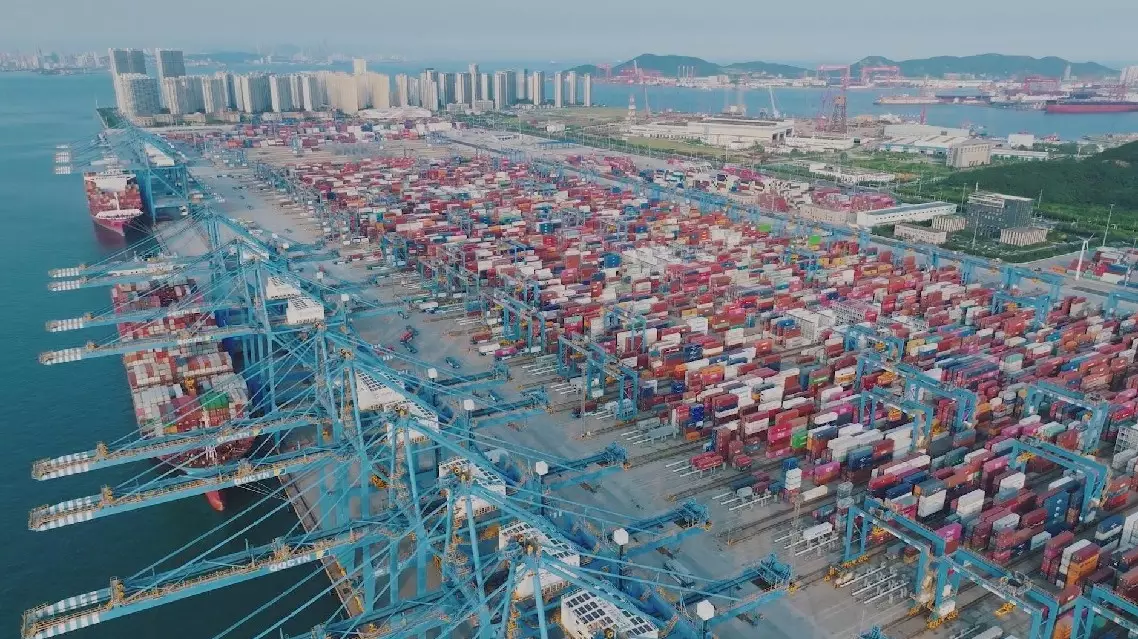
Qingdao port revolutionizes operations with cutting-edge automation

China's two major power grid operators -- the State Grid Corporation of China (State Grid) and China Southern Power Grid (CSG) -- reported a surge in investment in the first quarter of 2026, underscoring efforts to strengthen infrastructure construction and support high-quality socioeconomic development in China.
The State Grid said it completed fixed-asset investment worth 129 billion yuan (about 18.77 billion U.S. dollars) in the first three months of this year, up 37 percent the corresponding period of the previous year. The spending has driven more than 250 billion yuan (36 billion U.S. dollars) of investment across the wider industrial chain.
Key projects such as the Panxi ultra-high-voltage (UHV) alternating current (AC) line and the Anhui-Hubei back-to-back direct current (DC) project have seen ground broken for their construction, while several west-to-east power transmission projects have been upgraded.
Investment in connecting renewable energy generation to the grid was reported to have exceeded 10 billion yuan (1.45 billion U.S. dollars) from January to March, a year-on-year rise of more than 50 percent.
The CSG also reported robust growth in investment in the three-month period, with fixed-asset investment reaching 38.45 billion yuan (5.58 billion U.S. dollars), up about 50 percent from a year earlier.
Among its achievements, the company completed and commissioned 80 key projects, including the 220 kV cross-sea power grid interconnection project, which was officially put into operation on March 20. The project ended years of grid isolation on the Weizhou Island in south China by linking it to the main power system of the Guangxi Zhuang Autonomous Region.
The construction of 17 other major energy projects, including one linking the power grid of the Xizang Autonomous Region in southwest China with that of Guangdong Province in south China, is advancing rapidly. These projects are expected to bolster regional industries, the maritime economy, digital collaboration and the transition to green energy.
"By accelerating major project construction, investment during the 15th Five-Year Plan period (2026-2030) is expected to approach 1 trillion yuan (145 billion U.S. dollars), driving a further 2 trillion yuan (290 billion U.S. dollars) of investment across upstream and downstream industries," said Dong Yanle, deputy general manager of the Engineering Construction Department under the China Southern Power Grid.
China ramps up power grid investment in January-March to boost growth